2OCV image
Deposition Date 2006-12-21
Release Date 2007-04-10
Last Version Date 2024-12-25
Entry Detail
PDB ID:
2OCV
Keywords:
Title:
Structural basis of Na+ activation mimicry in murine thrombin
Biological Source:
Source Organism:
Mus musculus (Taxon ID: 10090)
Method Details:
Experimental Method:
Resolution:
2.20 Å
R-Value Free:
0.24
R-Value Work:
0.18
R-Value Observed:
0.18
Space Group:
C 1 2 1
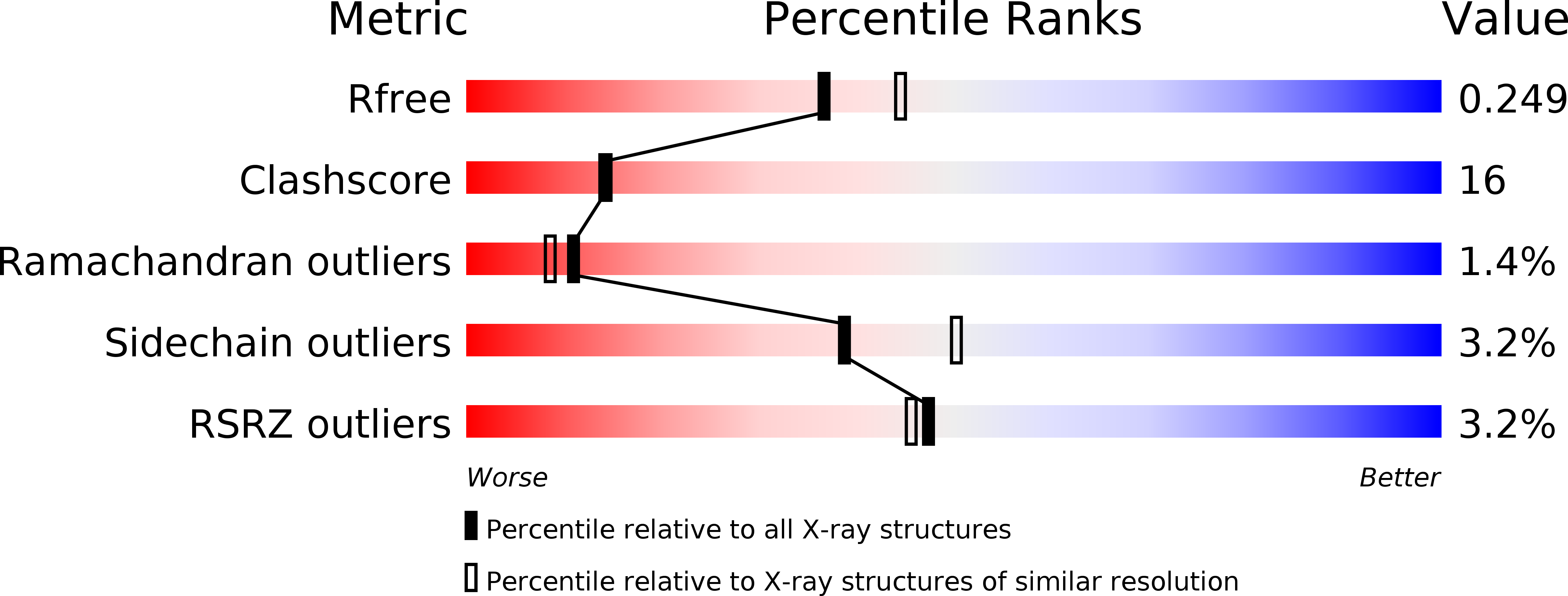
Macromolecular Entities
Structures with similar UniProt ID
Protein Blast
Polymer Type:polypeptide(L)
Molecule:Thrombin
Gene (Uniprot):F2
Chain IDs:A
Chain Length:42
Number of Molecules:1
Biological Source:Mus musculus
Structures with similar UniProt ID
Protein Blast
Polymer Type:polypeptide(L)
Molecule:Thrombin
Gene (Uniprot):F2
Chain IDs:B
Chain Length:259
Number of Molecules:1
Biological Source:Mus musculus
Modified Residue
Compound ID Chain ID Parent Comp ID Details 2D Image
ASN B ASN GLYCOSYLATION SITE
Ligand Molecules
Primary Citation
Structural basis of na+ activation mimicry in murine thrombin.
J.Biol.Chem. 282 16355 16361 (2007)
PMID: 17428793 DOI: 10.1074/jbc.M701323200

Abstact

Unlike human thrombin, murine thrombin lacks Na+ activation due to the charge reversal substitution D222K in the Na+ binding loop. However, the enzyme is functionally stabilized in a Na+-bound form and is highly active toward physiologic substrates. The structural basis of this peculiar property is unknown. Here, we present the 2.2 A resolution x-ray crystal structure of murine thrombin in the absence of inhibitors and salts. The enzyme assumes an active conformation, with Ser-195, Glu-192, and Asp-189 oriented as in the Na+-bound fast form of human thrombin. Lys-222 completely occludes the pore of entry to the Na+ binding site and positions its side chain inside the pore, with the Nzeta atom H-bonded to the backbone oxygen atoms of Lys-185, Asp-186b, and Lys-186d. The same architecture is observed in the 1.75 A resolution structure of a thrombin chimera in which the human enzyme carries all residues defining the Na+ pore in the murine enzyme. These findings demonstrate that Na+ activation in thrombin is linked to the architecture of the Na+ pore. The molecular strategy of Na+ activation mimicry unraveled for murine thrombin is relevant to serine proteases and enzymes activated by monovalent cations in general.

Legend

Protein

Chemical

Disease

Primary Citation of related structures
Feedback Form
Name
Email
Institute
Feedback