2OAN image
Deposition Date 2006-12-16
Release Date 2007-05-01
Last Version Date 2024-11-20
Entry Detail
PDB ID:
2OAN
Title:
Structure of oxidized beta-actin
Biological Source:
Source Organism:
Bos taurus (Taxon ID: 9913)
Method Details:
Experimental Method:
Resolution:
2.61 Å
R-Value Free:
0.28
R-Value Work:
0.20
R-Value Observed:
0.21
Space Group:
C 2 2 21
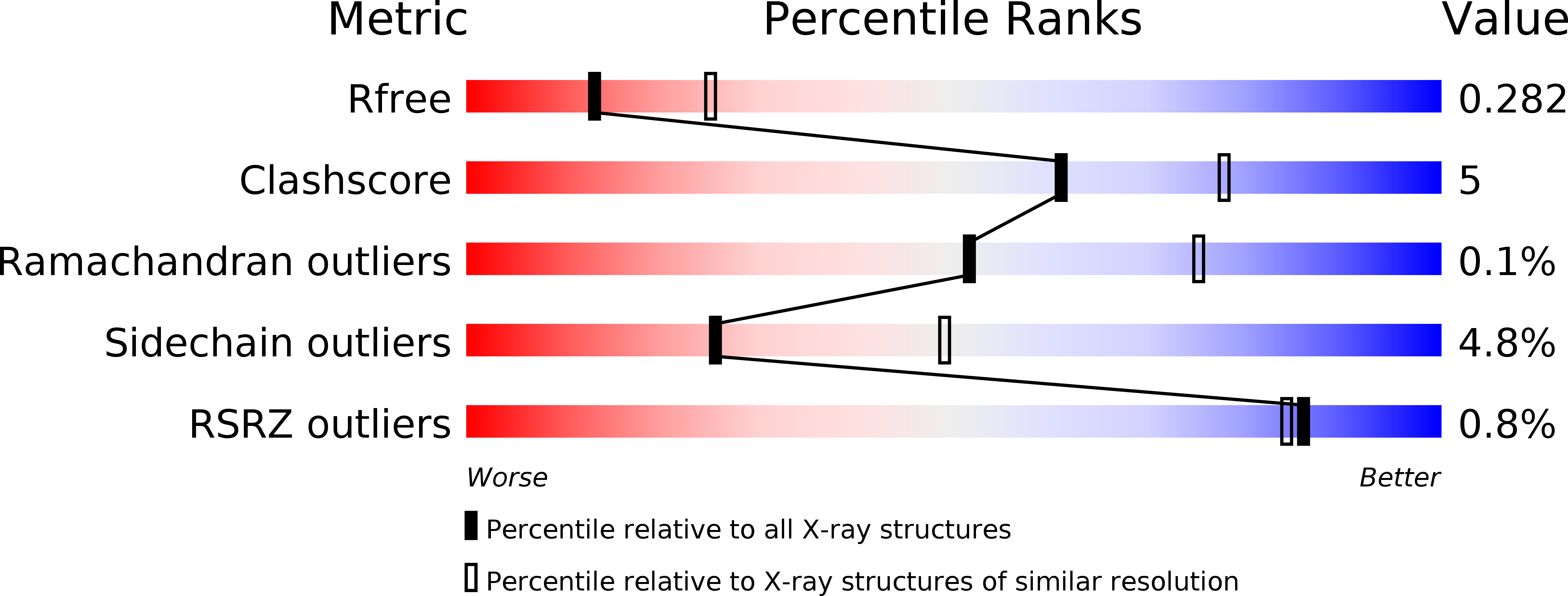
Macromolecular Entities
Structures with similar UniProt ID
Protein Blast
Polymer Type:polypeptide(L)
Molecule:Actin, cytoplasmic 1
Gene (Uniprot):ACTB
Chain IDs:A, B, C, D
Chain Length:375
Number of Molecules:4
Biological Source:Bos taurus
Modified Residue
Compound ID Chain ID Parent Comp ID Details 2D Image
CSD A CYS 3-SULFINOALANINE
Primary Citation
Molecular and Structural Basis for Redox Regulation of beta-Actin.
J.Mol.Biol. 370 331 348 (2007)
PMID: 17521670 DOI: 10.1016/j.jmb.2007.04.056

Abstact

An essential consequence of growth factor-mediated signal transduction is the generation of intracellular H(2)O(2). It operates as a second messenger in the control of actin microfilament dynamics, causing rapid and dramatic changes in the morphology and motile activity of stimulated cells. Little is understood about the molecular mechanisms causing these changes in the actin system. Here, it is shown that H(2)O(2) acts directly upon several levels of this system, and some of the mechanistic effects are detailed. We describe the impact of oxidation on the polymerizability of non-muscle beta/gamma-actin and compare with that of muscle alpha-actin. Oxidation of beta/gamma-actin can cause a complete loss of polymerizability, crucially, reversible by the thioredoxin system. Further, oxidation of the actin impedes its interaction with profilin and causes depolymerization of filamentous actin. The effects of oxidation are critically dependent on the nucleotide state and the concentration of Ca(2+). We have determined the crystal structure of oxidized beta-actin to a resolution of 2.6 A. The arrangement in the crystal implies an antiparallel homodimer connected by an intermolecular disulfide bond involving cysteine 374. Our data indicate that this dimer forms under non-polymerizing and oxidizing conditions. We identify oxidation of cysteine 272 in the crystallized actin dimer, likely to a cysteine sulfinic acid. In beta/gamma-actin, this is the cysteine residue most reactive towards H(2)O(2) in solution, and we suggest plausible structural determinants for its reactivity. No other oxidative modification was obvious in the structure, highlighting the specificity of the oxidation by H(2)O(2). Possible consequences of the observed effects in a cellular context and their potential relevance are discussed.

Legend

Protein

Chemical

Disease

Primary Citation of related structures
Feedback Form
Name
Email
Institute
Feedback