2O9B image
Deposition Date 2006-12-13
Release Date 2007-03-06
Last Version Date 2024-11-20
Entry Detail
PDB ID:
2O9B
Keywords:
Title:
Crystal Structure of Bacteriophytochrome chromophore binding domain
Biological Source:
Source Organism:
Host Organism:
Method Details:
Experimental Method:
Resolution:
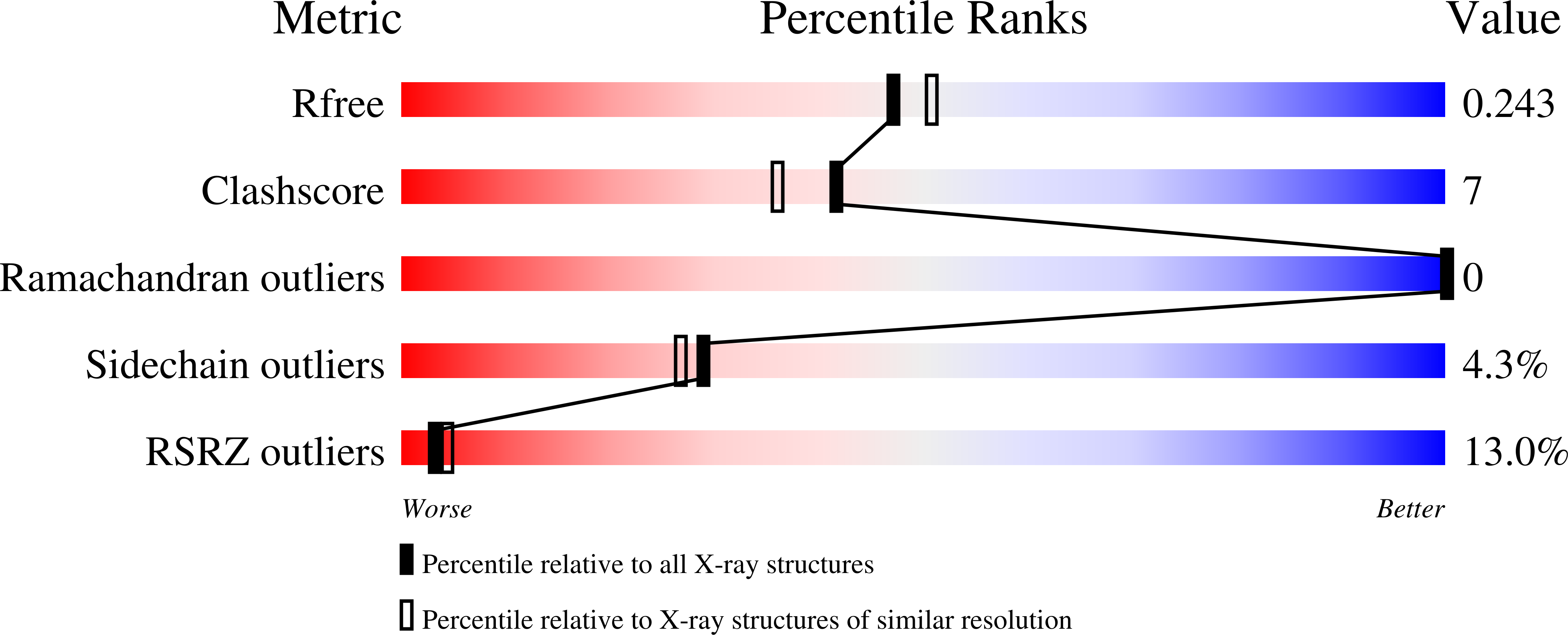
2.15 Å
R-Value Free:
0.23
R-Value Work:
0.18
R-Value Observed:
0.19
Space Group:
C 1 2 1
Macromolecular Entities
Structures with similar UniProt ID
Protein Blast
Polymer Type:polypeptide(L)
Molecule:Bacteriophytochrome
Gene (Uniprot):bphP
Mutagens:Y307S
Chain IDs:A
Chain Length:342
Number of Molecules:1
Biological Source:Deinococcus radiodurans
Ligand Molecules
Primary Citation
High resolution structure of deinococcus bacteriophytochrome yields new insights into phytochrome architecture and evolution.
J.Biol.Chem. 282 12298 12309 (2007)
PMID: 17322301 DOI: 10.1074/jbc.M611824200

Abstact

Phytochromes are red/far red light photochromic photoreceptors that direct many photosensory behaviors in the bacterial, fungal, and plant kingdoms. They consist of an N-terminal domain that covalently binds a bilin chromophore and a C-terminal region that transmits the light signal, often through a histidine kinase relay. Using x-ray crystallography, we recently solved the first three-dimensional structure of a phytochrome, using the chromophore-binding domain of Deinococcus radiodurans bacterial phytochrome assembled with its chromophore, biliverdin IXalpha. Now, by engineering the crystallization interface, we have achieved a significantly higher resolution model. This 1.45A resolution structure helps identify an extensive buried surface between crystal symmetry mates that may promote dimerization in vivo. It also reveals that upon ligation of the C3(2) carbon of biliverdin to Cys(24), the chromophore A-ring assumes a chiral center at C2, thus becoming 2(R),3(E)-phytochromobilin, a chemistry more similar to that proposed for the attached chromophores of cyanobacterial and plant phytochromes than previously appreciated. The evolution of bacterial phytochromes to those found in cyanobacteria and higher plants must have involved greater fitness using more reduced bilins, such as phycocyanobilin, combined with a switch of the attachment site from a cysteine near the N terminus to one conserved within the cGMP phosphodiesterase/adenyl cyclase/FhlA domain. From analysis of site-directed mutants in the D. radiodurans phytochrome, we show that this bilin preference was partially driven by the change in binding site, which ultimately may have helped photosynthetic organisms optimize shade detection. Collectively, these three-dimensional structural results better clarify bilin/protein interactions and help explain how higher plant phytochromes evolved from prokaryotic progenitors.

Legend

Protein

Chemical

Disease

Primary Citation of related structures
Feedback Form
Name
Email
Institute
Feedback