2O5V image
Deposition Date 2006-12-06
Release Date 2007-02-06
Last Version Date 2023-12-27
Entry Detail
PDB ID:
2O5V
Title:
Recombination mediator RecF
Biological Source:
Source Organism(s):
Expression System(s):
Method Details:
Experimental Method:
Resolution:
1.61 Å
R-Value Free:
0.21
R-Value Work:
0.16
R-Value Observed:
0.16
Space Group:
P 1 21 1
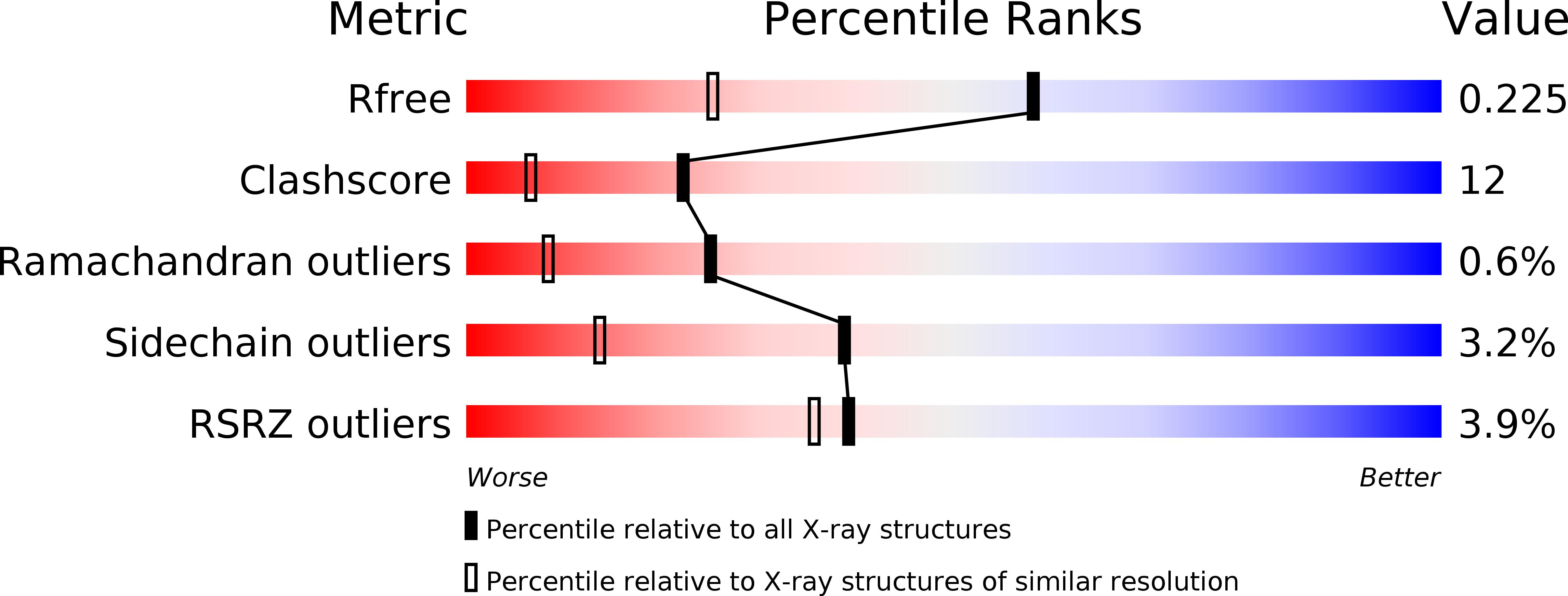
Macromolecular Entities
Structures with similar UniProt ID
Protein Blast
Polymer Type:polypeptide(L)
Molecule:DNA replication and repair protein recF
Gene (Uniprot):recF
Chain IDs:A
Chain Length:359
Number of Molecules:1
Biological Source:Deinococcus radiodurans
Ligand Molecules
Primary Citation
Structural conservation of RecF and Rad50: implications for DNA recognition and RecF function.
Embo J. 26 867 877 (2007)
PMID: 17255941 DOI: 10.1038/sj.emboj.7601537

Abstact

RecF, together with RecO and RecR, belongs to a ubiquitous group of recombination mediators (RMs) that includes eukaryotic proteins such as Rad52 and BRCA2. RMs help maintain genome stability in the presence of DNA damage by loading RecA-like recombinases and displacing single-stranded DNA-binding proteins. Here, we present the crystal structure of RecF from Deinococcus radiodurans. RecF exhibits a high degree of structural similarity with the head domain of Rad50, but lacks its long coiled-coil region. The structural homology between RecF and Rad50 is extensive, encompassing the ATPase subdomain and the so-called 'Lobe II' subdomain of Rad50. The pronounced structural conservation between bacterial RecF and evolutionarily diverged eukaryotic Rad50 implies a conserved mechanism of DNA binding and recognition of the boundaries of double-stranded DNA regions. The RecF structure, mutagenesis of conserved motifs and ATP-dependent dimerization of RecF are discussed with respect to its role in promoting presynaptic complex formation at DNA damage sites.

Legend

Protein

Chemical

Disease

Primary Citation of related structures
Feedback Form
Name
Email
Institute
Feedback