2NPS image
Deposition Date 2006-10-30
Release Date 2006-12-26
Last Version Date 2023-10-25
Entry Detail
PDB ID:
2NPS
Title:
Crystal Structure of the Early Endosomal SNARE Complex
Biological Source:
Source Organism:
Mus musculus (Taxon ID: 10090)
Rattus norvegicus (Taxon ID: 10116)
Homo sapiens (Taxon ID: 9606)
Method Details:
Experimental Method:
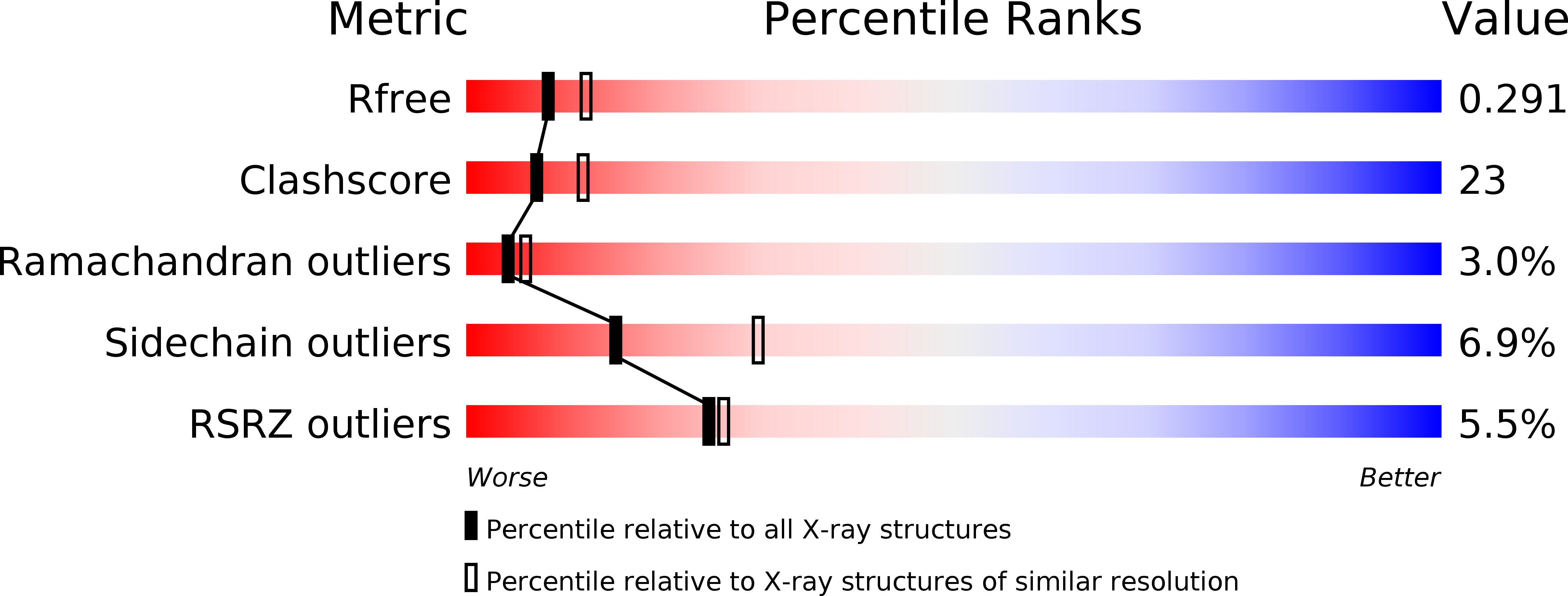
Resolution:
2.50 Å
R-Value Free:
0.28
R-Value Work:
0.24
R-Value Observed:
0.25
Space Group:
C 1 2 1
Macromolecular Entities
Structures with similar UniProt ID
Protein Blast
Polymer Type:polypeptide(L)
Molecule:Vesicle-associated membrane protein 4
Gene (Uniprot):Vamp4
Chain IDs:A
Chain Length:74
Number of Molecules:1
Biological Source:Mus musculus
Structures with similar UniProt ID
Protein Blast
Polymer Type:polypeptide(L)
Molecule:Syntaxin 13
Chain IDs:B
Chain Length:71
Number of Molecules:1
Biological Source:Rattus norvegicus
Structures with similar UniProt ID
Protein Blast
Polymer Type:polypeptide(L)
Molecule:Vesicle transport through interaction with t-SNAREs homolog 1A
Gene (Uniprot):Vti1a
Chain IDs:C
Chain Length:81
Number of Molecules:1
Biological Source:Rattus norvegicus
Structures with similar UniProt ID
Protein Blast
Polymer Type:polypeptide(L)
Molecule:Syntaxin-6
Gene (Uniprot):STX6
Chain IDs:D
Chain Length:82
Number of Molecules:1
Biological Source:Homo sapiens
Primary Citation
Early endosomal SNAREs form a structurally conserved SNARE complex and fuse liposomes with multiple topologies
Embo J. 26 9 18 (2007)
PMID: 17159904 DOI: 10.1038/sj.emboj.7601467

Abstact

SNARE proteins mediate membrane fusion in eukaryotic cells. They contain conserved SNARE motifs that are usually located adjacent to a C-terminal transmembrane domain. SNARE motifs spontaneously assemble into four helix bundles, with each helix belonging to a different subfamily. Liposomes containing SNAREs spontaneously fuse with each other, but it is debated how the SNAREs are distributed between the membranes. Here, we report that the SNAREs mediating homotypic fusion of early endosomes fuse liposomes in five out of seven possible combinations, in contrast to previously studied SNAREs involved in heterotypic fusion events. The crystal structure of the early endosomal SNARE complex resembles that of the neuronal and late endosomal complexes, but differs in surface side-chain interactions. We conclude that homotypic fusion reactions may proceed with multiple SNARE topologies, suggesting that the conserved SNARE structure allows for flexibility in the initial interactions needed for fusion.

Legend

Protein

Chemical

Disease

Primary Citation of related structures
Feedback Form
Name
Email
Institute
Feedback