2NNY image
Deposition Date 2006-10-24
Release Date 2008-03-04
Last Version Date 2023-08-30
Entry Detail
PDB ID:
2NNY
Title:
Crystal structure of the Ets1 dimer DNA complex.
Biological Source:
Source Organism(s):
Homo sapiens (Taxon ID: 9606)
Expression System(s):
Method Details:
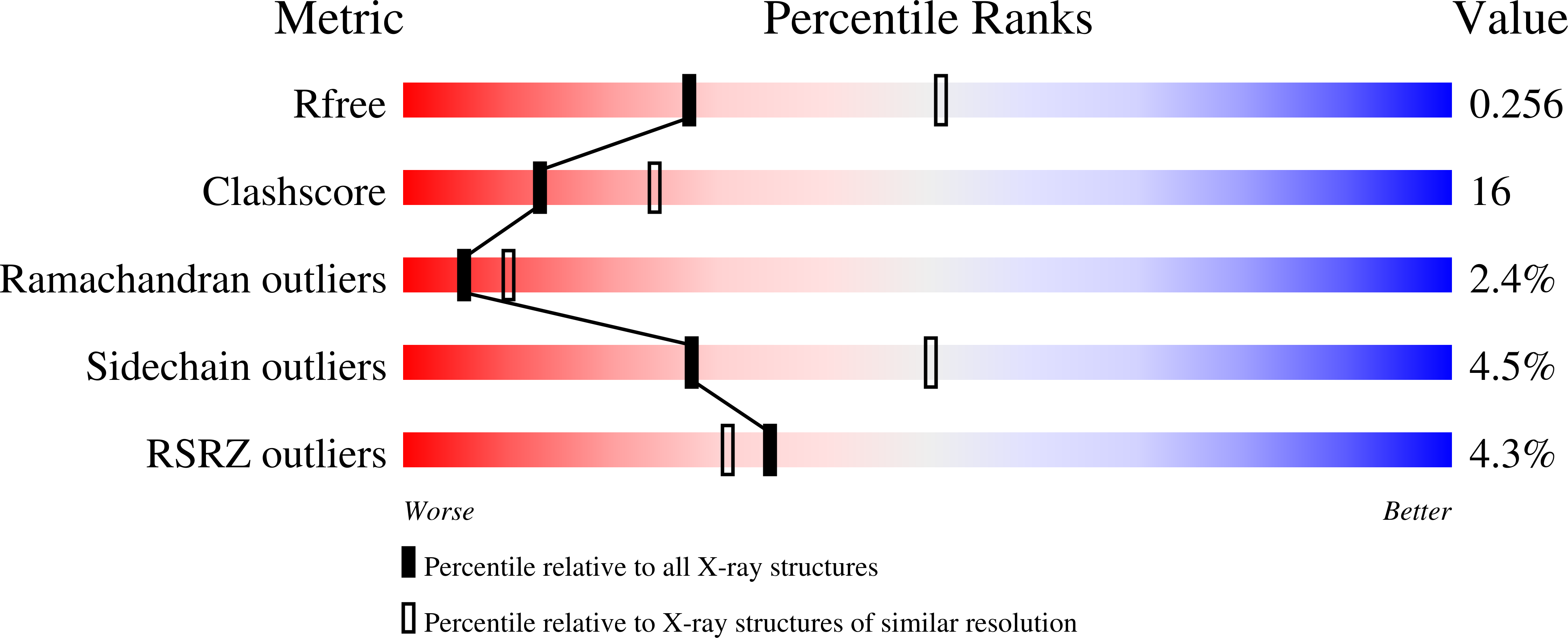
Experimental Method:
Resolution:
2.58 Å
R-Value Free:
0.27
R-Value Work:
0.23
Space Group:
P 21 21 2
Macromolecular Entities
Structures with similar UniProt ID
Protein Blast
Polymer Type:polypeptide(L)
Molecule:C-ets-1 protein
Gene (Uniprot):ETS1
Mutagens:C350S , C416S
Chain IDs:C (auth: A), D (auth: B)
Chain Length:171
Number of Molecules:2
Biological Source:Homo sapiens
Primary Citation
Regulation of the transcription factor Ets-1 by DNA-mediated homo-dimerization.
Embo J. 27 2006 2017 (2008)
PMID: 18566588 DOI: 10.1038/emboj.2008.117

Abstact

The function of the Ets-1 transcription factor is regulated by two regions that flank its DNA-binding domain. A previously established mechanism for auto-inhibition of monomeric Ets-1 on DNA response elements with a single ETS-binding site, however, has not been observed for the stromelysin-1 promoter containing two palindromic ETS-binding sites. We present the structure of Ets-1 on this promoter element, revealing a ternary complex in which protein homo-dimerization is mediated by the specific arrangement of the two ETS-binding sites. In this complex, the N-terminal-flanking region is required for ternary protein-DNA assembly. Ets-1 variants, in which residues from this region are mutated, loose the ability for DNA-mediated dimerization and stromelysin-1 promoter transactivation. Thus, our data unravel the molecular basis for relief of auto-inhibition and the ability of Ets-1 to function as a facultative dimeric transcription factor on this site. Our findings may also explain previous data of Ets-1 function in the context of heterologous transcription factors, thus providing a molecular model that could also be valid for Ets-1 regulation by hetero-oligomeric assembly.

Legend

Protein

Chemical

Disease

Primary Citation of related structures
Feedback Form
Name
Email
Institute
Feedback