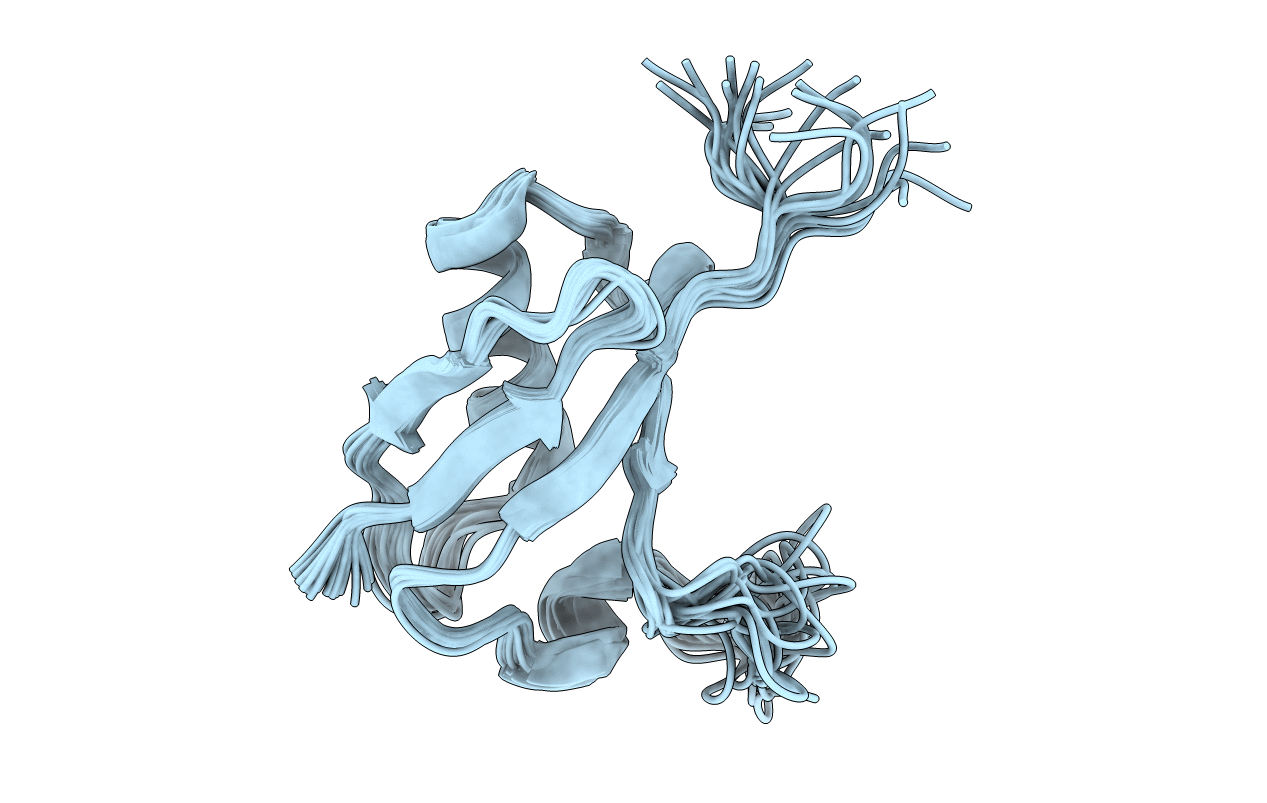
2NBE image
Deposition Date 2016-02-04
Release Date 2016-05-18
Last Version Date 2024-05-15
Entry Detail
PDB ID:
2NBE
Keywords:
Title:
Solution structure of V26A mutant of Ubiquitin at pH 2.0
Biological Source:
Source Organism:
Homo sapiens (Taxon ID: 9606)
Host Organism:
Method Details:
Experimental Method:
Conformers Calculated:
100
Conformers Submitted:
20
Selection Criteria:
structures with the lowest energy

Macromolecular Entities
Structures with similar UniProt ID
Protein Blast
Polymer Type:polypeptide(L)
Molecule:entity
Mutagens:V26A
Chain IDs:A
Chain Length:76
Number of Molecules:1
Biological Source:Homo sapiens
Ligand Molecules
Primary Citation
Observing a late folding intermediate of Ubiquitin at atomic resolution by NMR
Protein Sci. 25 1438 1450 (2016)
PMID: 27111887 DOI: 10.1002/pro.2940

Abstact

The study of intermediates in the protein folding pathway provides a wealth of information about the energy landscape. The intermediates also frequently initiate pathogenic fibril formations. While observing the intermediates is difficult due to their transient nature, extreme conditions can partially unfold the proteins and provide a glimpse of the intermediate states. Here, we observe the high resolution structure of a hydrophobic core mutant of Ubiquitin at an extreme acidic pH by nuclear magnetic resonance (NMR) spectroscopy. In the structure, the native secondary and tertiary structure is conserved for a major part of the protein. However, a long loop between the beta strands β3 and β5 is partially unfolded. The altered structure is supported by fluorescence data and the difference in free energies between the native state and the intermediate is reflected in the denaturant induced melting curves. The unfolded region includes amino acids that are critical for interaction with cofactors as well as for assembly of poly-Ubiquitin chains. The structure at acidic pH resembles a late folding intermediate of Ubiquitin and indicates that upon stabilization of the protein's core, the long loop converges on the core in the final step of the folding process.

Legend

Protein

Chemical

Disease

Primary Citation of related structures
Feedback Form
Name
Email
Institute
Feedback