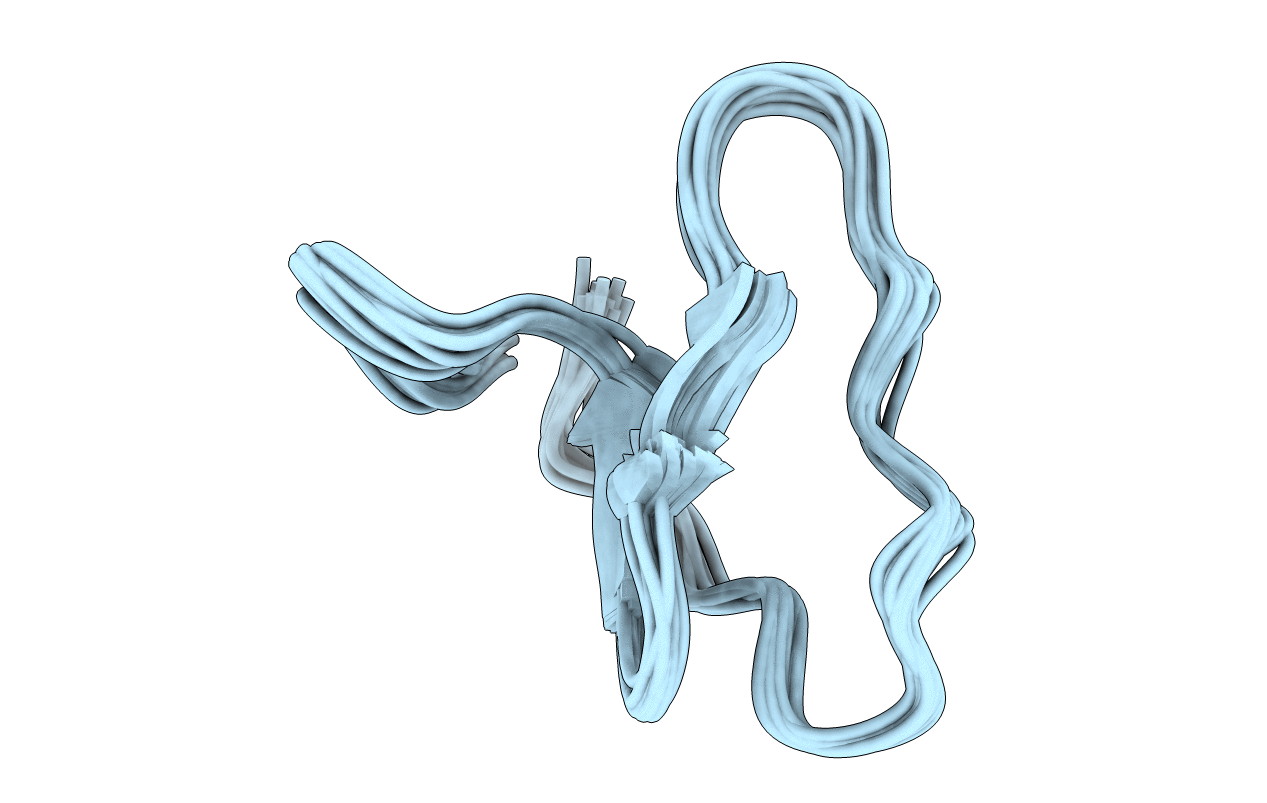
2LUR image
Deposition Date 2012-06-20
Release Date 2012-08-29
Last Version Date 2024-11-20
Entry Detail
PDB ID:
2LUR
Keywords:
Title:
NMR solution structure of Kb1[ghrw;23-28]
Method Details:
Experimental Method:
Conformers Calculated:
100
Conformers Submitted:
20
Selection Criteria:
structures with the lowest energy

Macromolecular Entities
Polymer Type:polypeptide(L)
Molecule:Kalata
Chain IDs:A
Chain Length:29
Number of Molecules:1
Biological Source:
Ligand Molecules
Primary Citation
Design, synthesis, structural and functional characterization of novel melanocortin agonists based on the cyclotide kalata b1.
J.Biol.Chem. 287 40493 40501 (2012)
PMID: 23012369 DOI: 10.1074/jbc.M112.395442

Abstact

BACKGROUND Cyclotides are useful scaffolds to stabilize bioactive peptides. RESULTS Four melanocortin analogues of kalata B1 were synthesized. One is a selective MC4R agonist. CONCLUSION The analogues retain the native kalata B1 scaffold and introduce a designed pharmacological activity, validating cyclotides as protein engineering scaffolds. SIGNIFICANCE A novel type of melanocortin agonist has been developed, with potential as a drug lead for treating obesity. Obesity is an increasingly important global health problem that lacks current treatment options. The melanocortin receptor 4 (MC4R) is a target for obesity therapies because its activation triggers appetite suppression and increases energy expenditure. Cyclotides have been suggested as scaffolds for the insertion and stabilization of pharmaceutically active peptides. In this study, we explored the development of appetite-reducing peptides by synthesizing MC4R agonists based on the insertion of the His-Phe-Arg-Trp sequence into the cyclotide kalata B1. The ability of the analogues to fold similarly to kalata B1 but display MC4R activity were investigated. Four peptides were synthesized using t-butoxycarbonyl peptide chemistry with a C-terminal thioester to facilitate backbone cyclization. The structures of the peptides were found to be similar to kalata B1, evaluated by Hα NMR chemical shifts. KB1(GHFRWG;23-28) had a K(i) of 29 nm at the MC4R and was 107 or 314 times more selective over this receptor than MC1R or MC5R, respectively, and had no detectable binding to MC3R. The peptide had higher affinity for the MC4R than the endogenous agonist, α-melanocyte stimulation hormone, but it was less potent at the MC4R, with an EC(50) of 580 nm for activation of the MC4R. In conclusion, we synthesized melanocortin analogues of kalata B1 that preserve the structural scaffold and display receptor binding and functional activity. KB1(GHFRWG;23-28) is potent and selective for the MC4R. This compound validates the use of cyclotides as scaffolds and has the potential to be a new lead for the treatment of obesity.

Legend

Protein

Chemical

Disease

Primary Citation of related structures
Feedback Form
Name
Email
Institute
Feedback