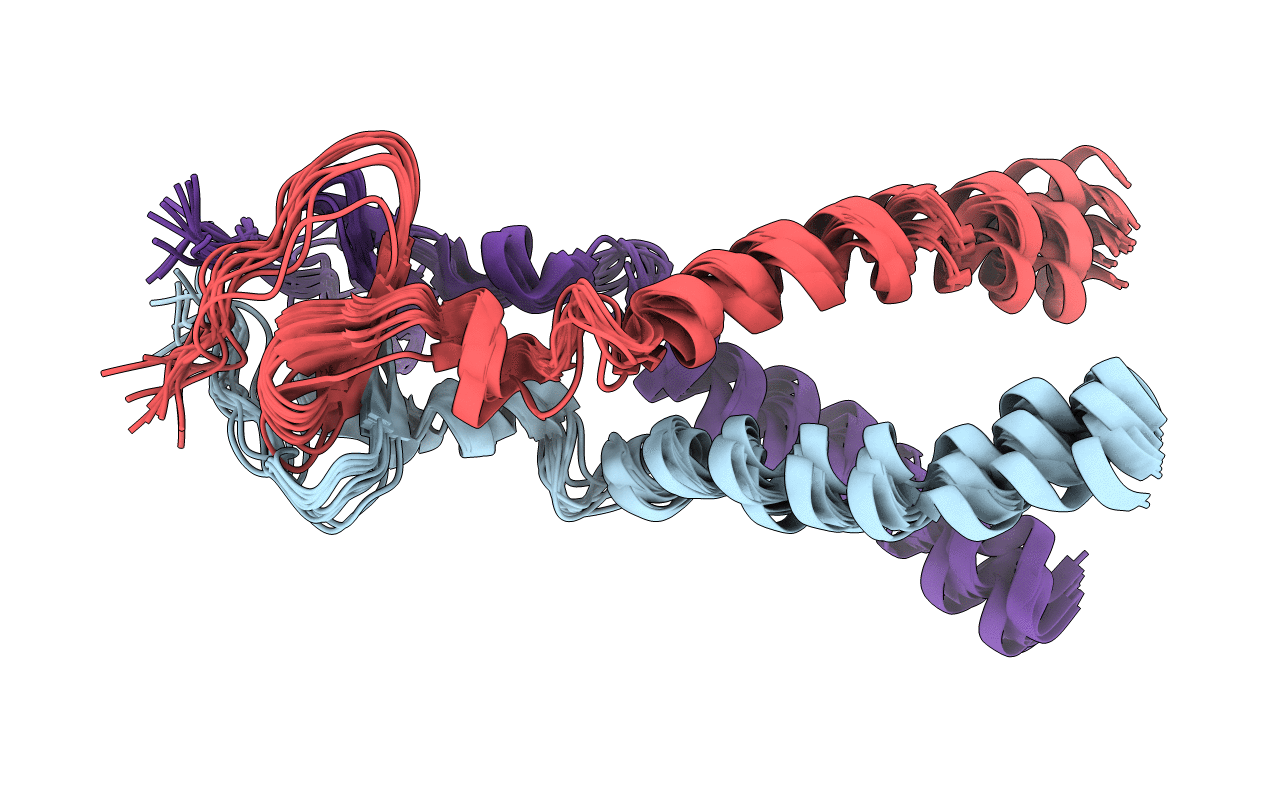
2LP7 image
Deposition Date 2012-02-03
Release Date 2013-02-06
Last Version Date 2024-05-15
Entry Detail
PDB ID:
2LP7
Keywords:
Title:
Structure of gp41-M-MAT, a membrane associated MPER trimer from HIV-1 gp41.
Biological Source:
Source Organism:
Host Organism:
Method Details:
Experimental Method:
Conformers Calculated:
400
Conformers Submitted:
11
Selection Criteria:
structures with the least restraint violations

Macromolecular Entities
Structures with similar UniProt ID
Protein Blast
Polymer Type:polypeptide(L)
Molecule:Envelope glycoprotein
Chain IDs:A, B, C
Chain Length:59
Number of Molecules:3
Biological Source:Human immunodeficiency virus 1
Ligand Molecules
Primary Citation
Structure of an HIV-1-neutralizing antibody target, the lipid-bound gp41 envelope membrane proximal region trimer.
Proc.Natl.Acad.Sci.USA 111 1391 1396 (2014)
PMID: 24474763 DOI: 10.1073/pnas.1309842111

Abstact

The membrane proximal external region (MPER) of HIV-1 glycoprotein (gp) 41 is involved in viral-host cell membrane fusion. It contains short amino acid sequences that are binding sites for the HIV-1 broadly neutralizing antibodies 2F5, 4E10, and 10E8, making these binding sites important targets for HIV-1 vaccine development. We report a high-resolution structure of a designed MPER trimer assembled on a detergent micelle. The NMR solution structure of this trimeric domain, designated gp41-M-MAT, shows that the three MPER peptides each adopt symmetric α-helical conformations exposing the amino acid side chains of the antibody binding sites. The helices are closely associated at their N termini, bend between the 2F5 and 4E10 epitopes, and gradually separate toward the C termini, where they associate with the membrane. The mAbs 2F5 and 4E10 bind gp41-M-MAT with nanomolar affinities, consistent with the substantial exposure of their respective epitopes in the trimer structure. The traditional structure determination of gp41-M-MAT using the Xplor-NIH protocol was validated by independently determining the structure using the DISCO sparse-data protocol, which exploits geometric arrangement algorithms that guarantee to compute all structures and assignments that satisfy the data.

Legend

Protein

Chemical

Disease

Primary Citation of related structures
Feedback Form
Name
Email
Institute
Feedback