2LKO image
Deposition Date 2011-10-17
Release Date 2011-10-26
Last Version Date 2024-05-15
Entry Detail
PDB ID:
2LKO
Keywords:
Title:
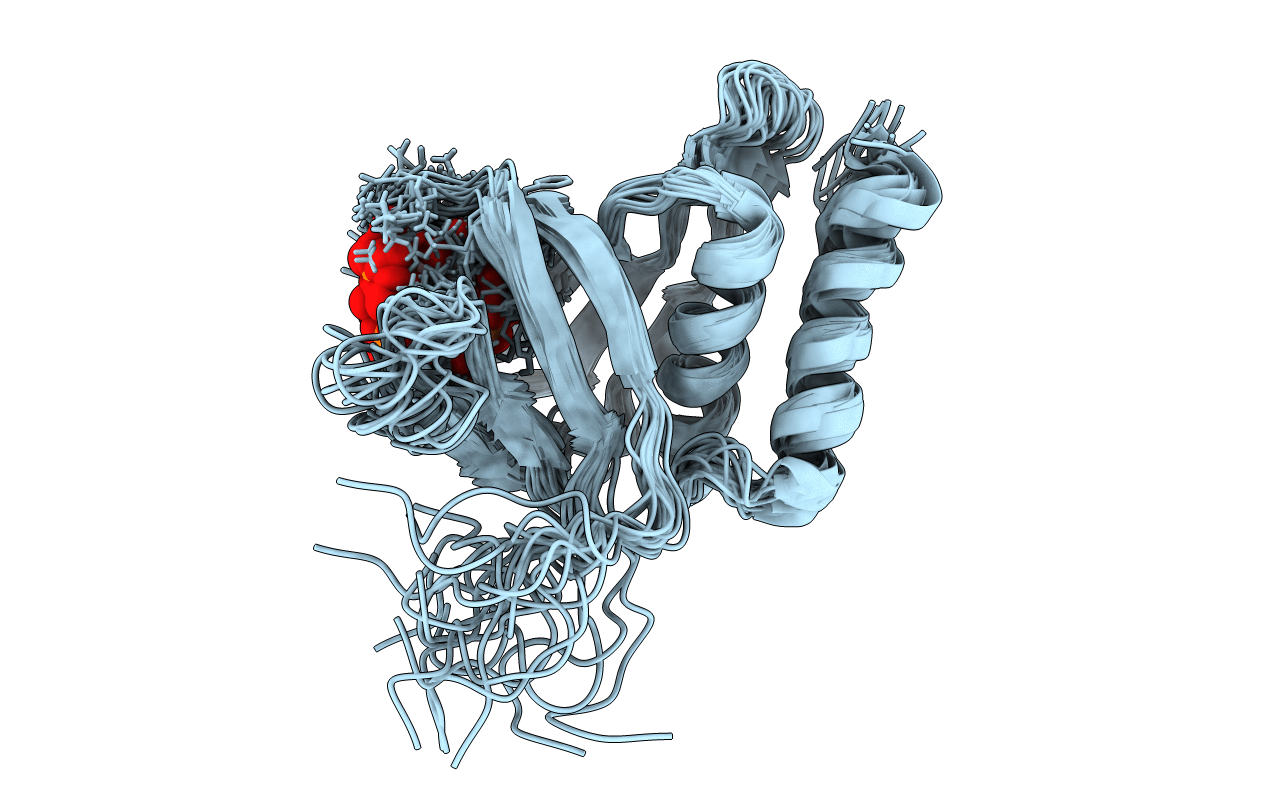
Structural Basis of Phosphoinositide Binding to Kindlin-2 Pleckstrin Homology Domain in Regulating Integrin Activation
Biological Source:
Source Organism:
Homo sapiens (Taxon ID: 9606)
Host Organism:
Method Details:
Experimental Method:
Conformers Calculated:
100
Conformers Submitted:
20
Selection Criteria:
structures with the lowest energy

Macromolecular Entities
Structures with similar UniProt ID
Protein Blast
Polymer Type:polypeptide(L)
Molecule:Fermitin family homolog 2
Gene (Uniprot):FERMT2
Chain IDs:A
Chain Length:138
Number of Molecules:1
Biological Source:Homo sapiens
Ligand Molecules
Primary Citation
Structural basis of phosphoinositide binding to kindlin-2 protein pleckstrin homology domain in regulating integrin activation.
J.Biol.Chem. 286 43334 43342 (2011)
PMID: 22030399 DOI: 10.1074/jbc.M111.295352

Abstact

Kindlins are a subclass of FERM-containing proteins that have recently emerged as key regulators of integrin receptor activation and signaling. As compared with the conventional FERM domain, the kindlin FERM domain contains an inserted pleckstrin homology (PH) domain that recognizes membrane phosphoinositides, including phosphatidylinositol 4,5-bisphosphate (PIP2) and phosphatidylinositol 3,4,5-trisphosphate (PIP3). Using NMR spectroscopy, we show that PIP3 site-specifically binds to kindlin-2 PH with substantial chemical shift changes that are much larger than PIP2. This suggests an enhanced association of kindlin-2 with membrane as mediated by PIP3 upon its conversion from PIP2 by phosphoinositide-3 kinase, a known regulator of integrin activation. We determined the NMR structure of the kindlin-2 PH domain bound to the head group of PIP3, inositol 1,3,4,5-tetraphosphate (IP4). The structure reveals a canonical PH domain fold, yet with a distinct IP4 binding pocket that appears highly conserved for the kindlin family members. Functional experiments demonstrate that although wild type kindlin-2 is capable of cooperating with integrin activator talin to induce synergistic integrin α(IIb)β(3) activation, this ability is significantly impaired for a phosphoinositide binding-defective kindlin-2 mutant. These results define a specific PIP3 recognition mode for the kindlin PH domain. Moreover, they shed light upon a mechanism as to how the PH domain mediates membrane engagement of kindlin-2 to promote its binding to integrin and cooperation with talin for regulation of integrin activation.

Legend

Protein

Chemical

Disease

Primary Citation of related structures
Feedback Form
Name
Email
Institute
Feedback