2LJ9 image
Deposition Date 2011-09-09
Release Date 2012-04-25
Last Version Date 2024-10-30
Entry Detail
PDB ID:
2LJ9
Keywords:
Title:
Partial 3d structure of the c-terminal part of the free arabidopsis thaliana cp12-2 in its oxidized form
Biological Source:
Source Organism:
Host Organism:
Method Details:
Experimental Method:
Conformers Calculated:
150
Conformers Submitted:
20
Selection Criteria:
structures with the lowest energy
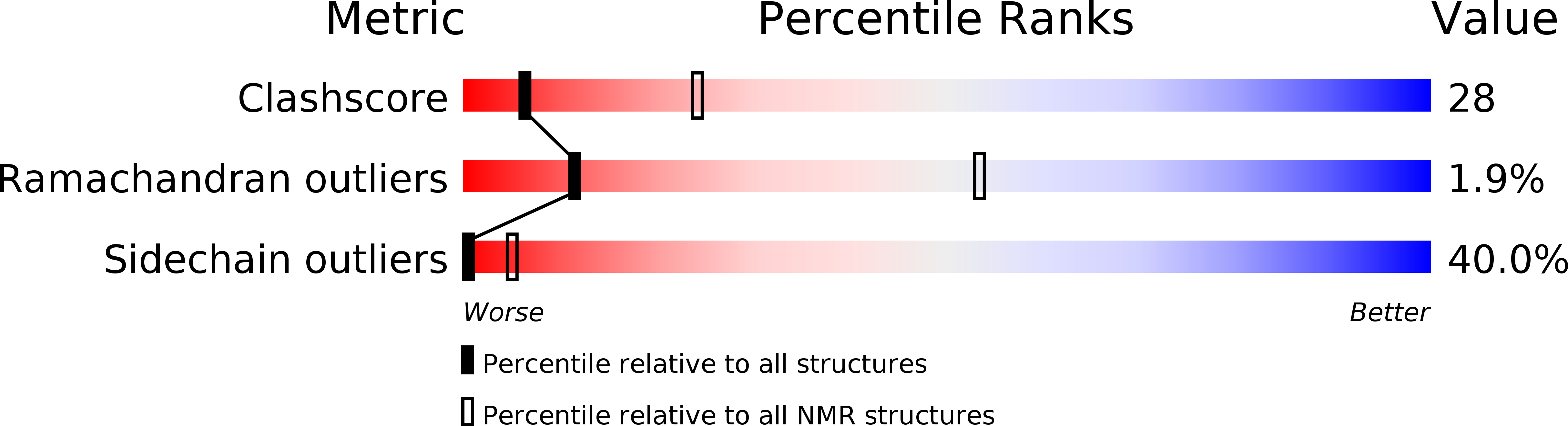
Macromolecular Entities
Structures with similar UniProt ID
Protein Blast
Polymer Type:polypeptide(L)
Molecule:CP12 domain-containing protein 2
Gene (Uniprot):CP12-2
Chain IDs:A
Chain Length:99
Number of Molecules:1
Biological Source:Arabidopsis thaliana
Ligand Molecules
Primary Citation
Conformational Selection and Folding-upon-binding of Intrinsically Disordered Protein CP12 Regulate Photosynthetic Enzymes Assembly.
J.Biol.Chem. 287 21372 21383 (2012)
PMID: 22514274 DOI: 10.1074/jbc.M112.350355

Abstact

Carbon assimilation in plants is regulated by the reduction of specific protein disulfides by light and their re-oxidation in the dark. The redox switch CP12 is an intrinsically disordered protein that can form two disulfide bridges. In the dark oxidized CP12 forms an inactive supramolecular complex with glyceraldehyde-3-phosphate dehydrogenase (GAPDH) and phosphoribulokinase, two enzymes of the carbon assimilation cycle. Here we show that binding of CP12 to GAPDH, the first step of ternary complex formation, follows an integrated mechanism that combines conformational selection with induced folding steps. Initially, a CP12 conformation characterized by a circular structural motif including the C-terminal disulfide is selected by GAPDH. Subsequently, the induced folding of the flexible C-terminal tail of CP12 in the active site of GAPDH stabilizes the binary complex. Formation of several hydrogen bonds compensates the entropic cost of CP12 fixation and terminates the interaction mechanism that contributes to carbon assimilation control.

Legend

Protein

Chemical

Disease

Primary Citation of related structures
Feedback Form
Name
Email
Institute
Feedback