2LHU image
Deposition Date 2011-08-18
Release Date 2012-01-11
Last Version Date 2024-05-01
Entry Detail
PDB ID:
2LHU
Title:
Structural Insight into the Unique Cardiac Myosin Binding Protein-C Motif: A Partially Folded Domain
Biological Source:
Source Organism:
Mus musculus (Taxon ID: 10090)
Host Organism:
Method Details:
Experimental Method:
Conformers Calculated:
5000
Conformers Submitted:
20
Selection Criteria:
structures with the lowest energy
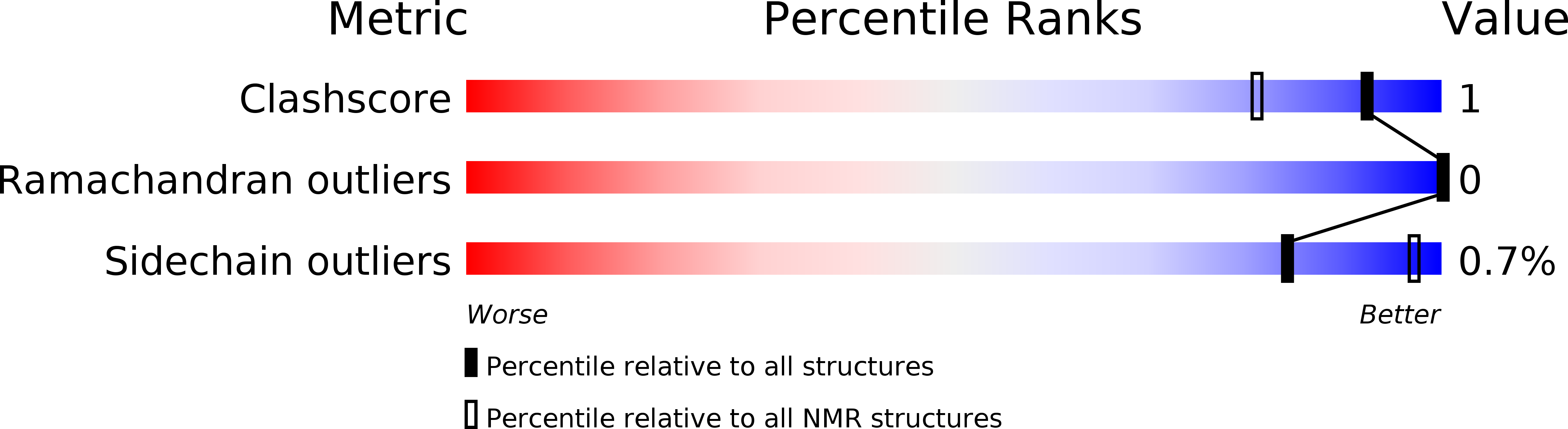
Macromolecular Entities
Structures with similar UniProt ID
Protein Blast
Polymer Type:polypeptide(L)
Molecule:Mybpc3 protein
Gene (Uniprot):Mybpc3
Chain IDs:A
Chain Length:124
Number of Molecules:1
Biological Source:Mus musculus
Ligand Molecules
Primary Citation
Structural Insight into Unique Cardiac Myosin-binding Protein-C Motif: A PARTIALLY FOLDED DOMAIN.
J.Biol.Chem. 287 8254 8262 (2012)
PMID: 22235120 DOI: 10.1074/jbc.M111.309591

Abstact

The structural role of the unique myosin-binding motif (m-domain) of cardiac myosin-binding protein-C remains unclear. Functionally, the m-domain is thought to directly interact with myosin, whereas phosphorylation of the m-domain has been shown to modulate interactions between myosin and actin. Here we utilized NMR to analyze the structure and dynamics of the m-domain in solution. Our studies reveal that the m-domain is composed of two subdomains, a largely disordered N-terminal portion containing three known phosphorylation sites and a more ordered and folded C-terminal portion. Chemical shift analyses, d(NN)(i, i + 1) NOEs, and (15)N{(1)H} heteronuclear NOE values show that the C-terminal subdomain (residues 315-351) is structured with three well defined helices spanning residues 317-322, 327-335, and 341-348. The tertiary structure was calculated with CS-Rosetta using complete (13)C(α), (13)C(β), (13)C', (15)N, (1)H(α), and (1)H(N) chemical shifts. An ensemble of 20 acceptable structures was selected to represent the C-terminal subdomain that exhibits a novel three-helix bundle fold. The solvent-exposed face of the third helix was found to contain the basic actin-binding motif LK(R/K)XK. In contrast, (15)N{(1)H} heteronuclear NOE values for the N-terminal subdomain are consistent with a more conformationally flexible region. Secondary structure propensity scores indicate two transient helices spanning residues 265-268 and 293-295. The presence of both transient helices is supported by weak sequential d(NN)(i, i + 1) NOEs. Thus, the m-domain consists of an N-terminal subdomain that is flexible and largely disordered and a C-terminal subdomain having a three-helix bundle fold, potentially providing an actin-binding platform.

Legend

Protein

Chemical

Disease

Primary Citation of related structures
Feedback Form
Name
Email
Institute
Feedback