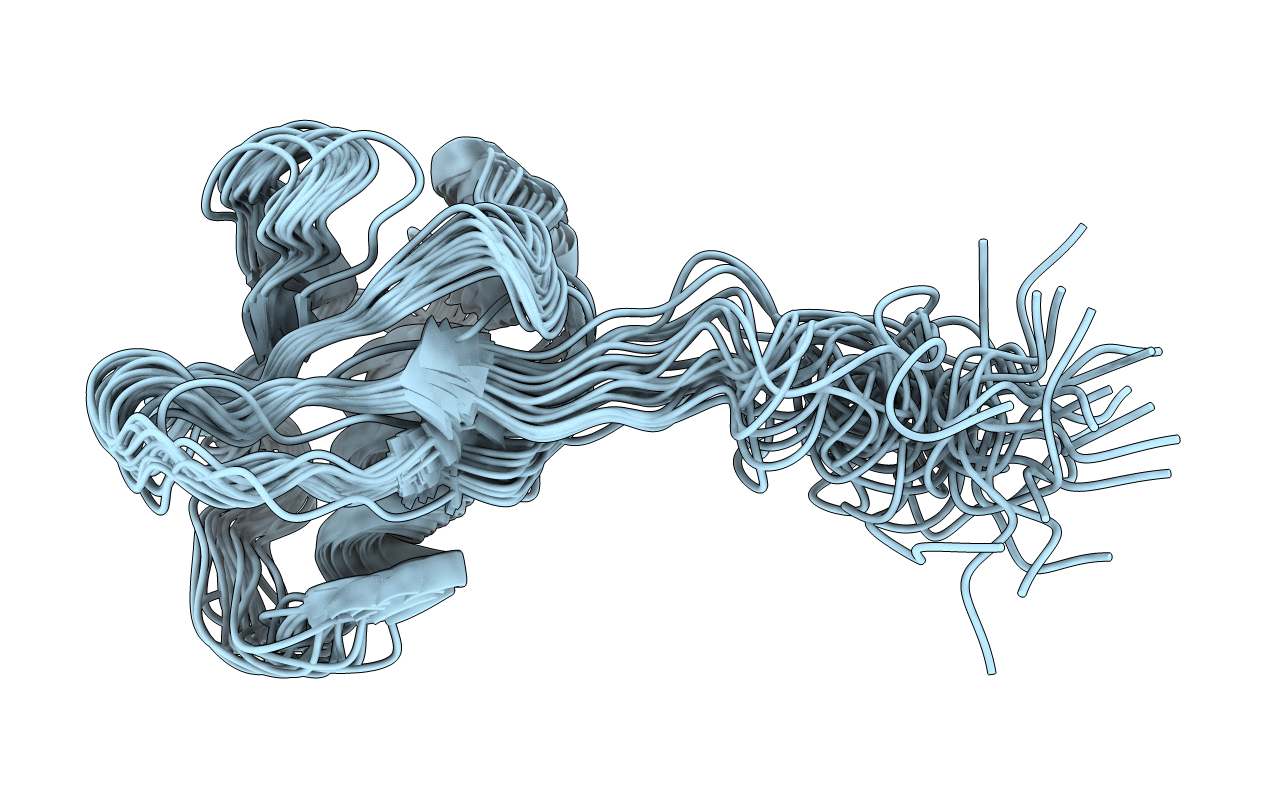
2LGX image
Deposition Date 2011-08-03
Release Date 2011-11-30
Last Version Date 2024-05-15
Entry Detail
PDB ID:
2LGX
Keywords:
Title:
NMR structure for Kindle-2 N-terminus
Biological Source:
Source Organism:
Homo sapiens (Taxon ID: 9606)
Host Organism:
Method Details:
Experimental Method:
Conformers Calculated:
100
Conformers Submitted:
20
Selection Criteria:
structures with the lowest energy
Macromolecular Entities
Structures with similar UniProt ID
Protein Blast
Polymer Type:polypeptide(L)
Molecule:Fermitin family homolog 2
Gene (Uniprot):FERMT2
Chain IDs:A
Chain Length:112
Number of Molecules:1
Biological Source:Homo sapiens
Ligand Molecules
Primary Citation
Membrane Binding of the N-Terminal Ubiquitin-Like Domain of kindlin-2 Is Crucial for Its Regulation of Integrin Activation.
Structure 19 1664 1671 (2011)
PMID: 22078565 DOI: 10.1016/j.str.2011.08.012

Abstact

Kindlin-2 belongs to an emerging class of regulators for heterodimeric (α/β) integrin adhesion receptors. By binding to integrin β cytoplasmic tail via its C-terminal FERM-like domain, kindlin-2 promotes integrin activation. Intriguingly, this activation process depends on the N terminus of kindlin-2 (K2-N) that precedes the FERM domain. The molecular function of K2-N is unclear. We present the solution structure of K2-N, which displays a ubiquitin fold similar to that observed in kindlin-1. Using chemical shift mapping and mutagenesis, we found that K2-N contains a conserved positively charged surface that binds to membrane enriched with negatively charged phosphatidylinositol-(4,5)-bisphosphate. We show that while wild-type kindlin-2 is capable of promoting integrin activation, such ability is significantly reduced for its membrane-binding defective mutant. These data suggest a membrane-binding function of the ubiquitin-like domain of kindlin-2, which is likely common for all kindlins to promote their localization to the plasma membrane and control integrin activation.

Legend

Protein

Chemical

Disease

Primary Citation of related structures
Feedback Form
Name
Email
Institute
Feedback