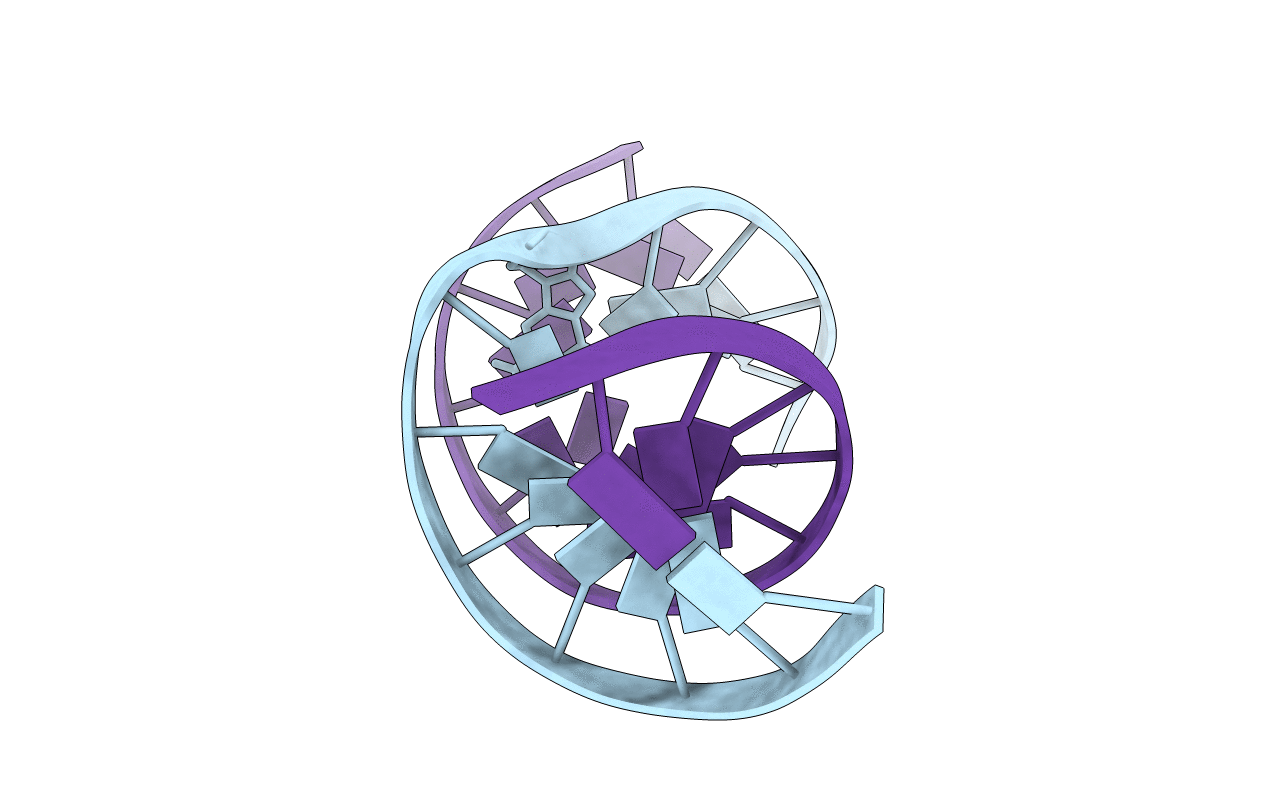
2LFX image
Deposition Date 2011-07-18
Release Date 2012-06-27
Last Version Date 2024-05-15
Entry Detail
PDB ID:
2LFX
Keywords:
Title:
Structure of the duplex when (5'S)-8,5'-cyclo-2'-deoxyguanosine is placed opposite dT
Biological Source:
Source Organism:
Method Details:
Experimental Method:
Conformers Calculated:
10
Conformers Submitted:
1
Selection Criteria:
back calculated data agree with experimental NOESY spectrum

Macromolecular Entities
Polymer Type:polydeoxyribonucleotide
Molecule:DNA (5'-D(*GP*TP*GP*CP*(2LF)P*TP*GP*TP*TP*TP*GP*T)-3')
Chain IDs:A
Chain Length:12
Number of Molecules:1
Biological Source:
Polymer Type:polydeoxyribonucleotide
Molecule:DNA (5'-D(*AP*CP*AP*AP*AP*CP*AP*TP*GP*CP*AP*C)-3')
Chain IDs:B
Chain Length:12
Number of Molecules:1
Biological Source:
Ligand Molecules
Primary Citation
Structures of (5'S)-8,5'-Cyclo-2'-deoxyguanosine Mismatched with dA or dT.
Chem.Res.Toxicol. 25 478 490 (2012)
PMID: 22309170 DOI: 10.1021/tx2005053

Abstact

Diastereomeric 8,5'-cyclopurine 2'-deoxynucleosides, containing a covalent bond between the deoxyribose and the purine base, are induced in DNA by ionizing radiation. They are suspected to play a role in the etiology of neurodegeneration in xeroderma pigmentosum patients. If not repaired, the S-8,5'-cyclo-2'-deoxyguanosine lesion (S-cdG) induces Pol V-dependent mutations at a frequency of 34% in Escherichia coli. Most are S-cdG → A transitions, suggesting mis-incorporation of dTTP opposite the lesion during replication bypass, although low levels of S-cdG → T transversions, arising from mis-incorporation of dATP, are also observed. We report the structures of 5'-d(GTGCXTGTTTGT)-3'·5'-d(ACAAACAYGCAC)-3', where X denotes S-cdG and Y denotes either dA or dT, corresponding to the situation following mis-insertion of either dTTP or dATP opposite the S-cdG lesion. The S-cdG·dT mismatch pair adopts a wobble base pairing. This provides a plausible rationale for the S-cdG → A transitions. The S-cdG·dA mismatch pair differs in conformation from the dG·dA mismatch pair. For the S-cdG·dA mismatch pair, both S-cdG and dA intercalate, but no hydrogen bonding is observed between S-cdG and dA. This is consistent with the lower levels of S-cdG → T transitions in E. coli.

Legend

Protein

Chemical

Disease

Primary Citation of related structures
Feedback Form
Name
Email
Institute
Feedback