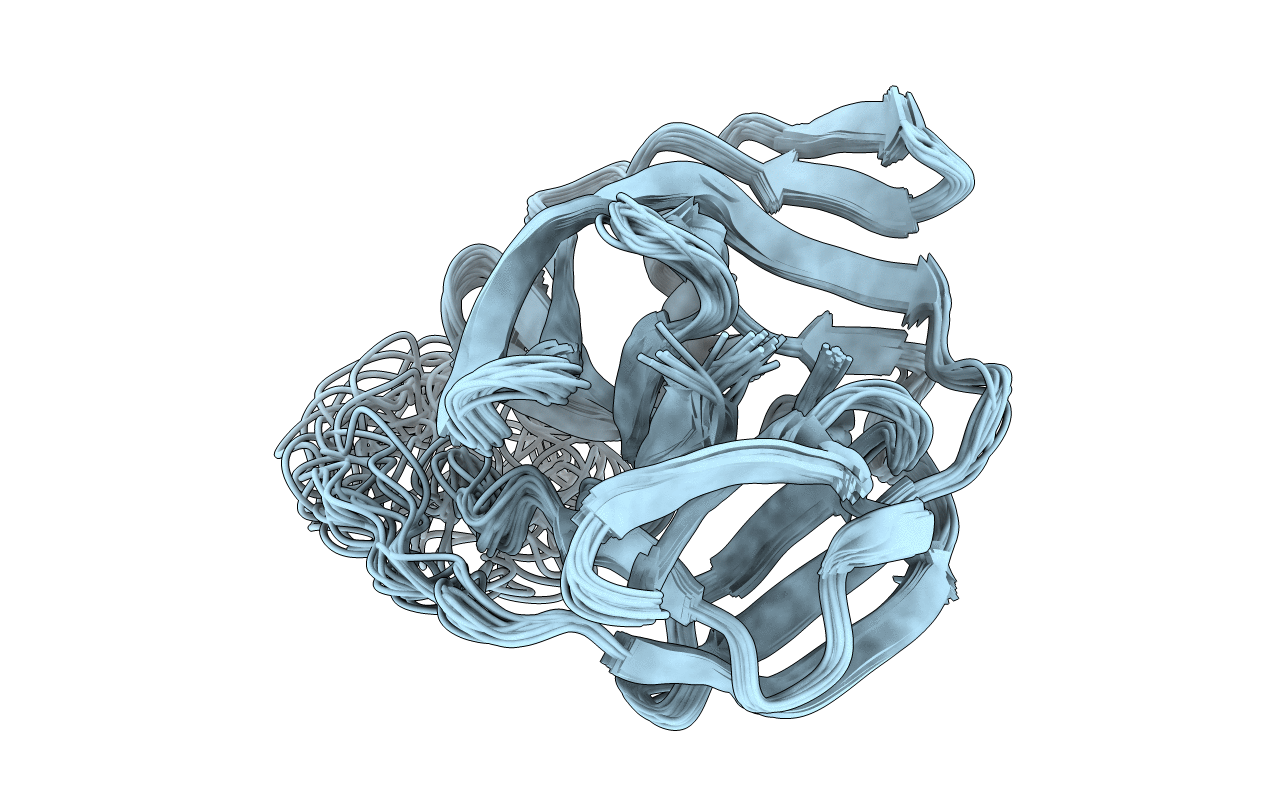
2LCJ image
Deposition Date 2011-04-29
Release Date 2011-09-21
Last Version Date 2024-05-15
Entry Detail
PDB ID:
2LCJ
Keywords:
Title:
Solution NMR structure of Pab PolII Intein
Biological Source:
Source Organism:
Host Organism:
Method Details:
Experimental Method:
Conformers Calculated:
200
Conformers Submitted:
20
Selection Criteria:
structures with the lowest energy

Macromolecular Entities
Structures with similar UniProt ID
Protein Blast
Polymer Type:polypeptide(L)
Molecule:Pab polC intein
Gene (Uniprot):polC
Chain IDs:A
Chain Length:185
Number of Molecules:1
Biological Source:Pyrococcus abyssi
Ligand Molecules
Primary Citation
Structural and Mutational Studies of a Hyperthermophilic Intein from DNA Polymerase II of Pyrococcus abyssi.
J.Biol.Chem. 286 38638 38648 (2011)
PMID: 21914805 DOI: 10.1074/jbc.M111.290569

Abstact

Protein splicing is a precise self-catalyzed process in which an intein excises itself from a precursor with the concomitant ligation of the flanking polypeptides (exteins). Protein splicing proceeds through a four-step reaction but the catalytic mechanism is not fully understood at the atomic level. We report the solution NMR structures of the hyperthermophilic Pyrococcus abyssi PolII intein, which has a noncanonical C-terminal glutamine instead of an asparagine. The NMR structures were determined to a backbone root mean square deviation of 0.46 Å and a heavy atom root mean square deviation of 0.93 Å. The Pab PolII intein has a common HINT (hedgehog intein) fold but contains an extra β-hairpin that is unique in the structures of thermophilic inteins. The NMR structures also show that the Pab PolII intein has a long and disordered loop in place of an endonuclease domain. The N-terminal Cys-1 amide is hydrogen bonded to the Thr-90 hydroxyl in the conserved block-B TXXH motif and the Cys-1 thiol forms a hydrogen bond with the block F Ser-166. Mutating Thr-90 to Ala dramatically slows N-terminal cleavage, supporting its pivotal role in promoting the N-S acyl shift. Mutagenesis also showed that Thr-90 and His-93 are synergistic in catalyzing the N-S acyl shift. The block F Ser-166 plays an important role in coordinating the steps of protein splicing. NMR spin relaxation indicates that the Pab PolII intein is significantly more rigid than mesophilic inteins, which may contribute to the higher optimal temperature for protein splicing.

Legend

Protein

Chemical

Disease

Primary Citation of related structures
Feedback Form
Name
Email
Institute
Feedback