Planned Maintenance: Some services may turn out to be unavailable from 15th January, 2026 to 16th January, 2026. We apologize for the inconvenience!

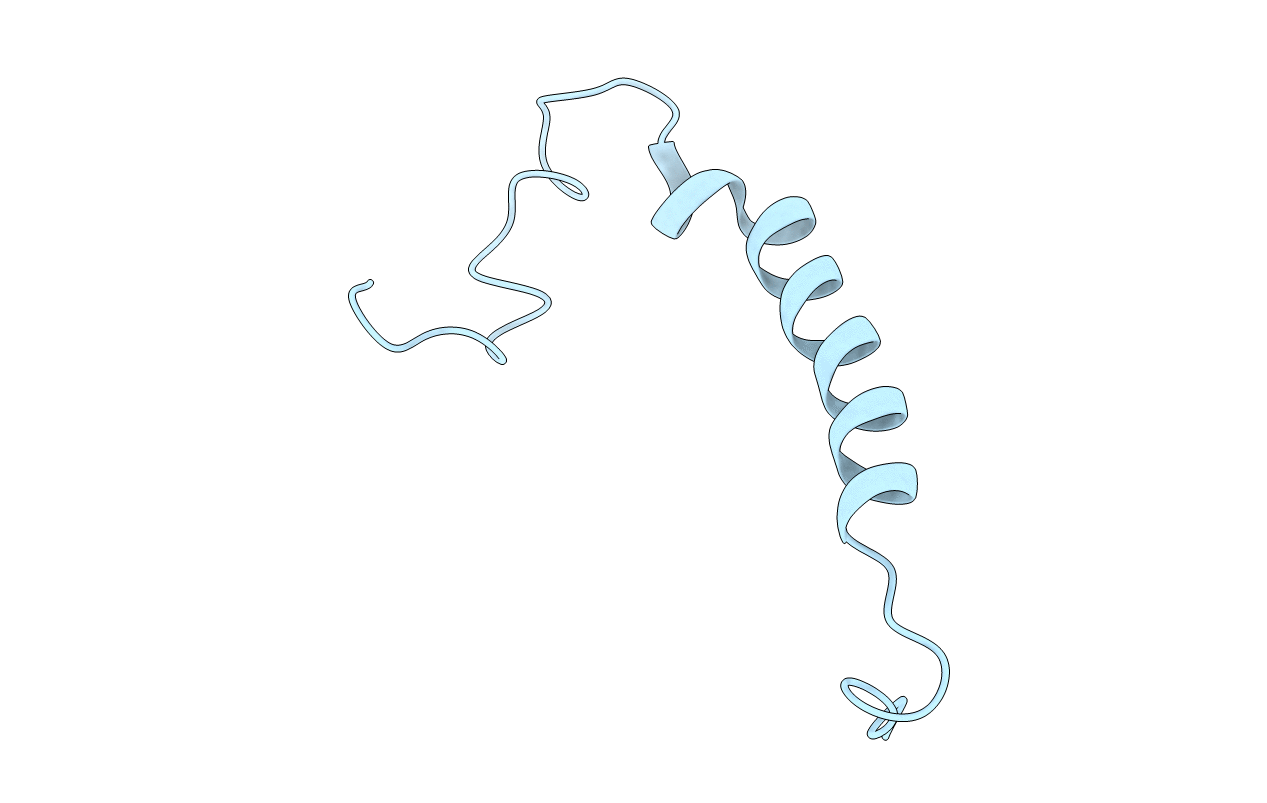
2KK9 image
Deposition Date 2009-06-16
Release Date 2010-06-16
Last Version Date 2024-11-20
Entry Detail
PDB ID:
2KK9
Title:
Anti-group A streptococcal vaccine epitope: structure, stability and its ability to interact with HLA class II molecules
Method Details:
Experimental Method:
Conformers Calculated:
50
Conformers Submitted:
1
Selection Criteria:
structures with the lowest energy

Macromolecular Entities
Structures with similar UniProt ID
Protein Blast
Polymer Type:polypeptide(L)
Molecule:M protein, serotype 5
Gene (Uniprot):emm5
Chain IDs:A
Chain Length:56
Number of Molecules:1
Biological Source:
Ligand Molecules
Primary Citation
Anti-Group A Streptococcal Vaccine Epitope: STRUCTURE, STABILITY, AND ITS ABILITY TO INTERACT WITH HLA CLASS II MOLECULES.
J.Biol.Chem. 286 6989 6998 (2011)
PMID: 21169359 DOI: 10.1074/jbc.M110.132118

Abstact

Streptococcus pyogenes infections remain a health problem in several countries due to poststreptococcal sequelae. We developed a vaccine epitope (StreptInCor) composed of 55 amino acids residues of the C-terminal portion of the M protein that encompasses both T and B cell protective epitopes. The nuclear magnetic resonance (NMR) structure of the StreptInCor peptide showed that the structure was composed of two microdomains linked by an 18-residue α-helix. A chemical stability study of the StreptInCor folding/unfolding process using far-UV circular dichroism showed that the structure was chemically stable with respect to pH and the concentration of urea. The T cell epitope is located in the first microdomain and encompasses 11 out of the 18 α-helix residues, whereas the B cell epitope is in the second microdomain and showed no α-helical structure. The prediction of StreptInCor epitope binding to different HLA class II molecules was evaluated based on an analysis of the 55 residues and the theoretical possibilities for the processed peptides to fit into the P1, P4, P6, and P9 pockets in the groove of several HLA class II molecules. We observed 7 potential sites along the amino acid sequence of StreptInCor that were capable of recognizing HLA class II molecules (DRB1*, DRB3*, DRB4*, and DRB5*). StreptInCor-overlapping peptides induced cellular and humoral immune responses of individuals bearing different HLA class II molecules and could be considered as a universal vaccine epitope.

Legend

Protein

Chemical

Disease

Primary Citation of related structures
Feedback Form
Name
Email
Institute
Feedback