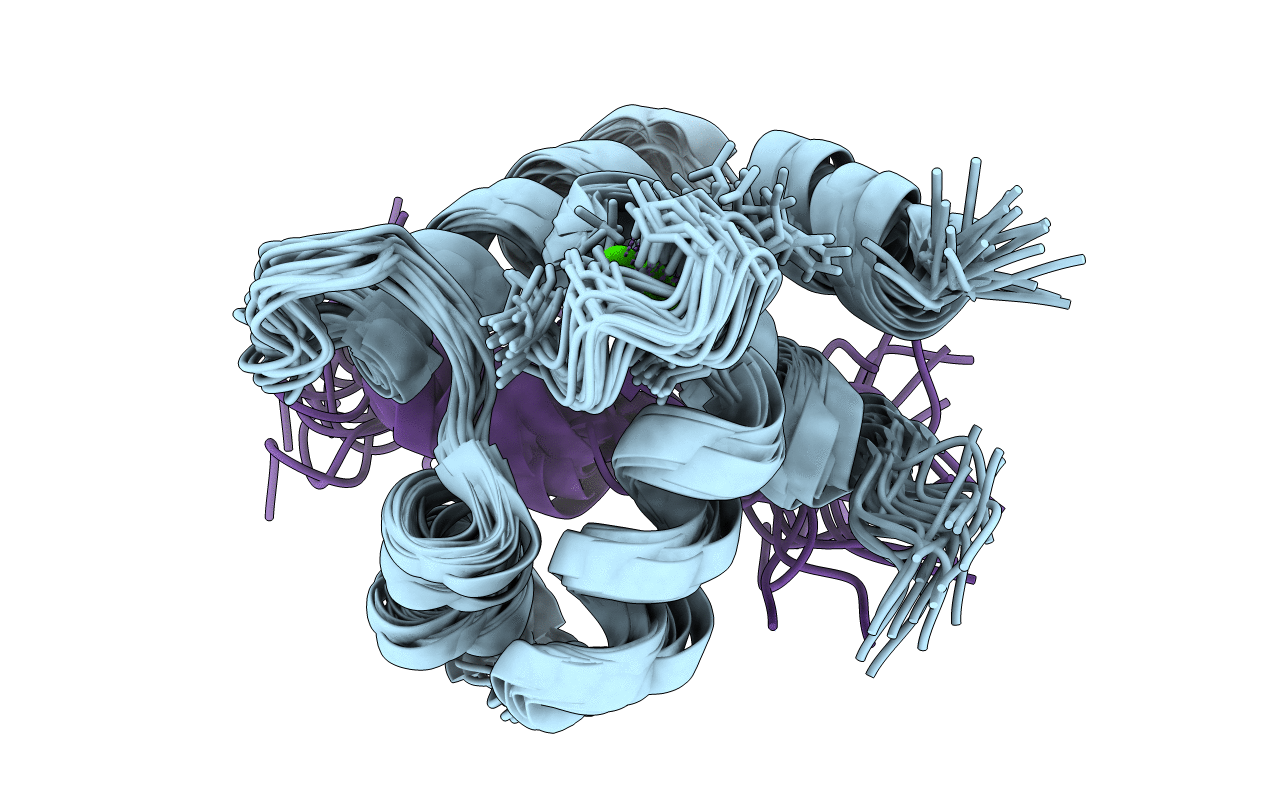
2KGB image
Deposition Date 2009-03-07
Release Date 2009-03-24
Last Version Date 2024-05-22
Entry Detail
PDB ID:
2KGB
Title:
NMR solution of the regulatory domain cardiac F77W-Troponin C in complex with the cardiac Troponin I 144-163 switch peptide
Biological Source:
Source Organism:
Homo sapiens (Taxon ID: 9606)
Host Organism:
Method Details:
Experimental Method:
Conformers Calculated:
100
Conformers Submitted:
20
Selection Criteria:
target function

Macromolecular Entities
Structures with similar UniProt ID
Protein Blast
Polymer Type:polypeptide(L)
Molecule:Troponin C, slow skeletal and cardiac muscles
Gene (Uniprot):TNNC1
Mutagens:F77W
Chain IDs:A (auth: C)
Chain Length:89
Number of Molecules:1
Biological Source:Homo sapiens
Ligand Molecules
Primary Citation
The effect of the cosolvent trifluoroethanol on a tryptophan side chain orientation in the hydrophobic core of troponin C.
Protein Sci. 18 1165 1174 (2009)
PMID: 19472326 DOI: 10.1002/pro.121

Abstact

The unique biophysical properties of tryptophan residues have been exploited for decades to monitor protein structure and dynamics using a variety of spectroscopic techniques, such as fluorescence and nuclear magnetic resonance (NMR). We recently designed a tryptophan mutant in the regulatory N-domain of cardiac troponin C (F77W-cNTnC) to study the domain orientation of troponin C in muscle fibers using solid-state NMR. In our previous study, we determined the NMR structure of calcium-saturated mutant F77W-V82A-cNTnC in the presence of 19% 2,2,2-trifluoroethanol (TFE). TFE is a widely used cosolvent in the biophysical characterization of the solution structures of peptides and proteins. It is generally assumed that the structures are unchanged in the presence of cosolvents at relatively low concentrations, and this has been verified for TFE at the level of the overall secondary and tertiary structure for several calcium regulatory proteins. Here, we present the NMR solution structure of the calcium saturated F77W-cNTnC in presence of its biological binding partner troponin I peptide (cTnI(144-163)) and in the absence of TFE. We have also characterized a panel of six F77W-cNTnC structures in the presence and absence TFE, cTnI(144-163), and the extra mutation V82A, and used (19)F NMR to characterize the effect of TFE on the F77(5fW) analog. Our results show that although TFE did not perturb the overall protein structure, TFE did induce a change in the orientation of the indole ring of the buried tryptophan side chain from the anticipated position based upon homology with other proteins, highlighting the potential dangers of the use of cosolvents.

Legend

Protein

Chemical

Disease

Primary Citation of related structures
Feedback Form
Name
Email
Institute
Feedback