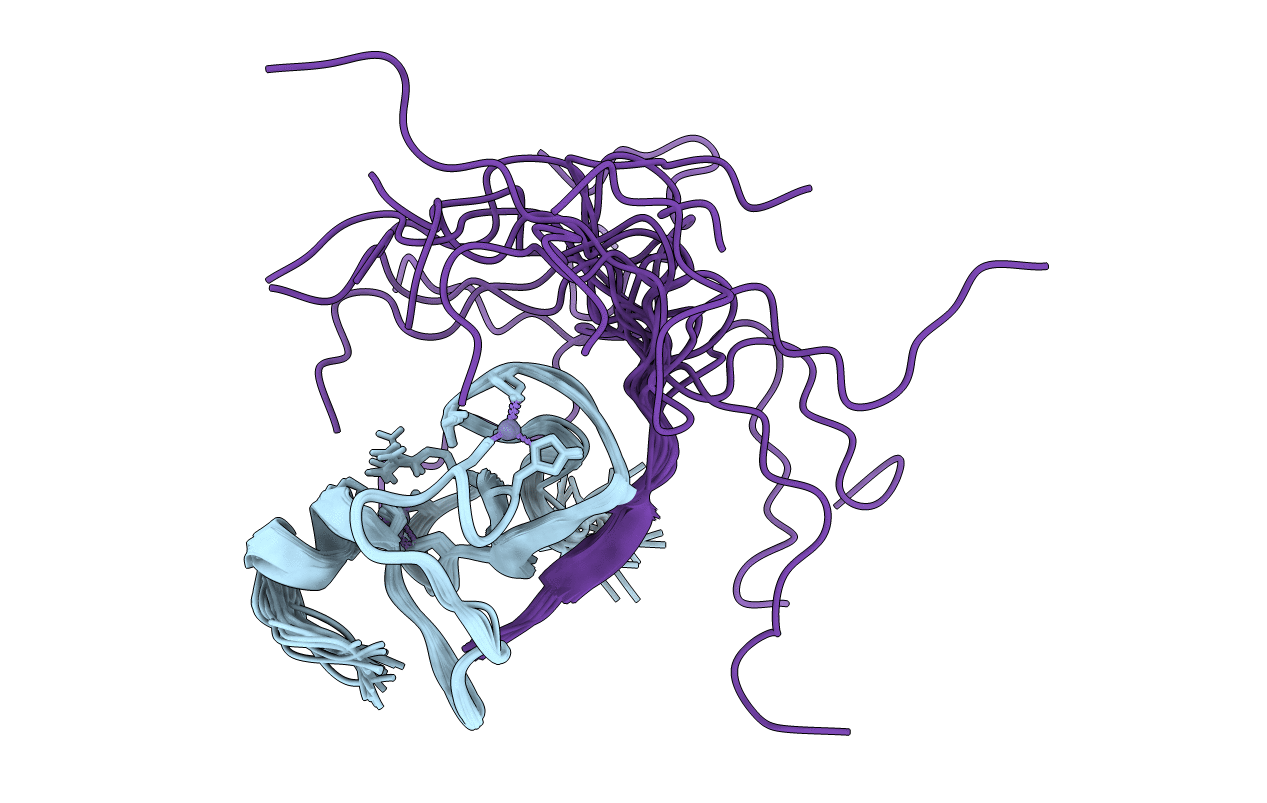
2KFT image
Deposition Date 2009-02-27
Release Date 2009-04-28
Last Version Date 2024-05-22
Entry Detail
PDB ID:
2KFT
Title:
NMR Solution structure of the first PHD finger domain of human Autoimmune Regulator (AIRE) in complex with Histone H3(1-20Cys) Peptide
Biological Source:
Source Organism:
Homo sapiens (Taxon ID: 9606)
Host Organism:
Method Details:
Experimental Method:
Conformers Calculated:
200
Conformers Submitted:
20
Selection Criteria:
structures with the lowest energy
Macromolecular Entities
Structures with similar UniProt ID
Protein Blast
Polymer Type:polypeptide(L)
Molecule:Autoimmune regulator
Gene (Uniprot):AIRE
Chain IDs:A
Chain Length:56
Number of Molecules:1
Biological Source:Homo sapiens
Ligand Molecules
Primary Citation
Structure and Site-Specific Recognition of Histone H3 by the PHD Finger of Human Autoimmune Regulator.
Structure 17 670 679 (2009)
PMID: 19446523 DOI: 10.1016/j.str.2009.02.017

Abstact

Human autoimmune regulator (AIRE) functions to control thymic expression of tissue-specific antigens via sequence-specific histone H3 recognition by its plant homeodomain (PHD) finger. Mutations in the AIRE PHD finger have been linked to autoimmune polyendocrinopathy-candidiasis-ectodermal dystrophy (APECED). Here we report the three-dimensional solution structure of the first PHD finger of human AIRE bound to a histone H3 peptide. The structure reveals a detailed network of interactions between the protein and the amino-terminal residues of histone H3, and particularly key electrostatic interactions of a conserved aspartic acid 297 in AIRE with the unmodified lysine 4 of histone H3 (H3K4). NMR binding study with H3 peptides carrying known posttranslational modifications flanking H3K4 confirms that transcriptional regulation by AIRE through its interactions with histone H3 is confined to the first N-terminal eight residues in H3. Our study offers a molecular explanation for the APECED mutations and helps define a subclass of the PHD finger family proteins that recognize histone H3 in a sequence-specific manner.

Legend

Protein

Chemical

Disease

Primary Citation of related structures
Feedback Form
Name
Email
Institute
Feedback