2KBL image
Deposition Date 2008-12-02
Release Date 2009-04-28
Last Version Date 2024-05-15
Entry Detail
PDB ID:
2KBL
Title:
NMR Structure of a Monomeric Folding Intermediate Reveals the Structural Basis for Rapid Assembly of an Evolutionary Optimized Trimerization Module
Biological Source:
Source Organism:
Host Organism:
Method Details:
Experimental Method:
Conformers Calculated:
100
Conformers Submitted:
10
Selection Criteria:
structures with the least restraint violations
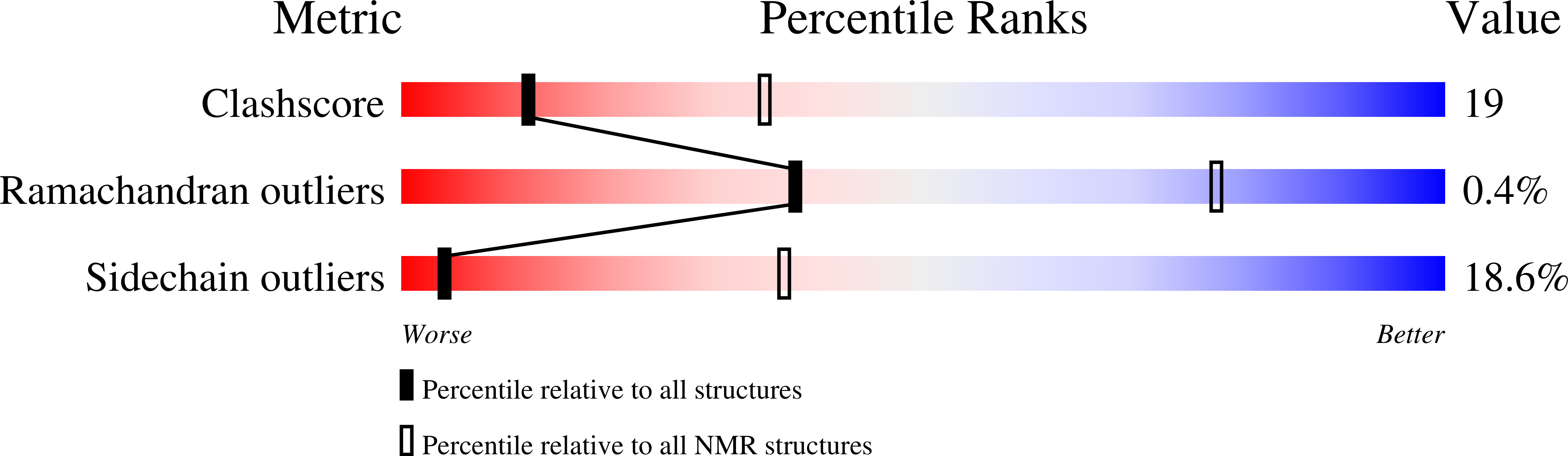
Macromolecular Entities
Structures with similar UniProt ID
Protein Blast
Polymer Type:polypeptide(L)
Molecule:Fibritin
Gene (Uniprot):wac
Mutagens:E5R, F22L
Chain IDs:A
Chain Length:29
Number of Molecules:1
Biological Source:Enterobacteria phage T4
Ligand Molecules
Primary Citation
NMR Structure of a Monomeric Intermediate on the Evolutionarily Optimized Assembly Pathway of a Small Trimerization Domain
J.Mol.Biol. 389 103 114 (2009)
PMID: 19361528 DOI: 10.1016/j.jmb.2009.03.073

Abstact

Efficient formation of specific intermolecular interactions is essential for self-assembly of biological structures. The foldon domain is an evolutionarily optimized trimerization module required for assembly of the large, trimeric structural protein fibritin from phage T4. Monomers consisting of the 27 amino acids comprising a single foldon domain subunit spontaneously form a natively folded trimer. During assembly of the foldon domain, a monomeric intermediate is formed on the submillisecond time scale, which provides the basis for two consecutive very fast association reactions. Mutation of an intermolecular salt bridge leads to a monomeric protein that resembles the kinetic intermediate in its spectroscopic properties. NMR spectroscopy revealed essentially native topology of the monomeric intermediate with defined hydrogen bonds and side-chain interactions but largely reduced stability compared to the native trimer. This structural preorganization leads to an asymmetric charge distribution on the surface that can direct rapid subunit recognition. The low stability of the intermediate allows a large free-energy gain upon trimerization, which serves as driving force for rapid assembly. These results indicate different free-energy landscapes for folding of small oligomeric proteins compared to monomeric proteins, which typically avoid the transient population of intermediates.

Legend

Protein

Chemical

Disease

Primary Citation of related structures
Feedback Form
Name
Email
Institute
Feedback