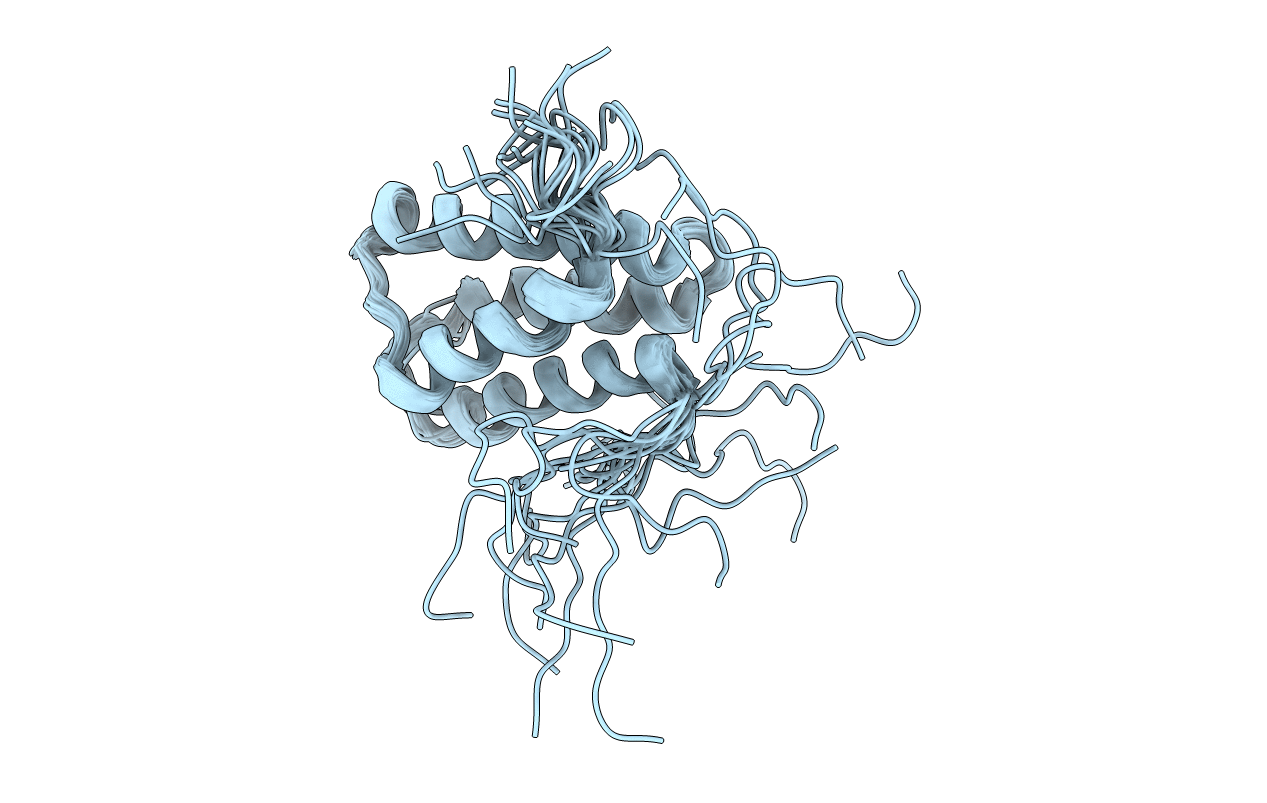
2K19 image
Deposition Date 2008-02-25
Release Date 2008-06-17
Last Version Date 2024-05-08
Entry Detail
PDB ID:
2K19
Title:
NMR solution structure of PisI
Biological Source:
Source Organism:
Host Organism:
Method Details:
Experimental Method:
Conformers Calculated:
100
Conformers Submitted:
20
Selection Criteria:
structures with the lowest energy

Macromolecular Entities
Structures with similar UniProt ID
Protein Blast
Polymer Type:polypeptide(L)
Molecule:Putative piscicolin 126 immunity protein
Gene (Uniprot):pisI
Chain IDs:A
Chain Length:98
Number of Molecules:1
Biological Source:Carnobacterium maltaromaticum
Ligand Molecules
Primary Citation
Nuclear magnetic resonance solution structure of PisI, a group B immunity protein that provides protection against the type IIa bacteriocin piscicolin 126, PisA.
Biochemistry 47 6427 6436 (2008)
PMID: 18500825 DOI: 10.1021/bi8004076

Abstact

Lactic acid bacteria produce and secrete bacteriocins. These bacteriocins are potent antimicrobial peptides that are active against other closely related bacteria. As a means of self-protection, producer organisms also express immunity proteins. Immunity proteins are generally located on the same genetic locus and are cotranscribed with the bacteriocin. Although some cross immunity between bacteriocins has been observed, immunity proteins are typically highly specific. Immunity proteins for the type IIa bacteriocins range from 81 to 115 amino acids in length and display substantial variation in their sequences. Nonetheless, such immunity proteins have been classified into three groupings (groups A, B, and C) according to sequence homology. The structures of a group C (ImB2) and two group A (EntA-im and PedB) immunity proteins have previously been reported. We herein report the nuclear magnetic resonance solution structure of the remaining class of the type IIa immunity proteins. PisI, a 98-amino acid protein, is a group B immunity protein conferring immunity against piscicolin 126 (PisA). Like ImB2, EntA-im, and PedB, PisI folds into a globular protein in aqueous solution and contains an antiparallel four-helix bundle. Compared to ImB2 and EntA-im, PisI has a substantially longer and more flexible N-terminus, but a shorter C-terminus. No direct interaction between the bacteriocin and immunity protein is observed by NMR in either aqueous or membrane mimicking environments. This further suggests that the mechanism that mediates immunity is not due to a direct bacteriocin-immunity protein interaction but rather is receptor-mediated. It has now been confirmed that the four-helix bundle is indeed a structural motif among the type IIa immunity proteins.

Legend

Protein

Chemical

Disease

Primary Citation of related structures
Feedback Form
Name
Email
Institute
Feedback