Planned Maintenance: Some services may turn out to be unavailable from 15th January, 2026 to 16th January, 2026. We apologize for the inconvenience!

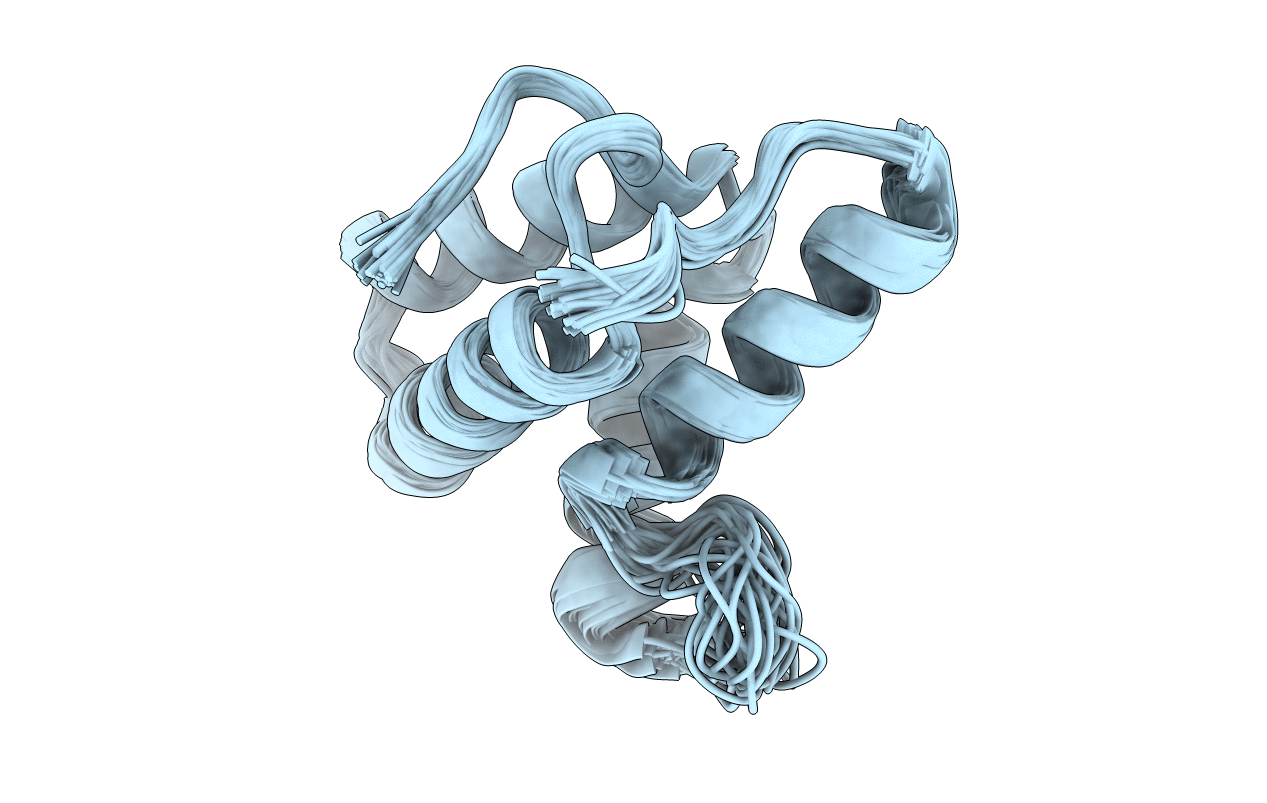
2K0D image
Deposition Date 2008-02-01
Release Date 2009-01-20
Last Version Date 2024-05-29
Entry Detail
PDB ID:
2K0D
Keywords:
Title:
NMR structure of a mutant colicin e7 immunity protein im7 with an extended helix III
Method Details:
Experimental Method:
Conformers Calculated:
100
Conformers Submitted:
30
Selection Criteria:
target function
Macromolecular Entities
Structures with similar UniProt ID
Protein Blast
Polymer Type:polypeptide(L)
Molecule:Colicin-E7 immunity protein
Gene (Uniprot):imm
Chain IDs:A (auth: X)
Chain Length:101
Number of Molecules:1
Biological Source:Escherichia coli
Ligand Molecules
Primary Citation
Amino acid insertion reveals a necessary three-helical intermediate in the folding pathway of the colicin E7 immunity protein Im7.
J.Mol.Biol. 392 1074 1086 (2009)
PMID: 19651139 DOI: 10.1016/j.jmb.2009.07.085

Abstact

The small (87-residue) alpha-helical protein Im7 (an inhibitor protein for colicin E7 that provides immunity to cells producing colicin E7) folds via a three-state mechanism involving an on-pathway intermediate. This kinetic intermediate contains three of four native helices that are oriented in a non-native manner so as to minimise exposed hydrophobic surface area at this point in folding. The short (6-residue) helix III has been shown to be unstructured in the intermediate ensemble and does not dock onto the developing hydrophobic core until after the rate-limiting transition state has been traversed. After helix III has docked, it adopts an alpha-helical secondary structure, and the side chains of residues within this region provide contacts that are crucial to native-state stability. In order to probe further the role of helix III in the folding mechanism of Im7, we created a variant that contains an eight-amino-acid polyalanine-like helix stabilised by a Glu-Arg salt bridge and an Asn-Pro-Gly capping motif, juxtaposed C-terminal to the natural 6-residue helix III. The effect of this insertion on the structure of the native protein and its folding mechanism were studied using NMR and varphi-value analysis, respectively. The results reveal a robust native structure that is not perturbed by the presence of the extended helix III. Mutational analysis performed to probe the folding mechanism of the redesigned protein revealed a conserved mechanism involving the canonical three-helical intermediate. The results suggest that folding via a three-helical species stabilised by both native and non-native interactions is an essential feature of Im7 folding, independent of the helical propensity of helix III.

Legend

Protein

Chemical

Disease

Primary Citation of related structures
Feedback Form
Name
Email
Institute
Feedback