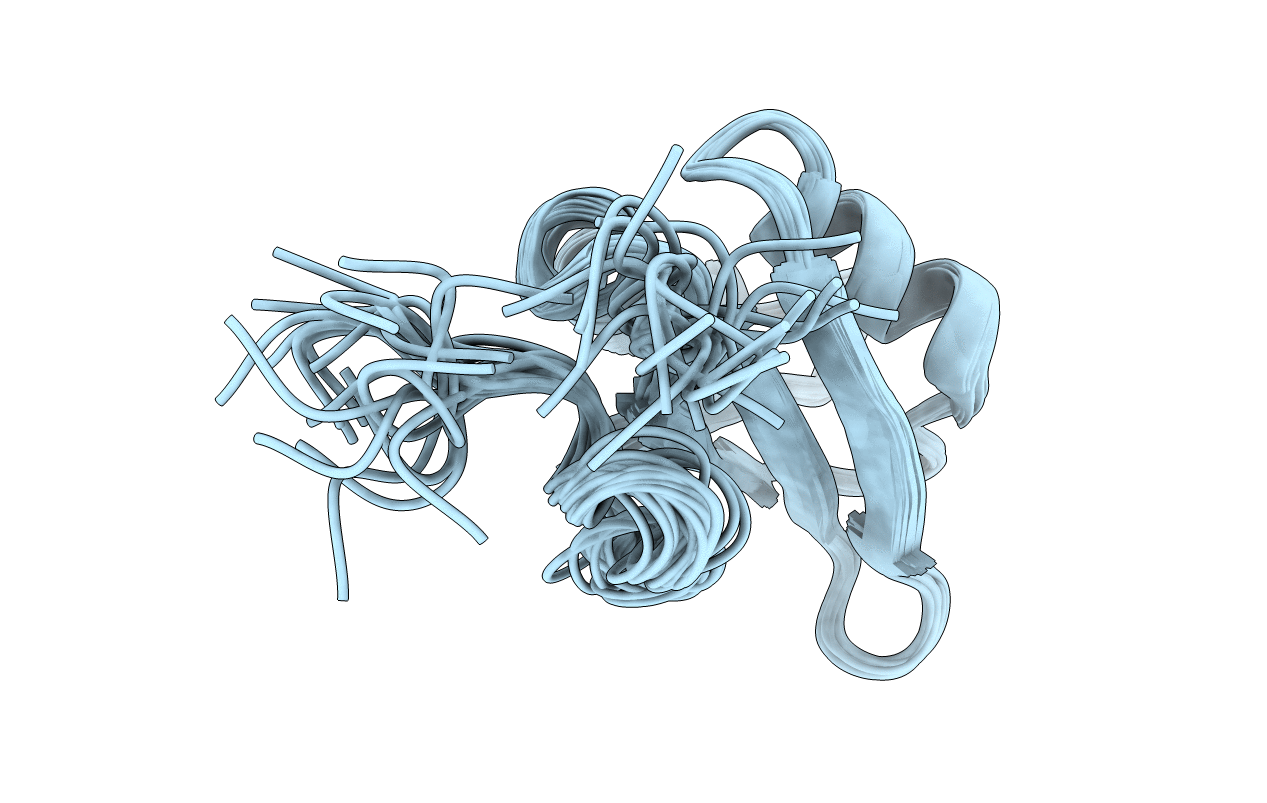
2JX2 image
Deposition Date 2007-11-02
Release Date 2008-04-08
Last Version Date 2024-05-08
Entry Detail
PDB ID:
2JX2
Keywords:
Title:
Solution conformation of RNA-bound NELF-E RRM
Biological Source:
Source Organism:
Homo sapiens (Taxon ID: 9606)
Host Organism:
Method Details:
Experimental Method:
Conformers Calculated:
160
Conformers Submitted:
20
Selection Criteria:
structures with the lowest energy
Macromolecular Entities
Structures with similar UniProt ID
Protein Blast
Polymer Type:polypeptide(L)
Molecule:Negative elongation factor E
Gene (Uniprot):NELFE
Chain IDs:A
Chain Length:121
Number of Molecules:1
Biological Source:Homo sapiens
Ligand Molecules
Primary Citation
NELF-E RRM Undergoes Major Structural Changes in Flexible Protein Regions on Target RNA Binding
Biochemistry 47 3756 3761 (2008)
PMID: 18303858 DOI: 10.1021/bi702429m

Abstact

The E subunit of the human heterotetrameric negative transcription elongation factor (NELF-E) contains a canonical betaalphabetabetaalphabeta RNA recognition motif (RRM) that binds to a wide variety of RNA sequences. These induce very similar conformational changes in the RRM as determined by nuclear magnetic resonance spectroscopy. Although the RNA binding interface of a canonical RRM is mainly located at its beta-sheet surface, for NELF-E RRM large chemical shift perturbations are observed for residues in the flexible C-terminal region and the loop between beta 3 and alpha 2, and both regions are distant from the interface. We determined the solution structure of single-stranded transactivator responsive element (TAR) RNA-bound NELF-E RRM. This structure clearly shows that RNA binding to NELF-E RRM induces formation of a helix in the C-terminus. The RNA-bound form of NELF-E RRM is very similar to the RNA-bound form of U1A RRM, although the C-terminus of the NELF-E RRM is unstructured in the free protein, whereas it is helical in the U1A protein. Thus, RNA binding to NELF-E RRM induces a conformational change toward the U1A structure, resulting in highly similar RNA binding conformations for both proteins.

Legend

Protein

Chemical

Disease

Primary Citation of related structures
Feedback Form
Name
Email
Institute
Feedback