2JK0 image
Deposition Date 2008-05-23
Release Date 2008-08-05
Last Version Date 2023-12-13
Entry Detail
PDB ID:
2JK0
Keywords:
Title:
Structural and functional insights into Erwinia carotovora L- asparaginase
Biological Source:
Source Organism:
Host Organism:
Method Details:
Experimental Method:
Resolution:
2.50 Å
R-Value Free:
0.26
R-Value Work:
0.18
R-Value Observed:
0.19
Space Group:
P 21 21 21
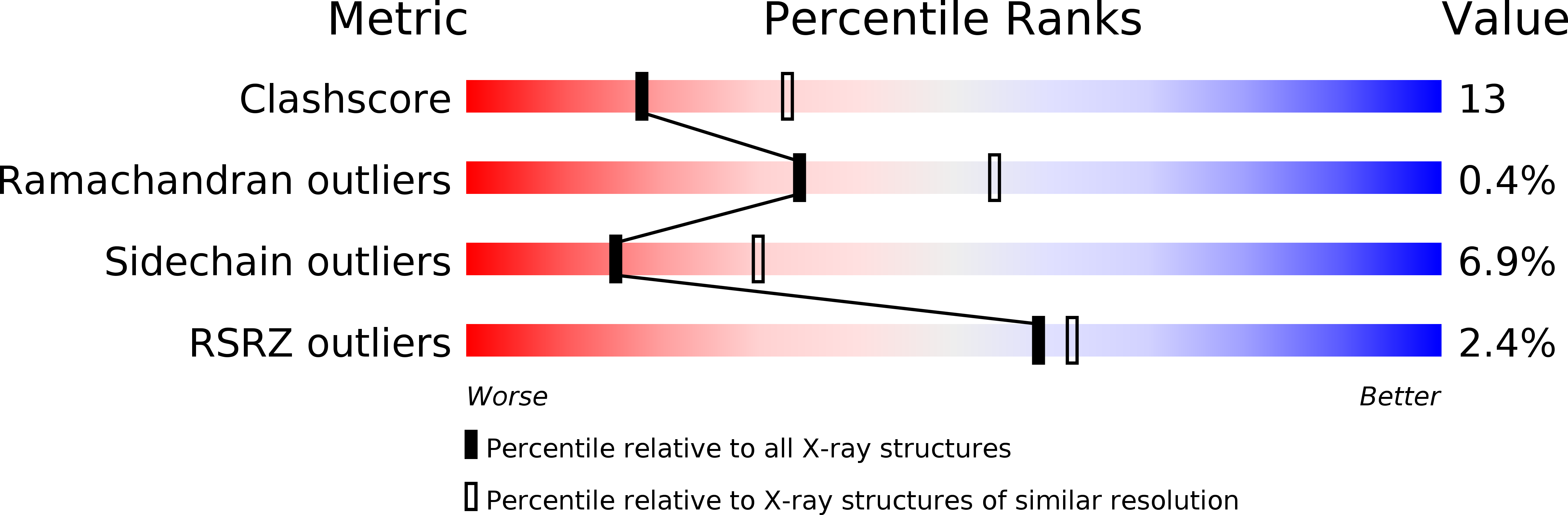
Macromolecular Entities
Structures with similar UniProt ID
Protein Blast
Polymer Type:polypeptide(L)
Molecule:L-ASPARAGINASE
Chain IDs:A, B, C, D, E, F, G, H
Chain Length:325
Number of Molecules:8
Biological Source:PECTOBACTERIUM CAROTOVORUM
Ligand Molecules
Primary Citation
Structural and Functional Insights Into Erwinia Carotovora L-Asparaginase.
FEBS J. 275 4306 ? (2008)
PMID: 18647344 DOI: 10.1111/J.1742-4658.2008.06574.X

Abstact

Bacterial L-asparaginases are enzymes that catalyze the hydrolysis of l-asparagine to aspartic acid. For the past 30 years, these enzymes have been used as therapeutic agents in the treatment of acute childhood lymphoblastic leukemia. Their intrinsic low-rate glutaminase activity, however, causes serious side-effects, including neurotoxicity, hepatitis, coagulopathy, and other dysfunctions. Erwinia carotovora asparaginase shows decreased glutaminase activity, so it is believed to have fewer side-effects in leukemia therapy. To gain detailed insights into the properties of E. carotovora asparaginase, combined crystallographic, thermal stability and cytotoxic experiments were performed. The crystal structure of E. carotovoral-asparaginase in the presence of L-Asp was determined at 2.5 A resolution and refined to an R cryst of 19.2 (R free = 26.6%) with good stereochemistry. Cytotoxicity measurements revealed that E. carotovora asparaginase is 30 times less toxic than the Escherichia coli enzyme against human leukemia cell lines. Moreover, denaturing experiments showed that E. carotovora asparaginase has decreased thermodynamic stability as compared to the E. coli enzyme and is rapidly inactivated in the presence of urea. On the basis of these results, we propose that E. carotovora asparaginase has limited potential as an antileukemic drug, despite its promising low glutaminase activity. Our analysis may be applicable to the therapeutic evaluation of other asparaginases as well.

Legend

Protein

Chemical

Disease

Primary Citation of related structures
Feedback Form
Name
Email
Institute
Feedback