2J62 image
Deposition Date 2006-09-22
Release Date 2007-02-13
Last Version Date 2024-05-08
Entry Detail
PDB ID:
2J62
Keywords:
Title:
Structure of a bacterial O-glcnacase in complex with glcnacstatin
Biological Source:
Source Organism:
Method Details:
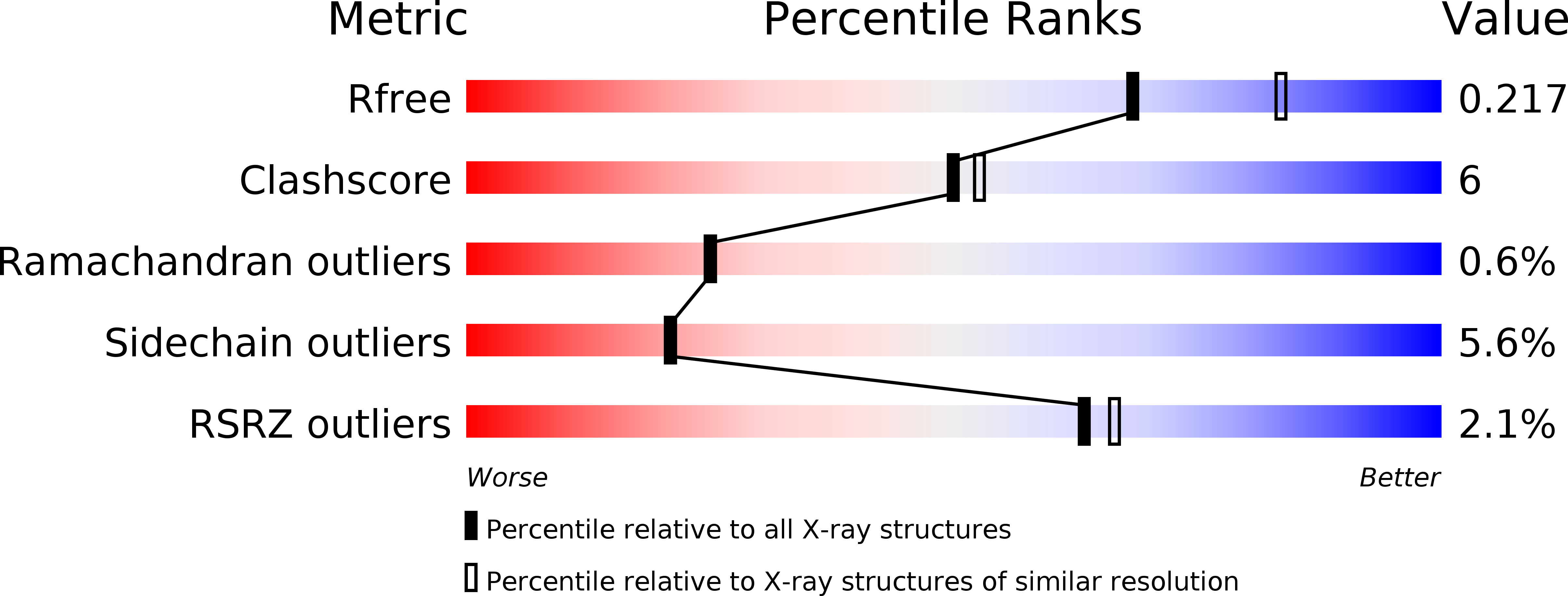
Experimental Method:
Resolution:
2.26 Å
R-Value Free:
0.21
R-Value Work:
0.17
R-Value Observed:
0.18
Space Group:
I 21 21 21
Macromolecular Entities
Structures with similar UniProt ID
Protein Blast
Polymer Type:polypeptide(L)
Molecule:O-GlcNAcase NagJ
Gene (Uniprot):nagJ
Chain IDs:A, B
Chain Length:594
Number of Molecules:2
Biological Source:Clostridium perfringens
Primary Citation
GlcNAcstatin: a picomolar, selective O-GlcNAcase inhibitor that modulates intracellular O-glcNAcylation levels.
J. Am. Chem. Soc. 128 16484 16485 (2006)
PMID: 17177381 DOI: 10.1021/ja066743n

Abstact

Many phosphorylation signal transduction pathways in the eukaryotic cell are modulated by posttranslational modification of specific serines/threonines with N-acetylglucosamine (O-GlcNAc). Levels of O-GlcNAc on key proteins regulate biological processes as diverse as the cell cycle, insulin signaling, and protein degradation. The two enzymes involved in this dynamic and abundant modification are the O-GlcNAc transferase and O-GlcNAcase. Structural data have recently revealed that the O-GlcNAcase possesses an active site with significant structural similarity to that of the human lysosomal hexosaminidases HexA/HexB. PUGNAc, an O-GlcNAcase inhibitor widely used to raise levels of O-GlcNAc in human cell lines, also inhibits these hexosaminidases. Here, we have exploited recent structural information of an O-GlcNAcase-PUGNAc complex to design and synthesize a glucoimidazole-based inhibitor, GlcNAcstatin, which is a 5 pM competitive inhibitor of enzymes of the O-GlcNAcase family, shows 100000-fold selectivity over HexA/B, and binds to the O-GlcNAcase active site by mimicking the transition state as revealed by X-ray crystallography. This compound is able to raise O-GlcNAc levels in human HEK 293 and SH-SY5Y neuroblastoma cell lines and thus provides a novel, potent tool for the study of the role of O-GlcNAc in intracellular signal transduction pathways.

Legend

Protein

Chemical

Disease

Primary Citation of related structures
Feedback Form
Name
Email
Institute
Feedback