2J4D image
Deposition Date 2006-08-28
Release Date 2007-06-19
Last Version Date 2023-12-13
Entry Detail
PDB ID:
2J4D
Title:
Cryptochrome 3 from Arabidopsis thaliana
Biological Source:
Source Organism:
Host Organism:
Method Details:
Experimental Method:
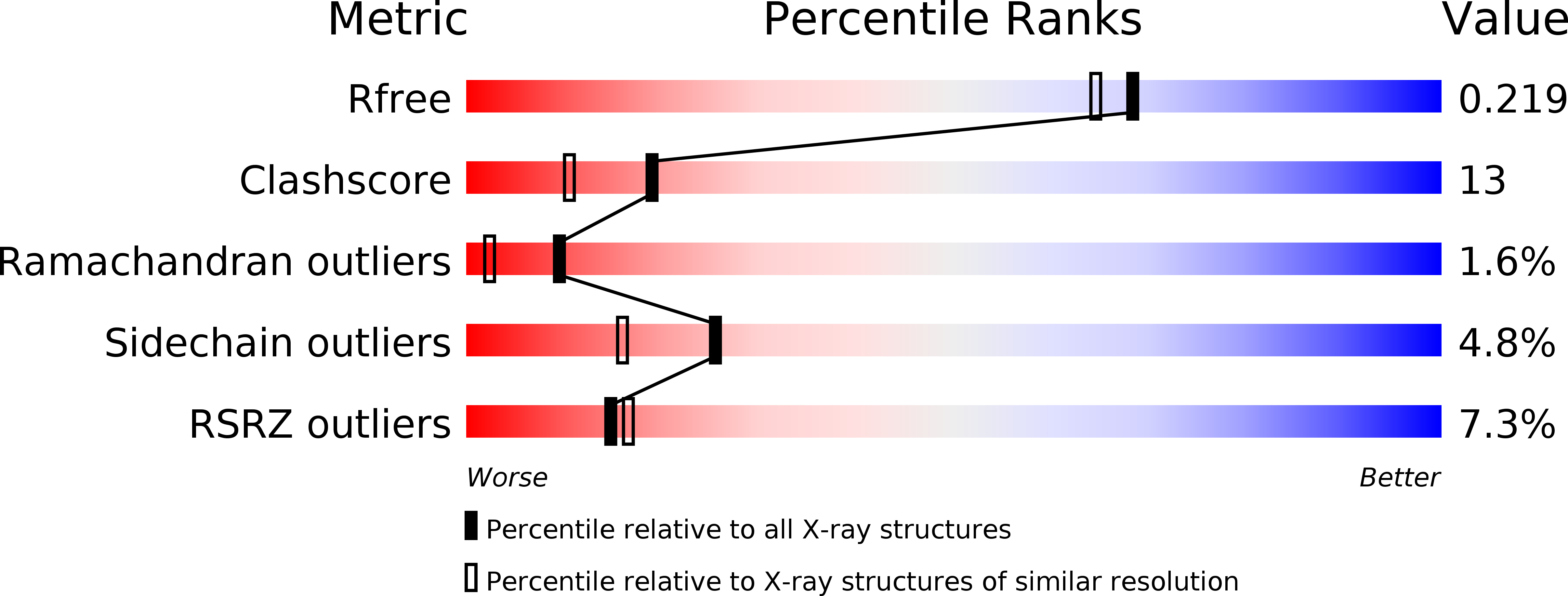
Resolution:
1.90 Å
R-Value Free:
0.22
R-Value Work:
0.18
R-Value Observed:
0.18
Space Group:
P 21 21 21
Macromolecular Entities
Structures with similar UniProt ID
Protein Blast
Polymer Type:polypeptide(L)
Molecule:CRYPTOCHROME DASH
Gene (Uniprot):CRYD
Chain IDs:A, B
Chain Length:525
Number of Molecules:2
Biological Source:ARABIDOPSIS THALIANA
Primary Citation
Cryptochrome 3 from Arabidopsis Thaliana: Structural and Functional Analysis of its Complex with a Folate Light Antenna
J.Mol.Biol. 366 954 ? (2007)
PMID: 17188299 DOI: 10.1016/J.JMB.2006.11.066

Abstact

Cryptochromes are almost ubiquitous blue-light receptors and act in several species as central components of the circadian clock. Despite being evolutionary and structurally related with DNA photolyases, a class of light-driven DNA-repair enzymes, and having similar cofactor compositions, cryptochromes lack DNA-repair activity. Cryptochrome 3 from the plant Arabidopsis thaliana belongs to the DASH-type subfamily. Its crystal structure determined at 1.9 Angstroms resolution shows cryptochrome 3 in a dimeric state with the antenna cofactor 5,10-methenyltetrahydrofolate (MTHF) bound in a distance of 15.2 Angstroms to the U-shaped FAD chromophore. Spectroscopic studies on a mutant where a residue crucial for MTHF-binding, E149, was replaced by site-directed mutagenesis demonstrate that MTHF acts in cryptochrome 3 as a functional antenna for the photoreduction of FAD.

Legend

Protein

Chemical

Disease

Primary Citation of related structures
Feedback Form
Name
Email
Institute
Feedback