2J0X image
Deposition Date 2006-08-07
Release Date 2006-08-10
Last Version Date 2024-05-01
Entry Detail
PDB ID:
2J0X
Keywords:
Title:
CRYSTAL STRUCTURE OF E. COLI ASPARTOKINASE III IN COMPLEX WITH LYSINE AND ASPARTATE (T-STATE)
Biological Source:
Source Organism:
ESCHERICHIA COLI (Taxon ID: 562)
Host Organism:
Method Details:
Experimental Method:
Resolution:
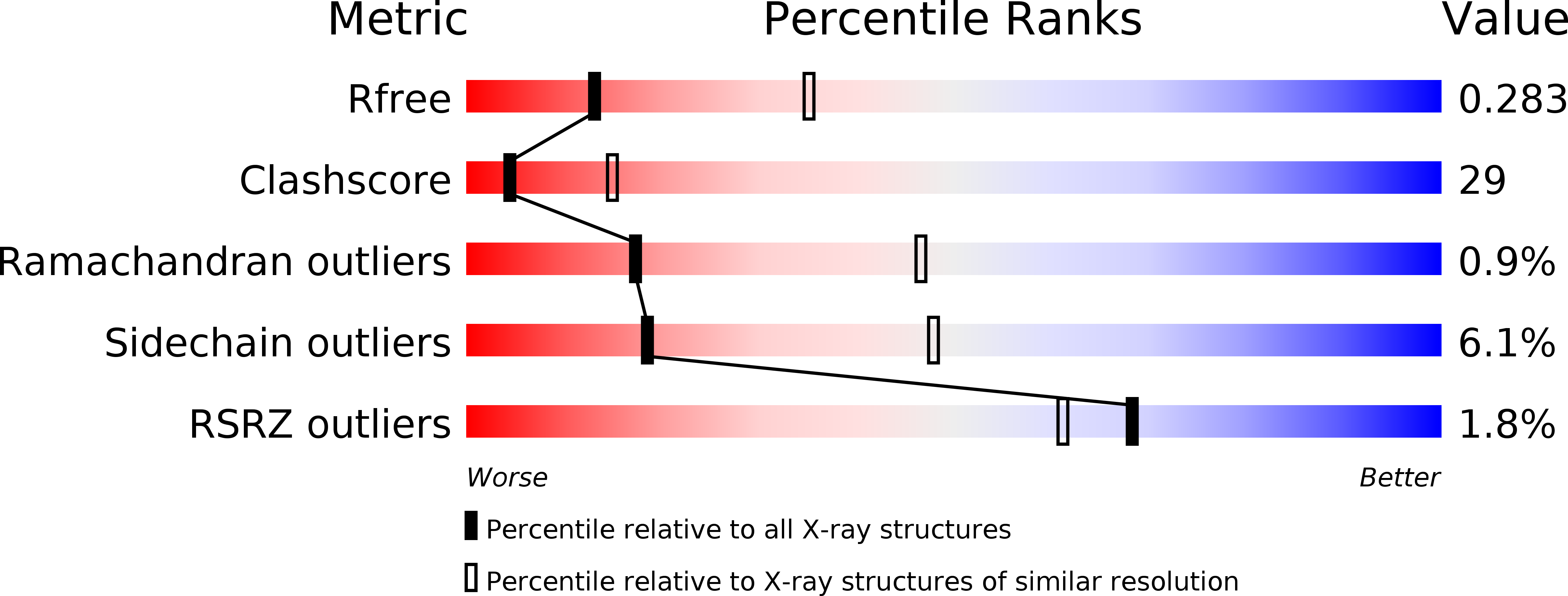
2.80 Å
R-Value Free:
0.28
R-Value Work:
0.21
R-Value Observed:
0.21
Space Group:
P 21 21 2
Macromolecular Entities
Structures with similar UniProt ID
Protein Blast
Polymer Type:polypeptide(L)
Molecule:LYSINE-SENSITIVE ASPARTOKINASE 3
Gene (Uniprot):lysC
Chain IDs:A, B
Chain Length:449
Number of Molecules:2
Biological Source:ESCHERICHIA COLI
Primary Citation
Structures of R- and T-State Escherichia Coli Aspartokinase III: Mechanisms of the Allosteric Transition and Inhibition by Lysine.
J.Biol.Chem. 281 31544 ? (2006)
PMID: 16905770 DOI: 10.1074/JBC.M605886200

Abstact

Aspartokinase III (AKIII) from Escherichia coli catalyzes an initial commitment step of the aspartate pathway, giving biosynthesis of certain amino acids including lysine. We report crystal structures of AKIII in the inactive T-state with bound feedback allosteric inhibitor lysine and in the R-state with aspartate and ADP. The structures reveal an unusual configuration for the regulatory ACT domains, in which ACT2 is inserted into ACT1 rather than the expected tandem repeat. Comparison of R- and T-state AKIII indicates that binding of lysine to the regulatory ACT1 domain in R-state AKIII instigates a series of changes that release a "latch", the beta15-alphaK loop, from the catalytic domain, which in turn undergoes large rotational rearrangements, promoting tetramer formation and completion of the transition to the T-state. Lysine-induced allosteric transition in AKIII involves both destabilizing the R-state and stabilizing the T-state tetramer. Rearrangement of the catalytic domain blocks the ATP-binding site, which is therefore the structural basis for allosteric inhibition of AKIII by lysine.

Legend

Protein

Chemical

Disease

Primary Citation of related structures
Feedback Form
Name
Email
Institute
Feedback