2IWI image
Deposition Date 2006-06-30
Release Date 2006-08-02
Last Version Date 2023-12-13
Entry Detail
PDB ID:
2IWI
Keywords:
Title:
CRYSTAL STRUCTURE OF THE HUMAN PIM2 IN COMPLEX WITH A RUTHENIUM ORGANOMETALLIC LIGAND RU1
Biological Source:
Source Organism:
HOMO SAPIENS (Taxon ID: 9606)
Method Details:
Experimental Method:
Resolution:
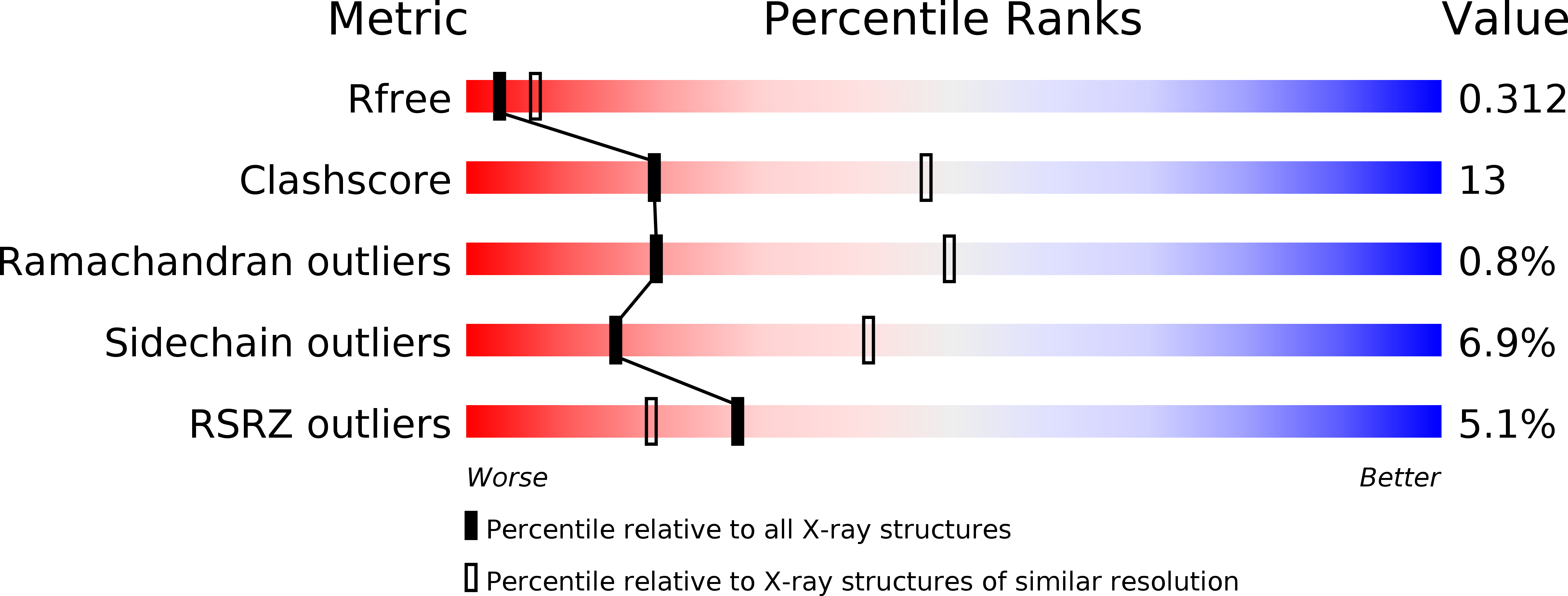
2.80 Å
R-Value Free:
0.28
R-Value Work:
0.24
R-Value Observed:
0.24
Space Group:
H 3
Macromolecular Entities
Structures with similar UniProt ID
Protein Blast
Polymer Type:polypeptide(L)
Molecule:SERINE/THREONINE-PROTEIN KINASE PIM-2
Gene (Uniprot):PIM2
Chain IDs:A, B
Chain Length:312
Number of Molecules:2
Biological Source:HOMO SAPIENS
Ligand Molecules
Primary Citation
Crystal structure of the PIM2 kinase in complex with an organoruthenium inhibitor.
PLoS ONE 4 e7112 e7112 (2009)
PMID: 19841674 DOI: 10.1371/journal.pone.0007112

Abstact

BACKGROUND The serine/threonine kinase PIM2 is highly expressed in human leukemia and lymphomas and has been shown to positively regulate survival and proliferation of tumor cells. Its diverse ATP site makes PIM2 a promising target for the development of anticancer agents. To date our knowledge of catalytic domain structures of the PIM kinase family is limited to PIM1 which has been extensively studied and which shares about 50% sequence identity with PIM2. PRINCIPAL FINDINGS Here we determined the crystal structure of PIM2 in complex with an organoruthenium complex (inhibition in sub-nanomolar level). Due to its extraordinary shape complementarity this stable organometallic compound is a highly potent inhibitor of PIM kinases. SIGNIFICANCE The structure of PIM2 revealed several differences to PIM1 which may be explored further to generate isoform selective inhibitors. It has also demonstrated how an organometallic inhibitor can be adapted to the binding site of protein kinases to generate highly potent inhibitors. ENHANCED VERSION This article can also be viewed as an enhanced version in which the text of the article is integrated with interactive 3D representations and animated transitions. Please note that a web plugin is required to access this enhanced functionality. Instructions for the installation and use of the web plugin are available in Text S1.

Legend

Protein

Chemical

Disease

Primary Citation of related structures
Feedback Form
Name
Email
Institute
Feedback