2IUW image
Deposition Date 2006-06-07
Release Date 2006-07-26
Last Version Date 2025-04-09
Entry Detail
PDB ID:
2IUW
Keywords:
Title:
Crystal structure of human ABH3 in complex with iron ion and 2- oxoglutarate
Biological Source:
Source Organism:
HOMO SAPIENS (Taxon ID: 9606)
Host Organism:
Method Details:
Experimental Method:
Resolution:
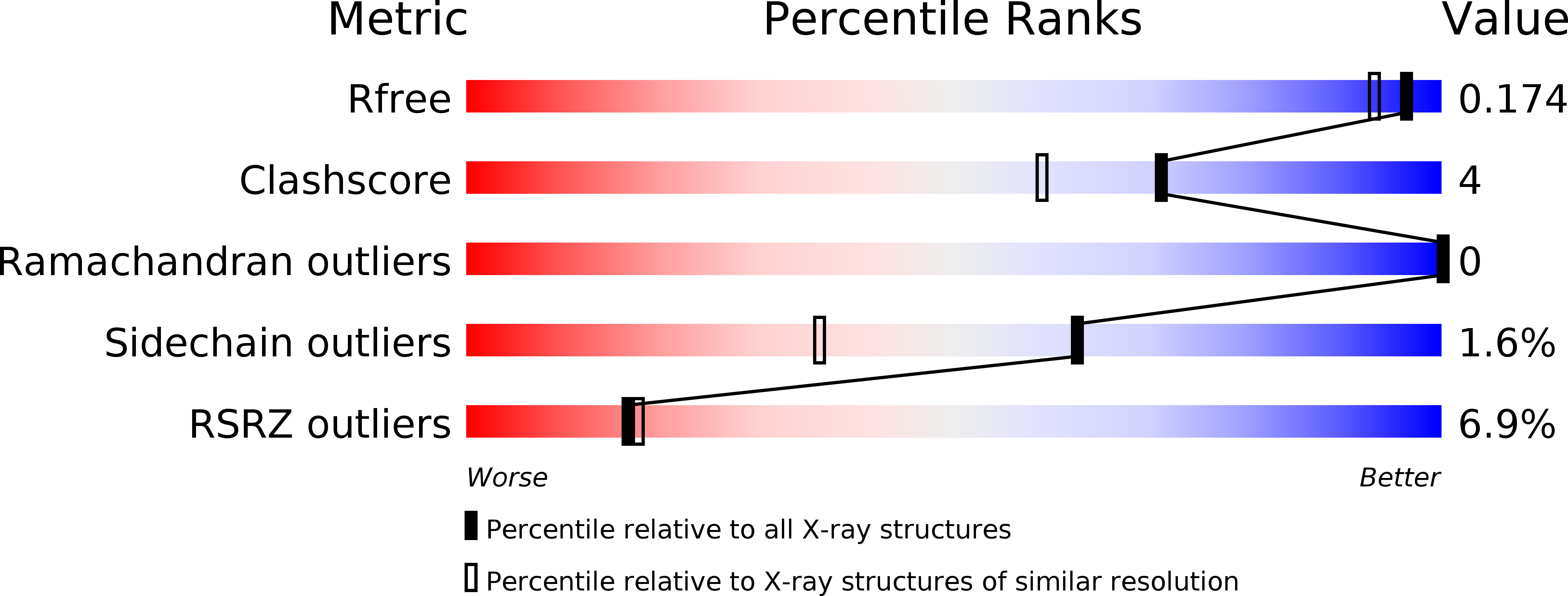
1.50 Å
R-Value Free:
0.19
R-Value Observed:
0.14
Space Group:
I 41
Macromolecular Entities
Structures with similar UniProt ID
Protein Blast
Polymer Type:polypeptide(L)
Molecule:ALKYLATED REPAIR PROTEIN ALKB HOMOLOG 3
Gene (Uniprot):ALKBH3
Chain IDs:A
Chain Length:238
Number of Molecules:1
Biological Source:HOMO SAPIENS
Modified Residue
Compound ID Chain ID Parent Comp ID Details 2D Image
LED A LEU (4R)-5-OXO-L-LEUCINE
Primary Citation
Human Abh3 Structure and Key Residues for Oxidative Demethylation to Reverse DNA/RNA Damage.
Embo J. 25 3389 ? (2006)
PMID: 16858410 DOI: 10.1038/SJ.EMBOJ.7601219

Abstact

Methylating agents are ubiquitous in the environment, and central in cancer therapy. The 1-methyladenine and 3-methylcytosine lesions in DNA/RNA contribute to the cytotoxicity of such agents. These lesions are directly reversed by ABH3 (hABH3) in humans and AlkB in Escherichia coli. Here, we report the structure of the hABH3 catalytic core in complex with iron and 2-oxoglutarate (2OG) at 1.5 A resolution and analyse key site-directed mutants. The hABH3 structure reveals the beta-strand jelly-roll fold that coordinates a catalytically active iron centre by a conserved His1-X-Asp/Glu-X(n)-His2 motif. This experimentally establishes hABH3 as a structural member of the Fe(II)/2OG-dependent dioxygenase superfamily, which couples substrate oxidation to conversion of 2OG into succinate and CO2. A positively charged DNA/RNA binding groove indicates a distinct nucleic acid binding conformation different from that predicted in the AlkB structure with three nucleotides. These results uncover previously unassigned key catalytic residues, identify a flexible hairpin involved in nucleotide flipping and ss/ds-DNA discrimination, and reveal self-hydroxylation of an active site leucine that may protect against uncoupled generation of dangerous oxygen radicals.

Legend

Protein

Chemical

Disease

Primary Citation of related structures
Feedback Form
Name
Email
Institute
Feedback