2IUC image
Deposition Date 2006-06-01
Release Date 2006-11-28
Last Version Date 2023-12-13
Entry Detail
PDB ID:
2IUC
Keywords:
Title:
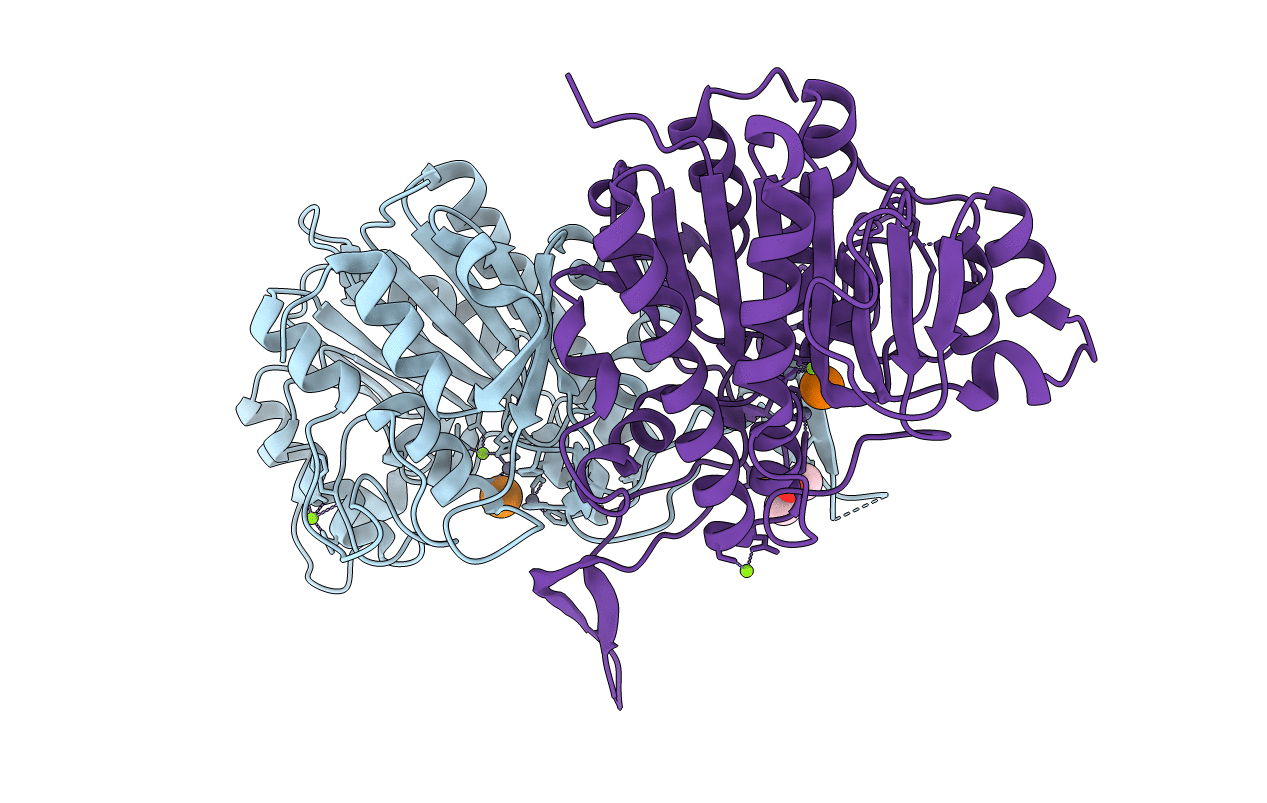
Structure of alkaline phosphatase from the Antarctic bacterium TAB5
Biological Source:
Source Organism:
Host Organism:
Method Details:
Experimental Method:
Resolution:
1.95 Å
R-Value Free:
0.22
R-Value Work:
0.16
R-Value Observed:
0.16
Space Group:
P 21 21 2

Macromolecular Entities
Structures with similar UniProt ID
Protein Blast
Polymer Type:polypeptide(L)
Molecule:ALKALINE PHOSPHATASE
Gene (Uniprot):phoA
Chain IDs:A
Chain Length:375
Number of Molecules:1
Biological Source:ANTARCTIC BACTERIUM TAB5
Structures with similar UniProt ID
Protein Blast
Polymer Type:polypeptide(L)
Molecule:ALKALINE PHOSPHATASE
Gene (Uniprot):phoA
Chain IDs:B
Chain Length:375
Number of Molecules:1
Biological Source:ANTARCTIC BACTERIUM TAB5
Primary Citation
Crystal Structure of Alkaline Phosphatase from the Antarctic Bacterium Tab5.
J.Mol.Biol. 366 1318 ? (2007)
PMID: 17198711 DOI: 10.1016/J.JMB.2006.11.079

Abstact

Alkaline phosphatases (APs) are non-specific phosphohydrolases that are widely used in molecular biology and diagnostics. We describe the structure of the cold active alkaline phosphatase from the Antarctic bacterium TAB5 (TAP). The fold and the active site geometry are conserved with the other AP structures, where the monomer has a large central beta-sheet enclosed by alpha-helices. The dimer interface of TAP is relatively small, and only a single loop from each monomer replaces the typical crown domain. The structure also has typical cold-adapted features; lack of disulfide bridges, low number of salt-bridges, and a loose dimer interface that completely lacks charged interactions. The dimer interface is more hydrophobic than that of the Escherichia coli AP and the interactions have tendency to pair with backbone atoms, which we propose to result from the cold adaptation of TAP. The structure contains two additional magnesium ions outside of the active site, which we believe to be involved in substrate binding as well as contributing to the local stability. The M4 site stabilises an interaction that anchors the substrate-coordinating R148. The M5 metal-binding site is in a region that stabilises metal coordination in the active site. In other APs the M5 binding area is supported by extensive salt-bridge stabilisation, as well as positively charged patches around the active site. We propose that these charges, and the TAP M5 binding, influence the release of the product phosphate and thus might influence the rate-determining step of the enzyme.

Legend

Protein

Chemical

Disease

Primary Citation of related structures
Feedback Form
Name
Email
Institute
Feedback