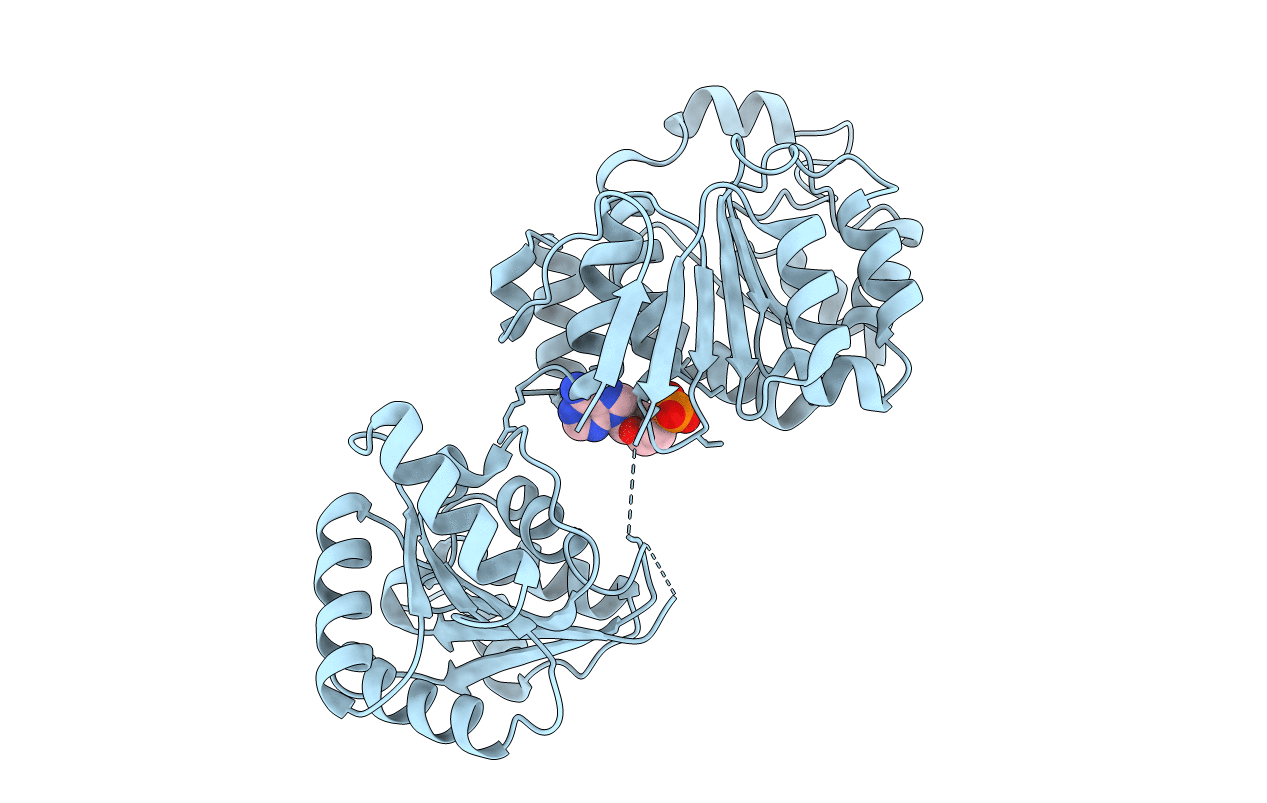
2I4I image
Deposition Date 2006-08-22
Release Date 2006-09-05
Last Version Date 2023-08-30
Entry Detail
PDB ID:
2I4I
Keywords:
Title:
Crystal Structure of human DEAD-box RNA helicase DDX3X
Biological Source:
Source Organism:
Homo sapiens (Taxon ID: 9606)
Method Details:
Experimental Method:
Resolution:
2.20 Å
R-Value Free:
0.21
R-Value Work:
0.18
R-Value Observed:
0.18
Space Group:
P 31 2 1

Macromolecular Entities
Structures with similar UniProt ID
Protein Blast
Polymer Type:polypeptide(L)
Molecule:ATP-dependent RNA helicase DDX3X
Gene (Uniprot):DDX3X
Chain IDs:A
Chain Length:417
Number of Molecules:1
Biological Source:Homo sapiens
Ligand Molecules
Primary Citation
Crystal Structure of Conserved Domains 1 and 2 of the Human DEAD-box Helicase DDX3X in Complex with the Mononucleotide AMP
J.Mol.Biol. 372 150 159 (2007)
PMID: 17631897 DOI: 10.1016/j.jmb.2007.06.050

Abstact

DExD-box helicases are involved in all aspects of cellular RNA metabolism. Conserved domains 1 and 2 contain nine signature motifs that are responsible for nucleotide binding, RNA binding and ATP hydrolysis. The human DEAD-box helicase DDX3X has been associated with several different cellular processes, such as cell-growth control, mRNA transport and translation, and is suggested to be essential for the export of unspliced/partially spliced HIV mRNAs from the nucleus to the cytoplasm. Here, the crystal structure of conserved domains 1 and 2 of DDX3X, including a DDX3-specific insertion that is not generally found in human DExD-box helicases, is presented. The N-terminal domain 1 and the C-terminal domain 2 both display RecA-like folds comprising a central beta-sheet flanked by alpha-helices. Interestingly, the DDX3X-specific insertion forms a helical element that extends a highly positively charged sequence in a loop, thus increasing the RNA-binding surface of the protein. Surprisingly, although DDX3X was crystallized in the presence of a large excess of ADP or the slowly hydrolyzable ATP analogue ATPgammaS the contaminant AMP was seen in the structure. A fluorescent-based stability assay showed that the thermal stability of DDX3X was increased by the mononucleotide AMP but not by ADP or ATPgammaS, suggesting that DDX3X is stabilized by AMP and elucidating why AMP was found in the nucleotide-binding pocket.

Legend

Protein

Chemical

Disease

Primary Citation of related structures
Feedback Form
Name
Email
Institute
Feedback