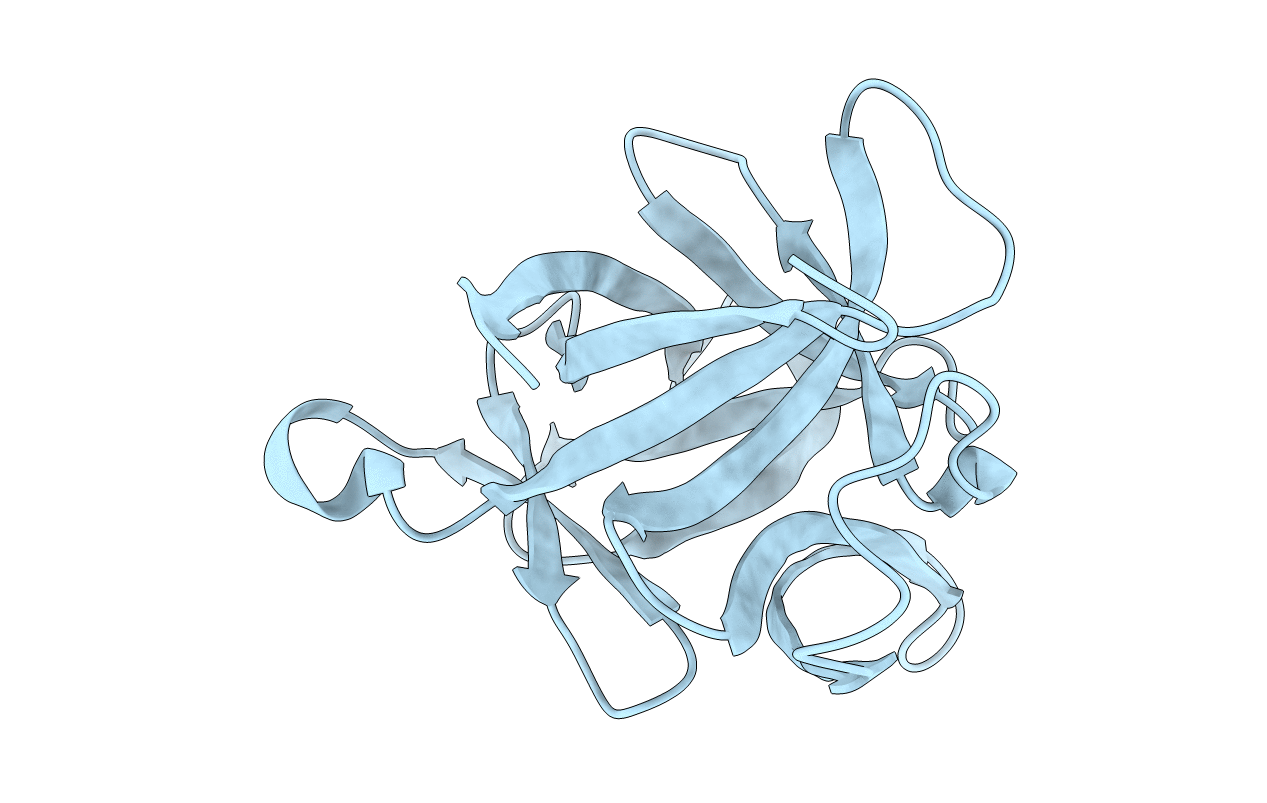
2I1B image
Deposition Date 1990-01-02
Release Date 1990-04-15
Last Version Date 2024-02-21
Entry Detail
PDB ID:
2I1B
Keywords:
Title:
CRYSTALLOGRAPHIC REFINEMENT OF INTERLEUKIN-1 BETA AT 2.0 ANGSTROMS RESOLUTION
Biological Source:
Source Organism:
Homo sapiens (Taxon ID: 9606)
Host Organism:
Method Details:

Experimental Method:
Resolution:
2.00 Å
R-Value Observed:
0.17
Space Group:
P 43
Macromolecular Entities
Structures with similar UniProt ID
Protein Blast
Polymer Type:polypeptide(L)
Molecule:INTERLEUKIN-1 BETA
Gene (Uniprot):IL1B
Chain IDs:A
Chain Length:153
Number of Molecules:1
Biological Source:Homo sapiens
Primary Citation
Crystallographic refinement of interleukin 1 beta at 2.0 A resolution.
Proc.Natl.Acad.Sci.USA 86 9667 9671 (1989)
PMID: 2602367 DOI: 10.1073/pnas.86.24.9667

Abstact

The structure of human recombinant interleukin 1 beta (IL-1 beta) has been refined by a restrained least-squares method to a crystallographic R factor of 17.2% to 2.0 A resolution. One-hundred sixty-eight solvent molecules have been located, and isotropic temperature factors for each atom have been refined. The overall structure is composed of 12 beta-strands that can best be described as forming the four triangular faces of a tetrahedron with hydrogen bonding resembling normal antiparallel beta-sheets only at the vertices. The interior of this tetrahedron is filled by hydrophobic side chains. Analysis of sequence alignments with IL-1 beta from other mammalian species shows the interior to be very well conserved with the exterior residues markedly less so. There does not appear to be a clustering of invariant amino acid side chains on the surface of the molecule, suggesting an area of interaction with the IL-1 receptor. Comparison of the IL-1 beta structure with IL-1 alpha sequences indicates that IL-1 alpha probably has a similar overall folding as IL-1 beta but binds to the receptor in a different fashion. The three-dimensional structure of the IL-1 beta is analyzed in light of what has been suggested by previously published work on mutants and fragments of the molecule.

Legend

Protein

Chemical

Disease

Primary Citation of related structures
Feedback Form
Name
Email
Institute
Feedback