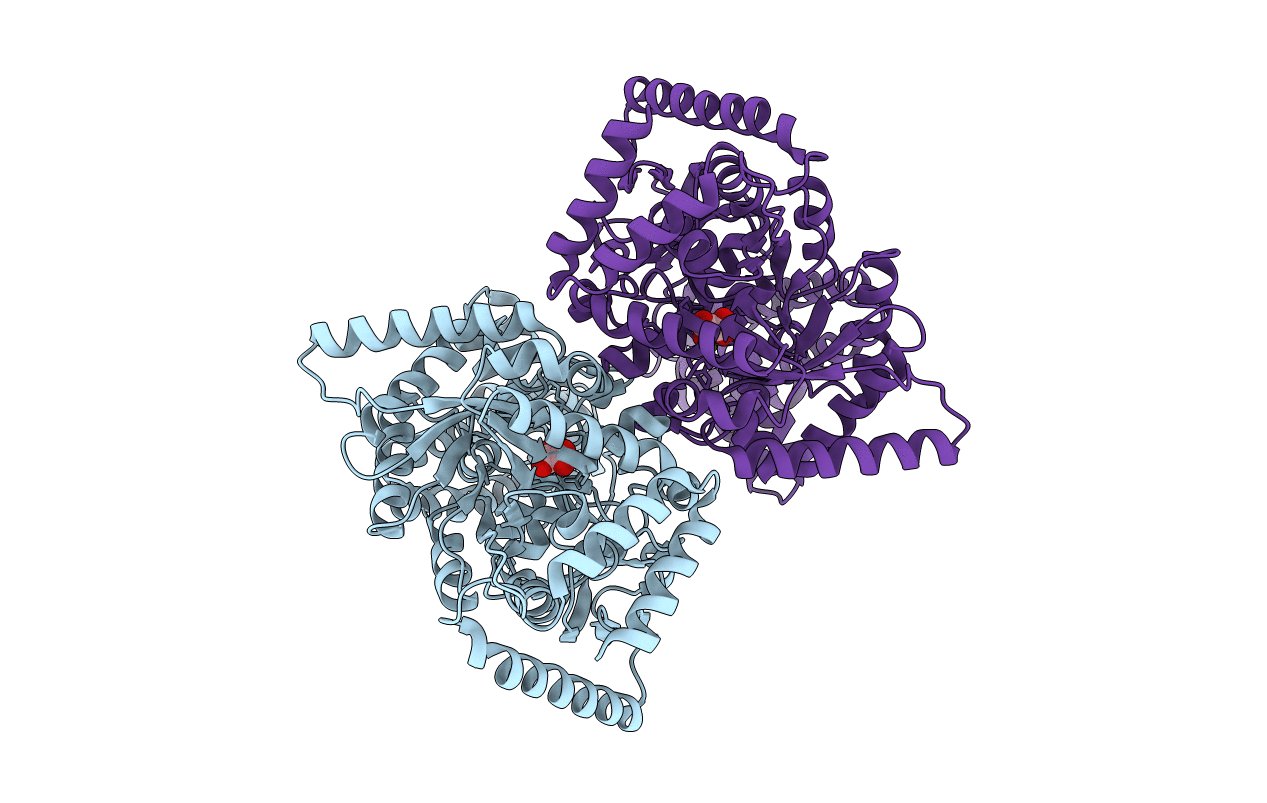
2HWG image
Deposition Date 2006-08-01
Release Date 2006-11-14
Last Version Date 2023-11-15
Entry Detail
PDB ID:
2HWG
Keywords:
Title:
Structure of phosphorylated Enzyme I of the phosphoenolpyruvate:sugar phosphotransferase system
Biological Source:
Source Organism:
Escherichia coli (Taxon ID: 562)
Host Organism:
Method Details:
Experimental Method:
Resolution:
2.70 Å
R-Value Free:
0.28
R-Value Work:
0.20
R-Value Observed:
0.20
Space Group:
P 21 21 21

Macromolecular Entities
Structures with similar UniProt ID
Protein Blast
Polymer Type:polypeptide(L)
Molecule:Phosphoenolpyruvate-protein phosphotransferase
Gene (Uniprot):ptsI
Chain IDs:A, B
Chain Length:575
Number of Molecules:2
Biological Source:Escherichia coli
Modified Residue
Compound ID Chain ID Parent Comp ID Details 2D Image
MSE A MET SELENOMETHIONINE
NEP A HIS N1-PHOSPHONOHISTIDINE
Primary Citation
Structure of phosphorylated enzyme I, the phosphoenolpyruvate:sugar phosphotransferase system sugar translocation signal protein.
Proc.Natl.Acad.Sci.Usa 103 16218 16223 (2006)
PMID: 17053069 DOI: 10.1073/pnas.0607587103

Abstact

Bacterial transport of many sugars, coupled to their phosphorylation, is carried out by the phosphoenolpyruvate (PEP):sugar phosphotransferase system and involves five phosphoryl group transfer reactions. Sugar translocation initiates with the Mg(2+)-dependent phosphorylation of enzyme I (EI) by PEP. Crystals of Escherichia coli EI were obtained by mixing the protein with Mg(2+) and PEP, followed by oxalate, an EI inhibitor. The crystal structure reveals a dimeric protein where each subunit comprises three domains: a domain that binds the partner PEP:sugar phosphotransferase system protein, HPr; a domain that carries the phosphorylated histidine residue, His-189; and a PEP-binding domain. The PEP-binding site is occupied by Mg(2+) and oxalate, and the phosphorylated His-189 is in-line for phosphotransfer to/from the ligand. Thus, the structure represents an enzyme intermediate just after phosphotransfer from PEP and before a conformational transition that brings His-189 approximately P in proximity to the phosphoryl group acceptor, His-15 of HPr. A model of this conformational transition is proposed whereby swiveling around an alpha-helical linker disengages the His domain from the PEP-binding domain. Assuming that HPr binds to the HPr-binding domain as observed by NMR spectroscopy of an EI fragment, a rotation around two linker segments orients the His domain relative to the HPr-binding domain so that His-189 approximately P and His-15 are appropriately stationed for an in-line phosphotransfer reaction.

Legend

Protein

Chemical

Disease

Primary Citation of related structures
Feedback Form
Name
Email
Institute
Feedback