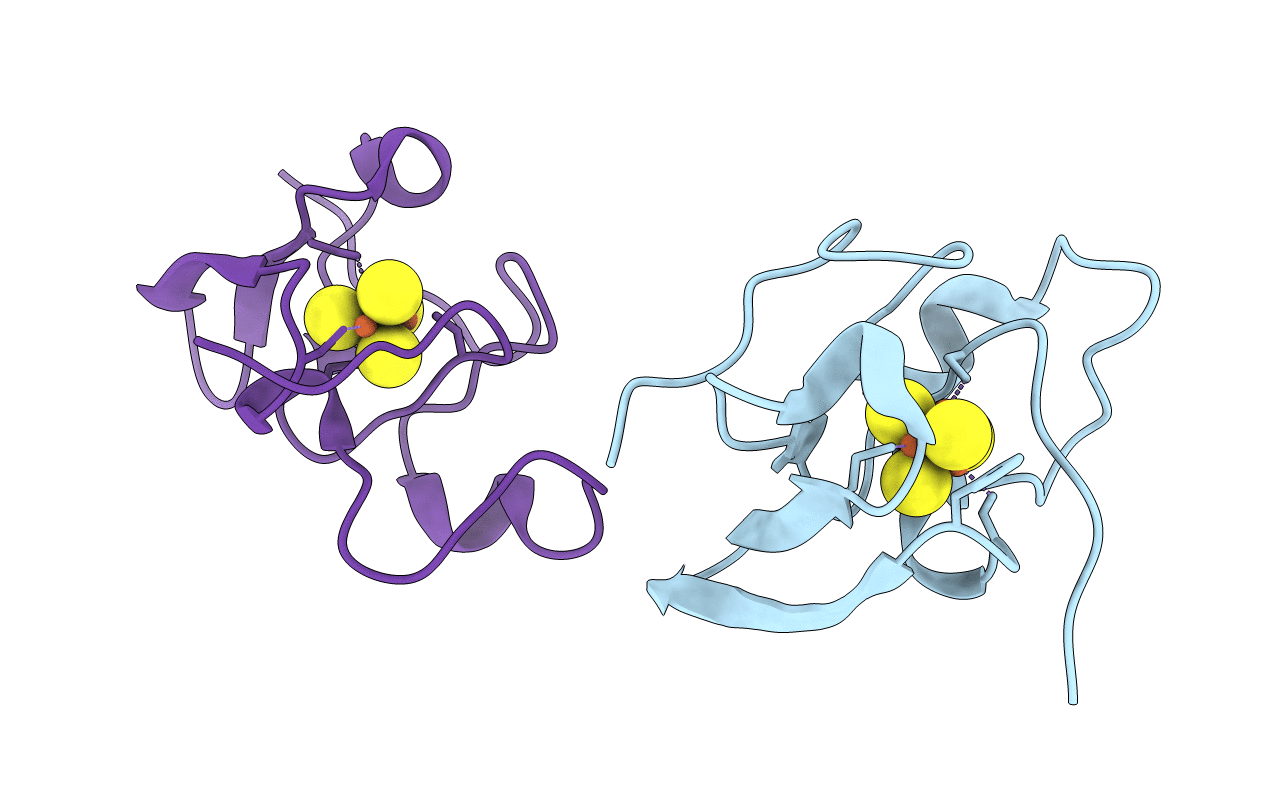
2HIP image
Deposition Date 1991-06-24
Release Date 1992-07-15
Last Version Date 2024-02-14
Entry Detail
PDB ID:
2HIP
Title:
THE MOLECULAR STRUCTURE OF THE HIGH POTENTIAL IRON-SULFUR PROTEIN ISOLATED FROM ECTOTHIORHODOSPIRA HALOPHILA DETERMINED AT 2.5-ANGSTROMS RESOLUTION
Biological Source:
Source Organism:
Method Details:
Experimental Method:
Resolution:
2.50 Å
R-Value Observed:
0.18
Space Group:
P 1 21 1

Macromolecular Entities
Structures with similar UniProt ID
Protein Blast
Polymer Type:polypeptide(L)
Molecule:HIGH POTENTIAL IRON SULFUR PROTEIN
Gene (Uniprot):hip1
Chain IDs:A, B
Chain Length:72
Number of Molecules:2
Biological Source:Halorhodospira halophila
Ligand Molecules
Primary Citation
The molecular structure of the high potential iron-sulfur protein isolated from Ectothiorhodospira halophila determined at 2.5-A resolution.
J.Biol.Chem. 266 18660 18667 (1991)
PMID: 1917989

Abstact

The molecular structure of a high potential iron-sulfur protein (HiPIP) isolated from the purple photosynthetic bacterium, Ectothiorhodospira halophila strain BN9626, has been solved by x-ray diffraction analysis to a nominal resolution of 2.5 A and refined to a crystallographic R value of 18.4% including all measured x-ray data from 30.0- to 2.5-A resolution. Crystals used in the investigation contained two molecules/asymmetric unit and belonged to the space group P21 with unit cell dimensions of a = 60.00 A, b = 31.94 A, c = 40.27 A, and beta = 100.5 degrees. An interpretable electron density map, obtained by combining x-ray data from one isomorphous heavy atom derivative with non-crystallographic symmetry averaging and solvent flattening, clearly showed that this high potential iron-sulfur protein contains 71 amino acid residues, rather than 70 as originally reported. As in other bacterial ferredoxins, the [4Fe-4S] cluster adopts a cubane-like conformation and is ligated to the protein via four cysteinyl sulfur ligands. The overall secondary structure of the E. halophila HiPIP is characterized by a series of Type I and Type II turns allowing the polypeptide chain to wrap around the [4Fe-4S] prosthetic group. The hydrogen bonding pattern around the cluster is nearly identical to that originally observed in the 85-amino acid residue Chromatium vinosum HiPIP and consequently, the 240 mV difference in redox potentials between these two proteins cannot be simply attributed to hydrogen bonding patterns alone.

Legend

Protein

Chemical

Disease

Primary Citation of related structures
Feedback Form
Name
Email
Institute
Feedback