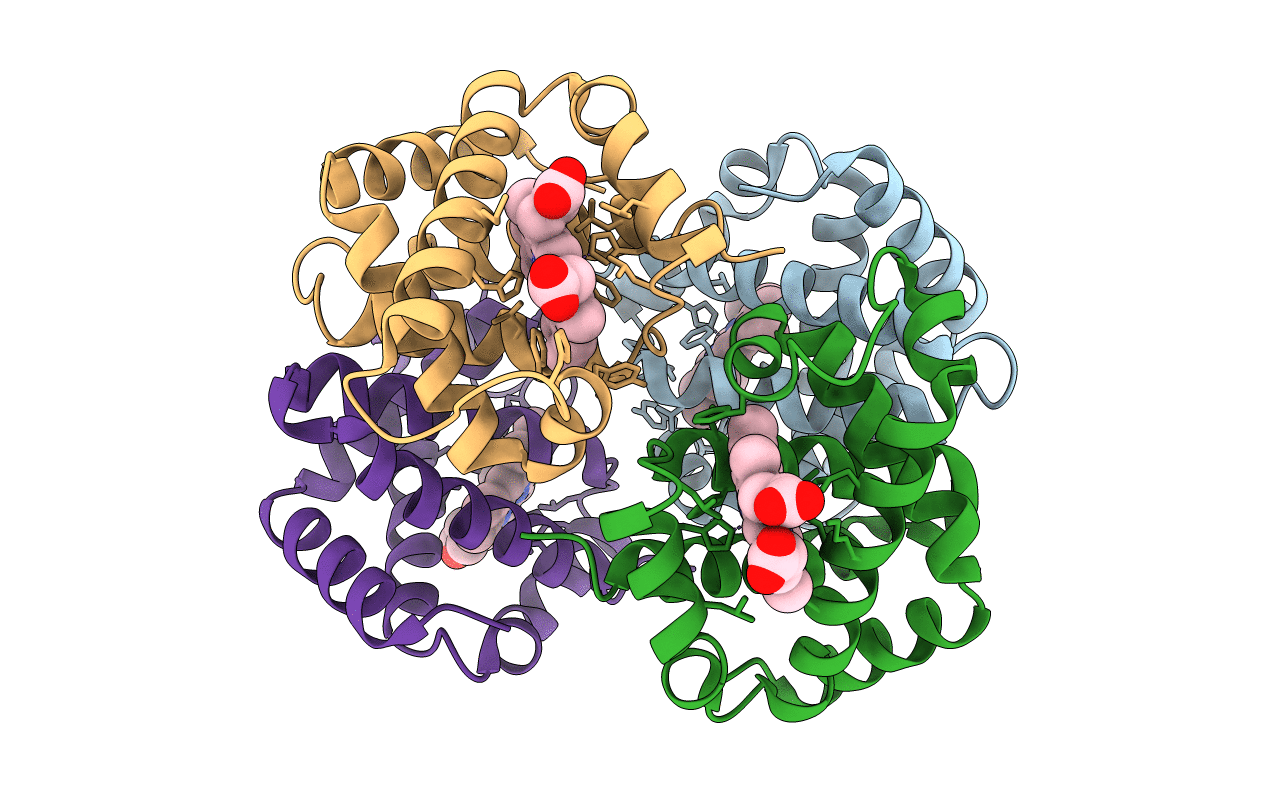
2HHE image
Deposition Date 1994-09-29
Release Date 1995-01-26
Last Version Date 2023-08-30
Entry Detail
PDB ID:
2HHE
Title:
OXYGEN AFFINITY MODULATION BY THE N-TERMINI OF THE BETA CHAINS IN HUMAN AND BOVINE HEMOGLOBIN
Biological Source:
Source Organism:
Homo sapiens (Taxon ID: 9606)
Host Organism:
Method Details:
Experimental Method:
Resolution:
2.20 Å
R-Value Observed:
0.17
Space Group:
P 1 21 1

Macromolecular Entities
Structures with similar UniProt ID
Protein Blast
Polymer Type:polypeptide(L)
Molecule:HEMOGLOBIN (DEOXY) (ALPHA CHAIN)
Gene (Uniprot):HBA1, HBA2
Chain IDs:A, C
Chain Length:141
Number of Molecules:2
Biological Source:Homo sapiens
Structures with similar UniProt ID
Protein Blast
Polymer Type:polypeptide(L)
Molecule:HEMOGLOBIN (DEOXY) (BETA CHAIN)
Gene (Uniprot):HBB
Chain IDs:B, D
Chain Length:145
Number of Molecules:2
Biological Source:Homo sapiens
Ligand Molecules
Primary Citation
Chloride ion independence of the Bohr effect in a mutant human hemoglobin beta (V1M+H2deleted).
J.Biol.Chem. 269 23965 23969 (1994)
PMID: 7929044

Abstact

A mutant human hemoglobin, beta (V1M+H2 delta), has been constructed. Analysis of the oxygen binding curves obtained at pH 8.3, where the Bohr effect is inoperative, indicates that this mutation results in an additional stabilization of the T-state conformation by 0.9 kcal/mol. The crystal structure of deoxy-beta (V1M+H2 delta) has been determined to 2.2-A resolution and compared with the deoxy structure of human hemoglobin at the same resolution. In human hemoglobin, a sulfate anion is anchored to the beta-chains by a complex network of H-bonds and electrostatic interactions with the amino terminus and Lys beta 82. In the mutant hemoglobin, the shortening of the amino-terminal region of the A helix by 1 residue results in the formation of an intrachain electrostatic interaction between the amino-terminal amino and Asp beta 79. This eliminates the sulfate binding site, and the sulfate is replaced by two water molecules. At variance with human hemoglobin, the alkaline Bohr effect for beta (V1M+H2 delta) is not sensitive to the presence of Cl-. This indicates that the sulfate binding site in human hemoglobin also serves as a Cl- binding site, and that the amino-terminal Val beta 1 is essential for oxygen-linked Cl- binding to hemoglobin as well as the Cl(-)-dependent Bohr effect. Analysis of the oxygen binding curves indicates that the oxygen-linked Cl- ions are released upon binding of the first oxygen molecule.

Legend

Protein

Chemical

Disease

Primary Citation of related structures
Feedback Form
Name
Email
Institute
Feedback