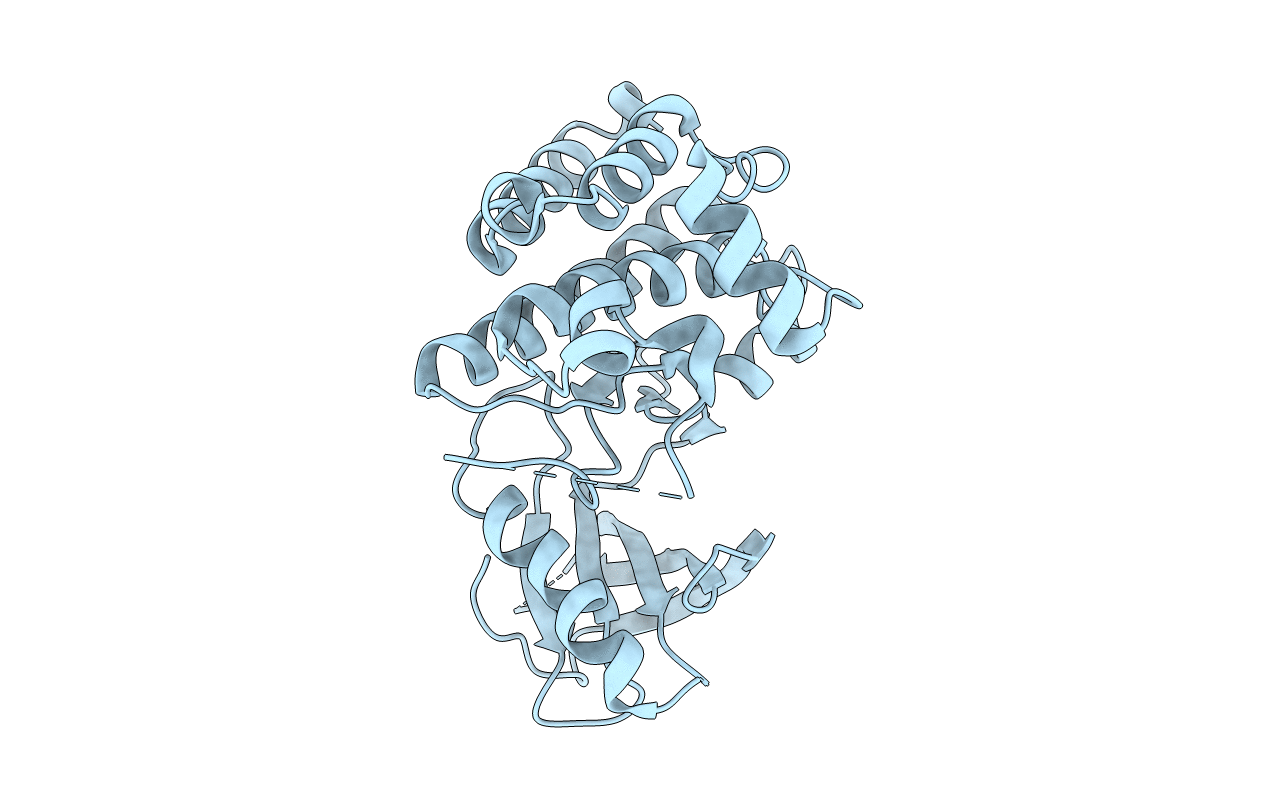
2HEL image
Deposition Date 2006-06-21
Release Date 2007-02-13
Last Version Date 2024-02-14
Entry Detail
PDB ID:
2HEL
Title:
Crystal structure of a mutant EphA4 kinase domain (Y742A)
Biological Source:
Source Organism:
Mus musculus (Taxon ID: 10090)
Host Organism:
Method Details:
Experimental Method:
Resolution:
2.35 Å
R-Value Free:
0.24
R-Value Work:
0.20
Space Group:
P 1 21 1
Macromolecular Entities
Structures with similar UniProt ID
Protein Blast
Polymer Type:polypeptide(L)
Molecule:Eph receptor A4
Mutagens:Y604F, Y610F, Y742A
Chain IDs:A
Chain Length:306
Number of Molecules:1
Biological Source:Mus musculus
Primary Citation
A change in conformational dynamics underlies the activation of Eph receptor tyrosine kinases.
EMBO J. 25 4686 4696 (2006)
PMID: 16977320 DOI: 10.1038/sj.emboj.7601315

Abstact

Eph receptor tyrosine kinases (RTKs) mediate numerous developmental processes. Their activity is regulated by auto-phosphorylation on two tyrosines within the juxtamembrane segment (JMS) immediately N-terminal to the kinase domain (KD). Here, we probe the molecular details of Eph kinase activation through mutational analysis, X-ray crystallography and NMR spectroscopy on auto-inhibited and active EphB2 and EphA4 fragments. We show that a Tyr750Ala gain-of-function mutation in the KD and JMS phosphorylation independently induce disorder of the JMS and its dissociation from the KD. Our X-ray analyses demonstrate that this occurs without major conformational changes to the KD and with only partial ordering of the KD activation segment. However, conformational exchange for helix alphaC in the N-terminal KD lobe and for the activation segment, coupled with increased inter-lobe dynamics, is observed upon kinase activation in our NMR analyses. Overall, our results suggest that a change in inter-lobe dynamics and the sampling of catalytically competent conformations for helix alphaC and the activation segment rather than a transition to a static active conformation underlies Eph RTK activation.

Legend

Protein

Chemical

Disease

Primary Citation of related structures
Feedback Form
Name
Email
Institute
Feedback