2H6J image
Deposition Date 2006-05-31
Release Date 2006-08-01
Last Version Date 2023-08-30
Entry Detail
PDB ID:
2H6J
Keywords:
Title:
Crystal Structure of the Beta F145A Rhodococcus Proteasome
Biological Source:
Source Organism:
Method Details:
Experimental Method:
Resolution:
3.20 Å
R-Value Free:
0.29
R-Value Work:
0.26
R-Value Observed:
0.26
Space Group:
C 2 2 21
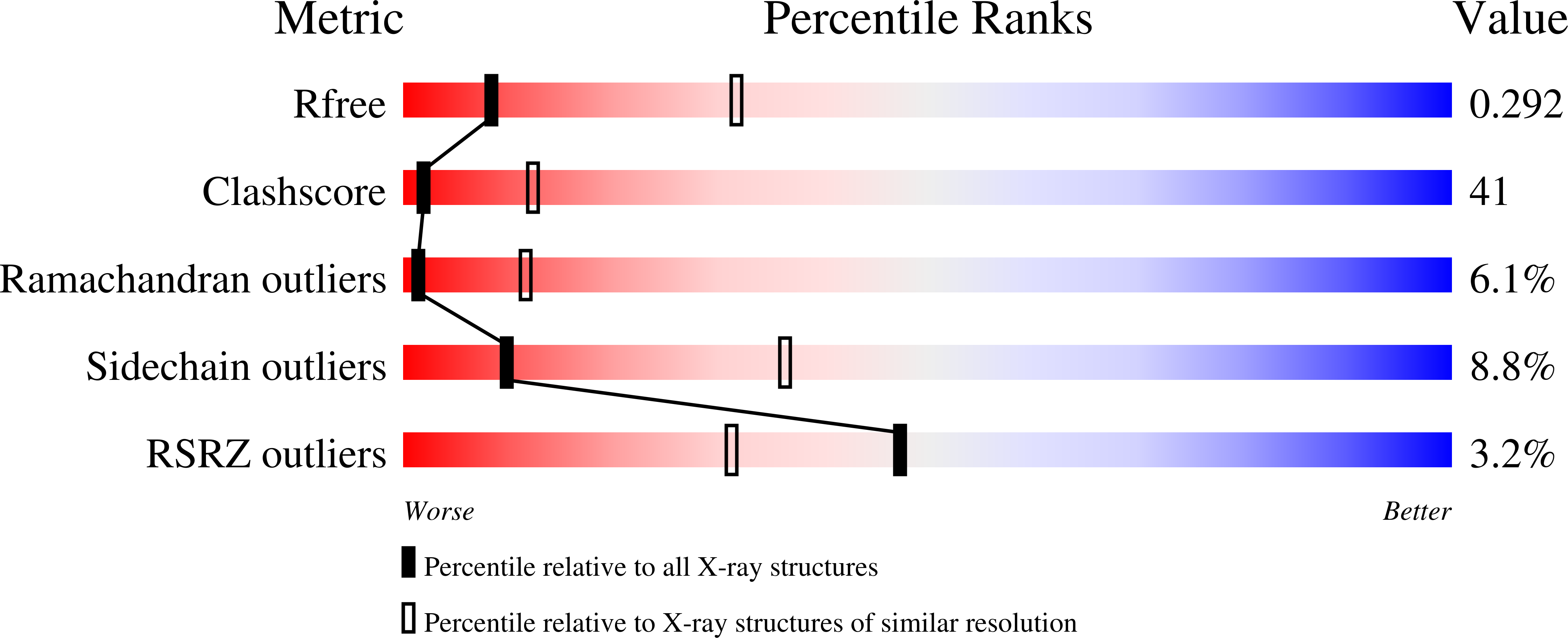
Macromolecular Entities
Structures with similar UniProt ID
Protein Blast
Polymer Type:polypeptide(L)
Molecule:Proteasome alpha-type subunit 1
Gene (Uniprot):prcA1
Chain IDs:A, B, C, D, E, F, G
Chain Length:259
Number of Molecules:7
Biological Source:Rhodococcus erythropolis
Structures with similar UniProt ID
Protein Blast
Polymer Type:polypeptide(L)
Molecule:Proteasome beta-type subunit 1
Gene (Uniprot):prcB1
Mutagens:F145A
Chain IDs:H, I, J, K, L, M, N
Chain Length:294
Number of Molecules:7
Biological Source:Rhodococcus erythropolis
Primary Citation
Proteasome assembly triggers a switch required for active-site maturation.
Structure 14 1179 1188 (2006)
PMID: 16843899 DOI: 10.1016/j.str.2006.05.019

Abstact

The processing of propeptides and the maturation of 20S proteasomes require the association of beta rings from two half proteasomes. We propose an assembly-dependent activation model in which interactions between helix (H3 and H4) residues of the opposing half proteasomes are prerequisite for appropriate positioning of the S2-S3 loop; such positioning enables correct coordination of the active-site residue needed for propeptide cleavage. Mutations of H3 or H4 residues that participate in the association of two half proteasomes inhibit activation and prevent, in nearly all cases, the formation of full proteasomes. In contrast, mutations affecting interactions with residues of the S2-S3 loop allow the assembly of full, but activity impacted, proteasomes. The crystal structure of the inactive H3 mutant, Phe145Ala, shows that the S2-S3 loop is displaced from the position observed in wild-type proteasomes. These data support the proposed assembly-dependent activation model in which the S2-S3 loop acts as an activation switch.

Legend

Protein

Chemical

Disease

Primary Citation of related structures
Feedback Form
Name
Email
Institute
Feedback