2H60 image
Deposition Date 2006-05-30
Release Date 2007-02-13
Last Version Date 2024-05-29
Entry Detail
PDB ID:
2H60
Keywords:
Title:
Solution Structure of Human Brg1 Bromodomain
Biological Source:
Source Organism(s):
Homo sapiens (Taxon ID: 9606)
Expression System(s):
Method Details:
Experimental Method:
Conformers Calculated:
100
Conformers Submitted:
11
Selection Criteria:
structures with the lowest energy
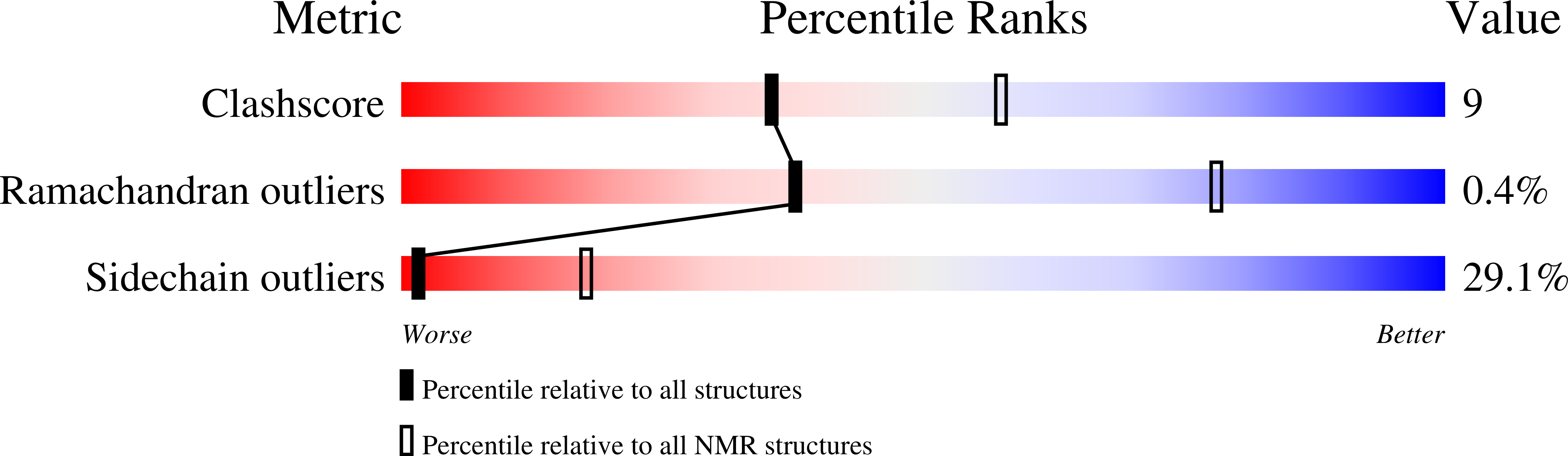
Macromolecular Entities
Structures with similar UniProt ID
Protein Blast
Polymer Type:polypeptide(L)
Molecule:Probable global transcription activator SNF2L4
Gene (Uniprot):SMARCA4
Chain IDs:A
Chain Length:128
Number of Molecules:1
Biological Source:Homo sapiens
Ligand Molecules
Primary Citation
Solution structure of human Brg1 bromodomain and its specific binding to acetylated histone tails
Biochemistry 46 2100 2110 (2007)
PMID: 17274598 DOI: 10.1021/bi0611208

Abstact

Human brahma-related gene 1 (Brg1) is a core protein in human SWI/SNF chromatin-remodeling complex which regulates gene expression. Brg1 contains a bromodomain that has been shown to anchor the entire complex to promoter nucleosomes by interacting with histones that are acetylated at specific lysine residues. The Brg1 bromodomain belongs to an important subclass of the bromodomain family for which no structural information is known. Here we report the solution structure of the Brg1 bromodomain determined by NMR. The Brg1 bromodomain conserves the left-handed, four-helix bundle topology found in other bromodomain structures. However, the alphaZ helix of Brg1 bromodomain is about 4 residues shorter relative to previously published bromodomain structures. Using NMR perturbation studies, we demonstrate the Brg1 bromodomain binds acetyllysine in the context of histone tails, with no comparable affinity for unacetylated peptides. The estimated dissociation constants (KD) for acetylated histone peptides H4-AcK8 and H4-AcK12 are 4.0 and 3.6 mM, respectively. In this study the dominant substrate was H3-AcK14 (KD approximately 1.2 mM). Mutagenesis analysis reveals several residues important for the binding specificity. Using molecular dynamics simulations, we present a model of the Brg1 bromodomain in complex with H3-AcK14 and discuss the potential interactions which provide the selectivity of the Brg1 bromodomain for histone H3-AcK14.

Legend

Protein

Chemical

Disease

Primary Citation of related structures
Feedback Form
Name
Email
Institute
Feedback