2H1Y image
Deposition Date 2006-05-17
Release Date 2007-05-22
Last Version Date 2023-10-25
Entry Detail
PDB ID:
2H1Y
Keywords:
Title:
Crystal structure of malonyl-CoA:Acyl carrier protein transacylase (MCAT) from Helicobacter pylori
Biological Source:
Source Organism:
Host Organism:
Method Details:
Experimental Method:
Resolution:
2.50 Å
R-Value Free:
0.26
R-Value Work:
0.21
Space Group:
P 1 21 1
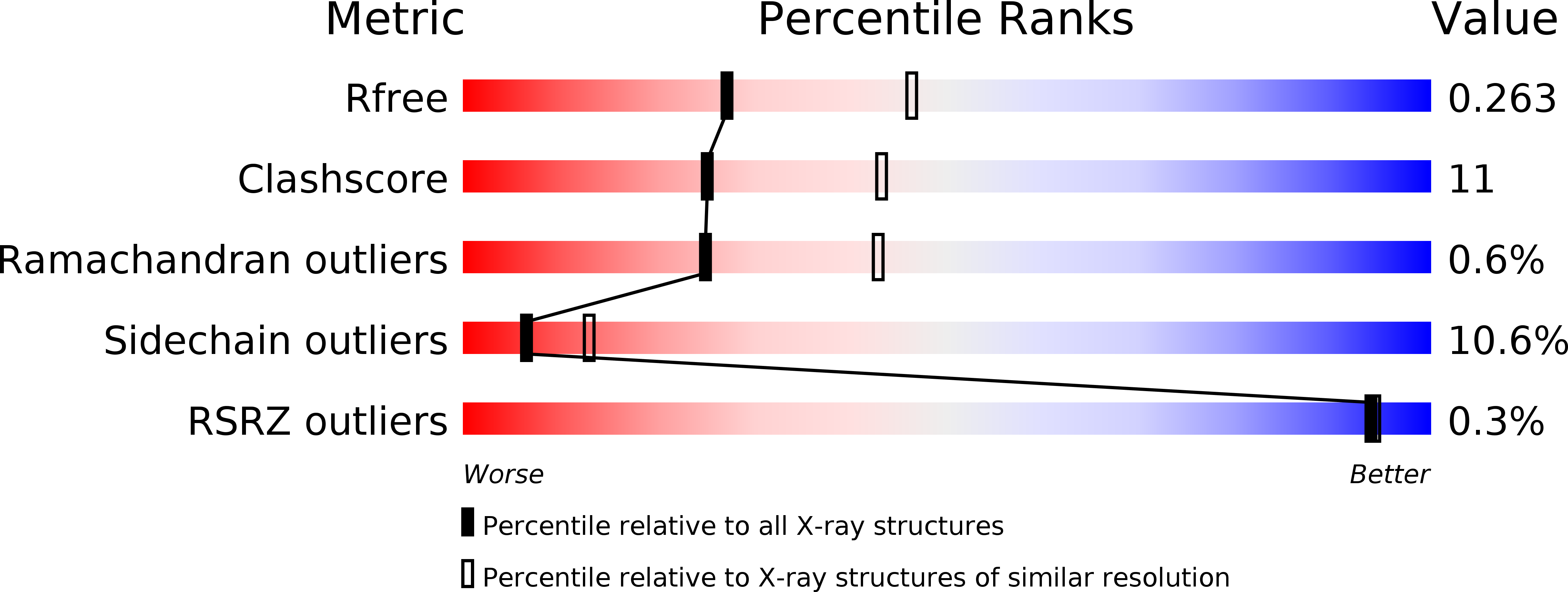
Macromolecular Entities
Structures with similar UniProt ID
Protein Blast
Polymer Type:polypeptide(L)
Molecule:Malonyl coenzyme A-acyl carrier protein transacylase
Gene (Uniprot):fabD
Chain IDs:A, B
Chain Length:321
Number of Molecules:2
Biological Source:Helicobacter pylori
Primary Citation
Malonyl-CoA: acyl carrier protein transacylase from Helicobacter pylori: Crystal structure and its interaction with acyl carrier protein
Protein Sci. 16 1184 1192 (2007)
PMID: 17525466 DOI: 10.1110/ps.072757307

Abstact

Malonyl-CoA: acyl carrier protein transacylase (MCAT) is a critical enzyme responsible for the transfer of the malonyl moiety to holo-acyl carrier protein (ACP) forming the malonyl-ACP intermediates in the initiation step of type II fatty acid synthesis (FAS II) in bacteria. MCAT has been considered as an attractive drug target in the discovery of antibacterial agents. In this study, the crystal structure of MCAT from Helicobacter pylori (Hp) at 2.5 angstroms resolution is reported, and the interaction of HpMCAT with HpACP is extensively investigated by using computational docking, GST-pull-down, and surface plasmon resonance (SPR) technology-based assays. The crystal structure results reveal that HpMCAT has a compact folding composed of a large subdomain with a similar core as in alpha/beta hydrolases, and a similar ferredoxin-like small subdomain as in acylphosphatases. The docking result suggests two positively charged areas near the entrance of the active site of HpMCAT as the ACP-binding region. Binding assay research shows that HpMCAT demonstrates a moderately binding ability against HpACP. The solved 3D structure of HpMCAT is expected to supply useful information for the structure-based discovery of novel inhibitors against MCAT, and the quantitative study of HpMCAT interaction with HpACP is hoped to give helpful hints in the understanding of the detailed catalytic mechanisms for HpMCAT.

Legend

Protein

Chemical

Disease

Primary Citation of related structures
Feedback Form
Name
Email
Institute
Feedback