2GUS image
Deposition Date 2006-05-01
Release Date 2006-07-25
Last Version Date 2024-02-14
Entry Detail
PDB ID:
2GUS
Title:
Conformational Transition between Four- and Five-stranded Phenylalanine Zippers Determined by a Local Packing Interaction
Biological Source:
Source Organism:
Escherichia coli (Taxon ID: 562)
Host Organism:
Method Details:
Experimental Method:
Resolution:
1.75 Å
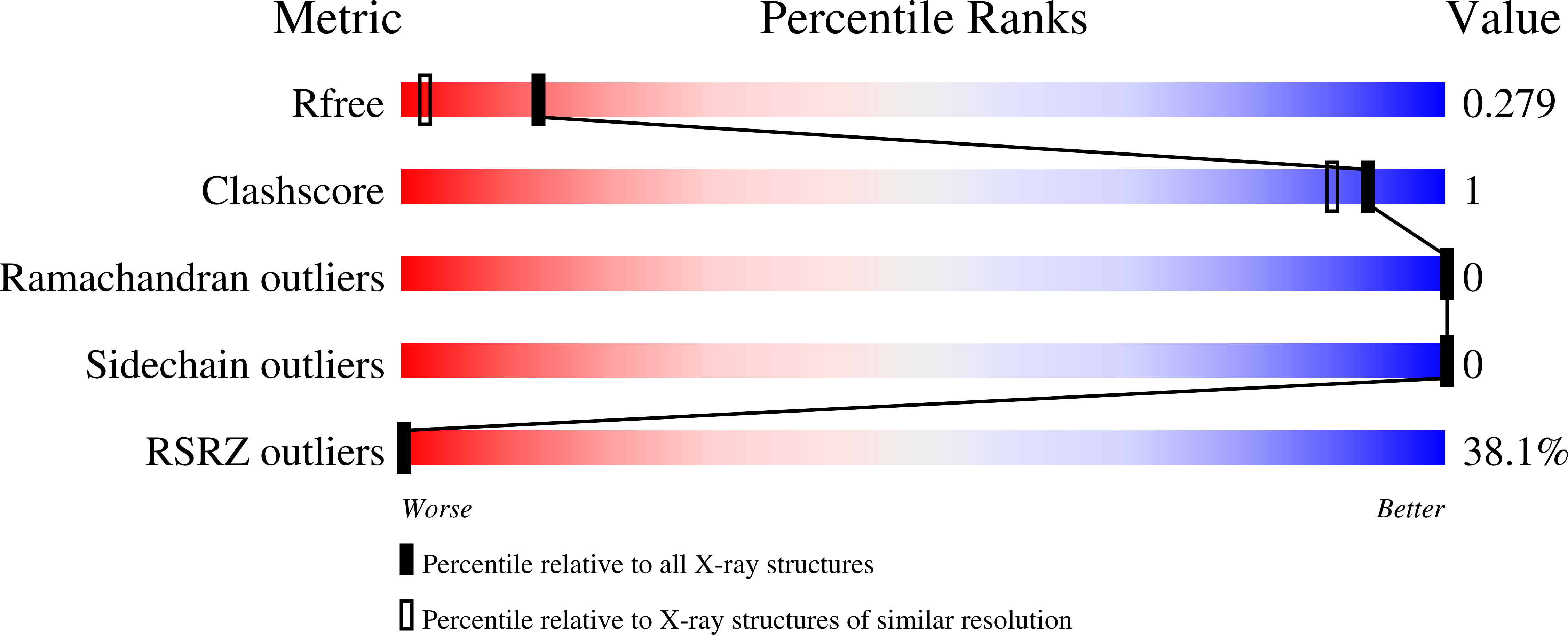
R-Value Free:
0.28
R-Value Work:
0.23
R-Value Observed:
0.24
Space Group:
P 4 21 2
Macromolecular Entities
Structures with similar UniProt ID
Protein Blast
Polymer Type:polypeptide(L)
Molecule:Major outer membrane lipoprotein
Gene (Uniprot):lpp
Mutagens:I6F, L9F, V13F, L16F, V20F, L23F, V27M, M30F, V34F, A37F, A41F, A44F, L48F, M51F
Chain IDs:A
Chain Length:56
Number of Molecules:1
Biological Source:Escherichia coli
Primary Citation
Conformational Transition between Four and Five-stranded Phenylalanine Zippers Determined by a Local Packing Interaction.
J.Mol.Biol. 361 168 179 (2006)
PMID: 16828114 DOI: 10.1016/j.jmb.2006.05.063

Abstact

Alpha-helical coiled coils play a crucial role in mediating specific protein-protein interactions. However, the rules and mechanisms that govern helix-helix association in coiled coils remain incompletely understood. Here we have engineered a seven heptad "Phe-zipper" protein (Phe-14) with phenylalanine residues at all 14 hydrophobic a and d positions, and generated a further variant (Phe-14(M)) in which a single core Phe residue is substituted with Met. Phe-14 forms a discrete alpha-helical pentamer in aqueous solution, while Phe-14(M) folds into a tetrameric helical structure. X-ray crystal structures reveal that in both the tetramer and the pentamer the a and d side-chains interlock in a classical knobs-into-holes packing to produce parallel coiled-coil structures enclosing large tubular cavities. However, the presence of the Met residue in the apolar interface of the tetramer markedly alters its local coiled-coil conformation and superhelical geometry. Thus, short-range interactions involving the Met side-chain serve to preferentially select for tetramer formation, either by inhibiting a nucleation step essential for pentamer folding or by abrogating an intermediate required to form the pentamer. Although specific trigger sequences have not been clearly identified in dimeric coiled coils, higher-order coiled coils, as well as other oligomeric multi-protein complexes, may require such sequences to nucleate and direct their assembly.

Legend

Protein

Chemical

Disease

Primary Citation of related structures
Feedback Form
Name
Email
Institute
Feedback