2GJY image
Deposition Date 2006-03-31
Release Date 2007-04-03
Last Version Date 2024-05-29
Entry Detail
PDB ID:
2GJY
Keywords:
Title:
NMR Solution Structure of Tensin1 PTB Domain
Biological Source:
Source Organism:
Gallus gallus (Taxon ID: 9031)
Host Organism:
Method Details:
Experimental Method:
Conformers Calculated:
100
Conformers Submitted:
20
Selection Criteria:
structures with the least restraint violations
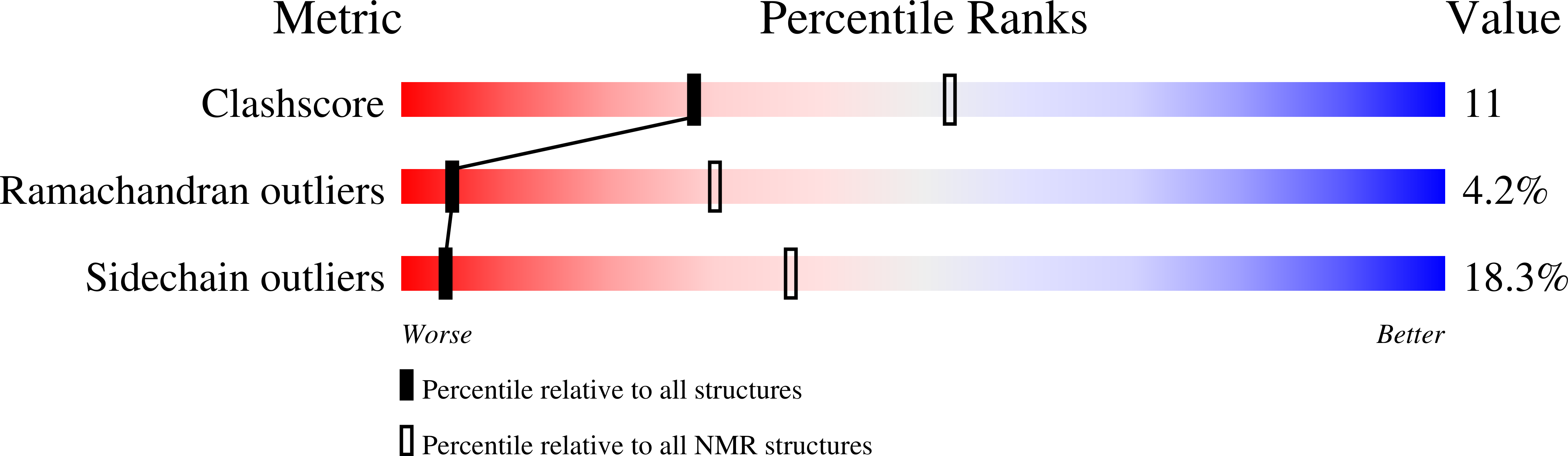
Macromolecular Entities
Structures with similar UniProt ID
Protein Blast
Polymer Type:polypeptide(L)
Molecule:Tensin
Gene (Uniprot):TNS1
Chain IDs:A
Chain Length:144
Number of Molecules:1
Biological Source:Gallus gallus
Ligand Molecules
Primary Citation
The PTB domain of tensin: NMR solution structure and phosphoinositides binding studies.
Biopolymers 89 86 92 (2007)
PMID: 17922498 DOI: 10.1002/bip.20862

Abstact

Tensin is a protein confined at those discrete and specialized regions of the plasma membrane, known as focal adhesions. It contains, at the C-terminus, a phosphotyrosine binding (PTB) domain that can interact with the cytoplasmic tail of beta-integrins and is necessary for localization of the protein to cell-matrix adhesions. Here, we present the NMR solution structure of the PTB domain of tensin1. Moreover, through NMR binding studies, we demonstrate that the PTB domain of tensin1 is able to interact with phosphatidylinositol 4, 5-diphosphate (PtIns(4,5)P2) and phosphatidylinositol 4-phosphate (PtIns(4)P), presenting higher affinity for the diphosphorylated inositide. Chemical shift mapping studies reveal a putative PtIns(4,5)P2 binding region that is distinct from the predicted integrin beta-tail recognition site. Heteronuclear NOE experiments, recorded in absence and presence of PtIns(4,5)P2, indicate that the interaction with lipids decreases the flexibility of loop regions, predicted to be important for integrin binding, and thus, proposes a possible correlation between the two distinct binding events. Therefore, our studies suggest that capture of lipids by the PTB domain of tensin1 may play a role for the protein function at focal adhesions.

Legend

Protein

Chemical

Disease

Primary Citation of related structures
Feedback Form
Name
Email
Institute
Feedback