2GD7 image
Deposition Date 2006-03-15
Release Date 2007-06-12
Last Version Date 2024-05-29
Entry Detail
PDB ID:
2GD7
Keywords:
Title:
The Structure of the Cyclin T-binding domain of Hexim1 reveals the molecular basis for regulation of transcription elongation
Biological Source:
Source Organism:
Homo sapiens (Taxon ID: 9606)
Method Details:
Experimental Method:
Conformers Calculated:
200
Conformers Submitted:
20
Selection Criteria:
structures with the lowest energy
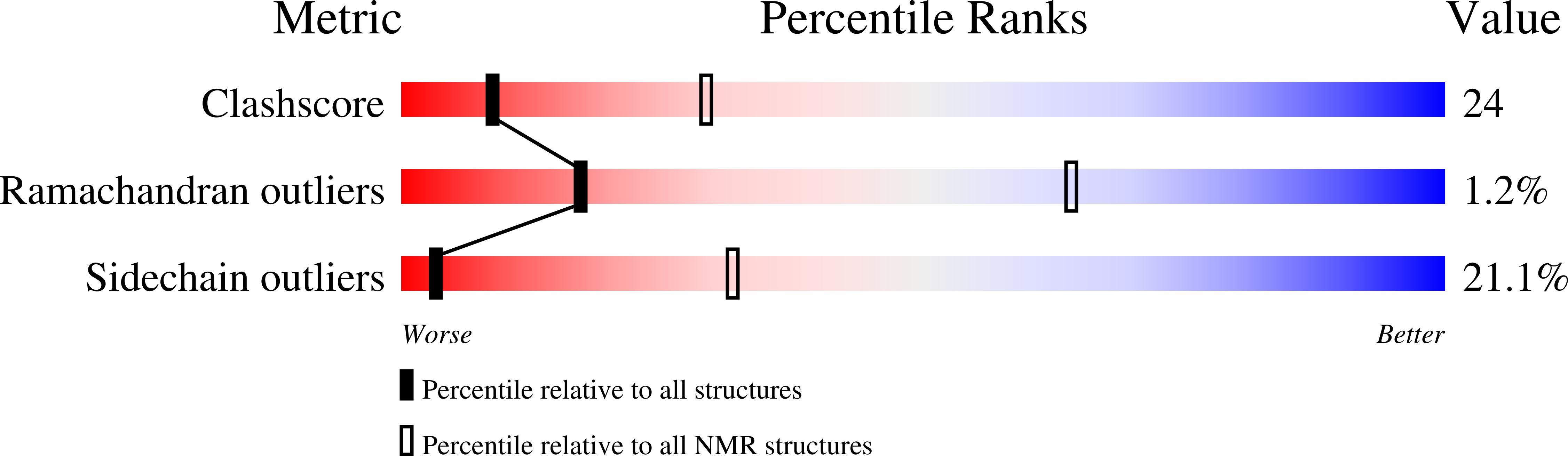
Macromolecular Entities
Structures with similar UniProt ID
Protein Blast
Polymer Type:polypeptide(L)
Molecule:HEXIM1 protein
Mutagens:G256A
Chain IDs:A, B
Chain Length:107
Number of Molecules:2
Biological Source:Homo sapiens
Ligand Molecules
Primary Citation
Structure of the Cyclin T binding domain of Hexim1 and molecular basis for its recognition of P-TEFb.
Proc.Natl.Acad.Sci.Usa 104 14312 14317 (2007)
PMID: 17724342 DOI: 10.1073/pnas.0701848104

Abstact

Hexim1 is a cellular protein that associates with the positive transcription elongation factor b (P-TEFb) to regulate RNA polymerase II elongation of nascent mRNA transcripts. It directly binds to Cyclin T1 of P-TEFb and inhibits the kinase activity of Cdk9, leading to an arrest of transcription elongation. Here, we report the solution structure of the Cyclin T binding domain (TBD) of Hexim1 that forms a parallel coiled-coil homodimer composed of two segments and a preceding alpha helix that folds back onto the first coiled-coil unit. NMR titration, fluorescence, and immunoprecipitation experiments revealed the binding interface to Cyclin T1, which covers a large surface on the first coiled-coil segment. Electrostatic interactions between an acidic patch on Hexim1 and positively charged residues of Cyclin T1 drive the complex formation that is confirmed by mutagenesis data on Hexim1 mediated transcription regulation in cells. Thus, our studies provide structural insights how Hexim1 recognizes the Cyclin T1 subunit of P-TEFb, which is a key step toward the regulation of transcription elongation.

Legend

Protein

Chemical

Disease

Primary Citation of related structures
Feedback Form
Name
Email
Institute
Feedback