2GBT image
Deposition Date 2006-03-11
Release Date 2007-01-02
Last Version Date 2024-11-06
Entry Detail
PDB ID:
2GBT
Keywords:
Title:
C6A/C111A CuZn Superoxide dismutase
Biological Source:
Source Organism(s):
Homo sapiens (Taxon ID: 9606)
Expression System(s):
Method Details:
Experimental Method:
Resolution:
1.70 Å
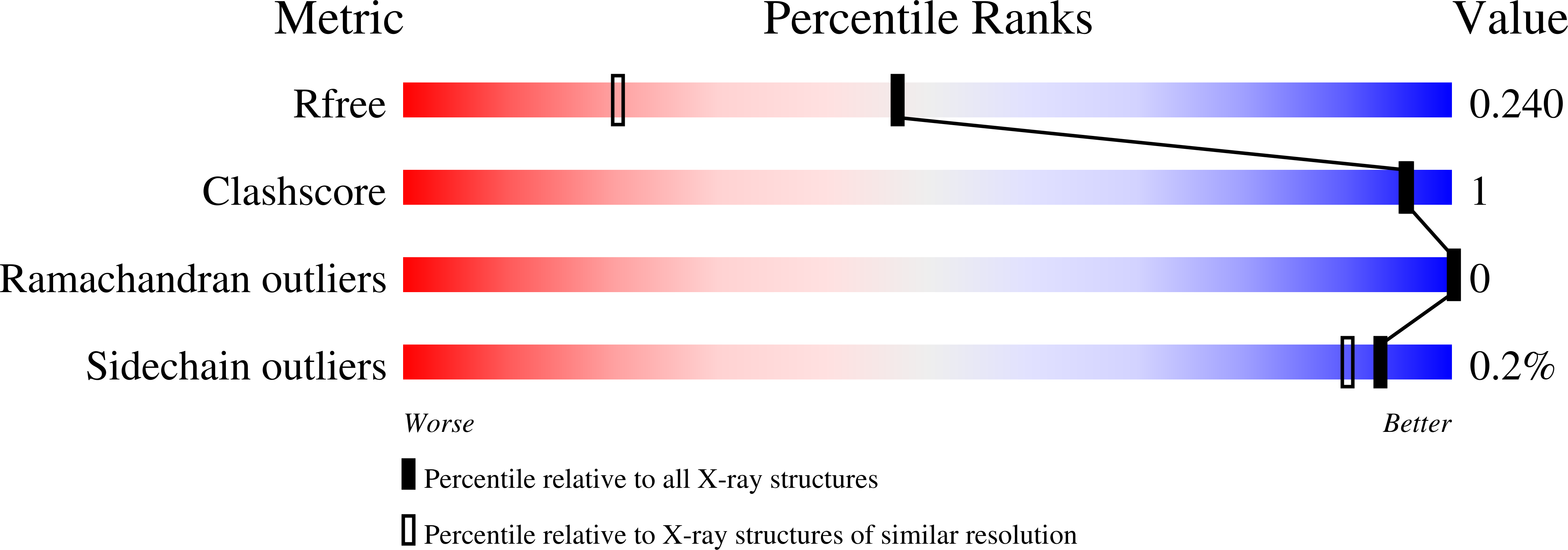
R-Value Free:
0.23
R-Value Work:
0.20
R-Value Observed:
0.20
Space Group:
C 1 2 1
Macromolecular Entities
Structures with similar UniProt ID
Protein Blast
Polymer Type:polypeptide(L)
Molecule:Superoxide dismutase [Cu-Zn]
Gene (Uniprot):SOD1
Mutagens:C6A/C111A
Chain IDs:A, B, C, D
Chain Length:153
Number of Molecules:4
Biological Source:Homo sapiens
Primary Citation
The Coupling between Disulphide Status, Metallation and Dimer Interface Strength in Cu/Zn Superoxide Dismutase
J.Mol.Biol. 365 333 342 (2007)
PMID: 17070542 DOI: 10.1016/j.jmb.2006.09.048

Abstact

The gain of neurotoxic function in amyotrophic lateral sclerosis (ALS) has been linked to misfolding of the homodimeric enzyme Cu/Zn superoxide dismutase (SOD). Here, we present the crystal structure of fully cysteine-depleted human SOD (SOD(CallA)), representing a reduced, marginally stable intermediate on the folding pathway in vivo that has also been implicated as neurotoxic precursor state. A hallmark of this species is that it fails to dimerize and becomes trapped as a monomer in the absence of the active-site metals. The crystallographic data show that removal of the C57-C146 disulphide bond sets free the interface loop IV in the apo protein, whereas the same loop remains unaffected in the holo protein. Thus, the low dimerisation propensity of disulphide-reduced apoSOD seems to be of entropic origin due to increased loop flexibility in the monomeric state: in the disulphide-reduced holo protein this gain in configurational entropy upon splitting of the dimer interface is reduced by the metal coordination.

Legend

Protein

Chemical

Disease

Primary Citation of related structures
Feedback Form
Name
Email
Institute
Feedback