2FFF image
Deposition Date 2005-12-19
Release Date 2006-06-20
Last Version Date 2023-08-30
Entry Detail
PDB ID:
2FFF
Title:
Open Form of a Class A Transpeptidase Domain
Biological Source:
Source Organism:
Host Organism:
Method Details:
Experimental Method:
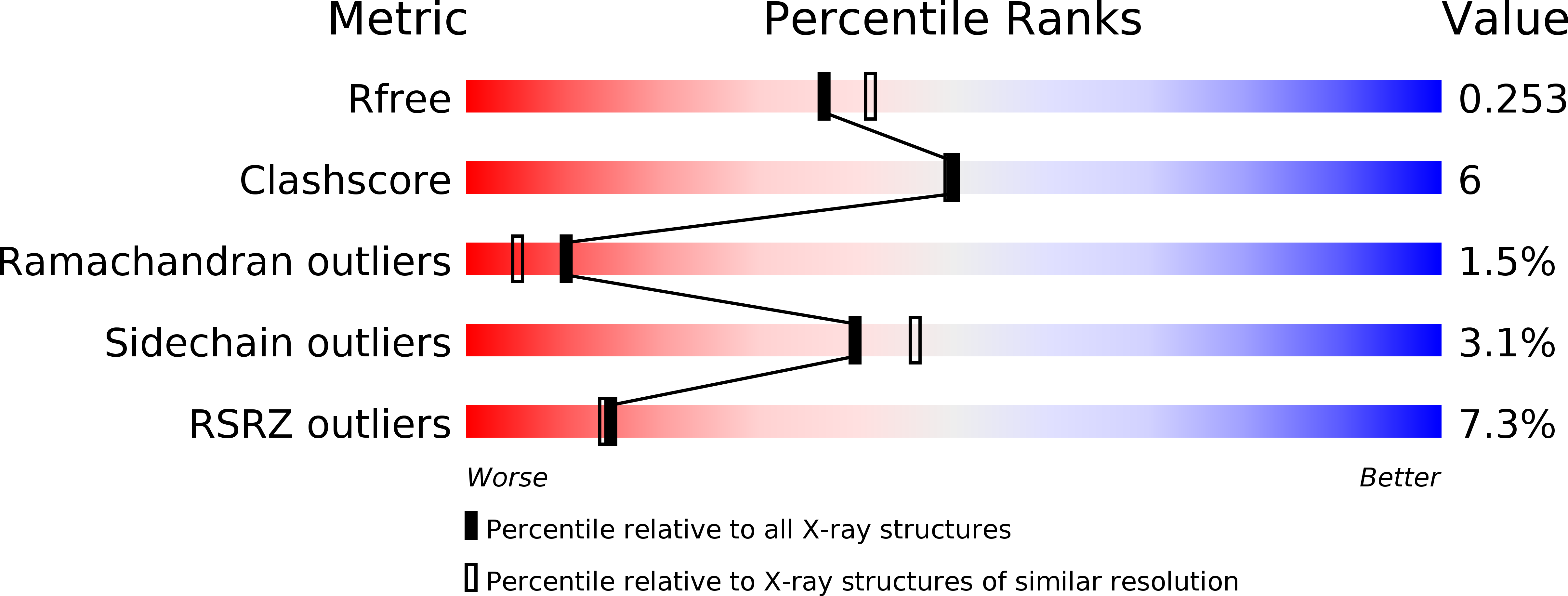
Resolution:
2.23 Å
R-Value Free:
0.24
R-Value Work:
0.18
R-Value Observed:
0.18
Space Group:
C 1 2 1
Macromolecular Entities
Structures with similar UniProt ID
Protein Blast
Polymer Type:polypeptide(L)
Molecule:penicillin-binding protein 1B
Gene (Uniprot):pbp1b
Chain IDs:A
Chain Length:15
Number of Molecules:1
Biological Source:Streptococcus pneumoniae
Structures with similar UniProt ID
Protein Blast
Polymer Type:polypeptide(L)
Molecule:penicillin-binding protein 1B
Gene (Uniprot):pbp1b
Chain IDs:B
Chain Length:453
Number of Molecules:1
Biological Source:Streptococcus pneumoniae
Ligand Molecules
Primary Citation
Structural analysis of an "open" form of PBP1B from Streptococcus pneumoniae.
Protein Sci. 15 1701 1709 (2006)
PMID: 16751607 DOI: 10.1110/ps.062112106

Abstact

The class A PBP1b from Streptococcus pneumoniae is responsible for glycosyltransferase and transpeptidase (TP) reactions, forming the peptidoglycan of the bacterial cell wall. The enzyme has been produced in a stable, soluble form and undergoes time-dependent proteolysis to leave an intact TP domain. Crystals of this TP domain were obtained, diffracting to 2.2 A resolution, and the structure was solved by using molecular replacement. Analysis of the structure revealed an "open" active site, with important conformational differences to the previously determined "closed" apoenzyme. The active-site nucleophile, Ser460, is in an orientation that allows for acylation by beta-lactams. Consistent with the productive conformation of the conserved active-site catalytic residues, adjacent loops show only minor deviation from those of known acyl-enzyme structures. These findings are discussed in the context of enzyme functionality and the possible conformational sampling of PBP1b between active and inactive states.

Legend

Protein

Chemical

Disease

Primary Citation of related structures
Feedback Form
Name
Email
Institute
Feedback