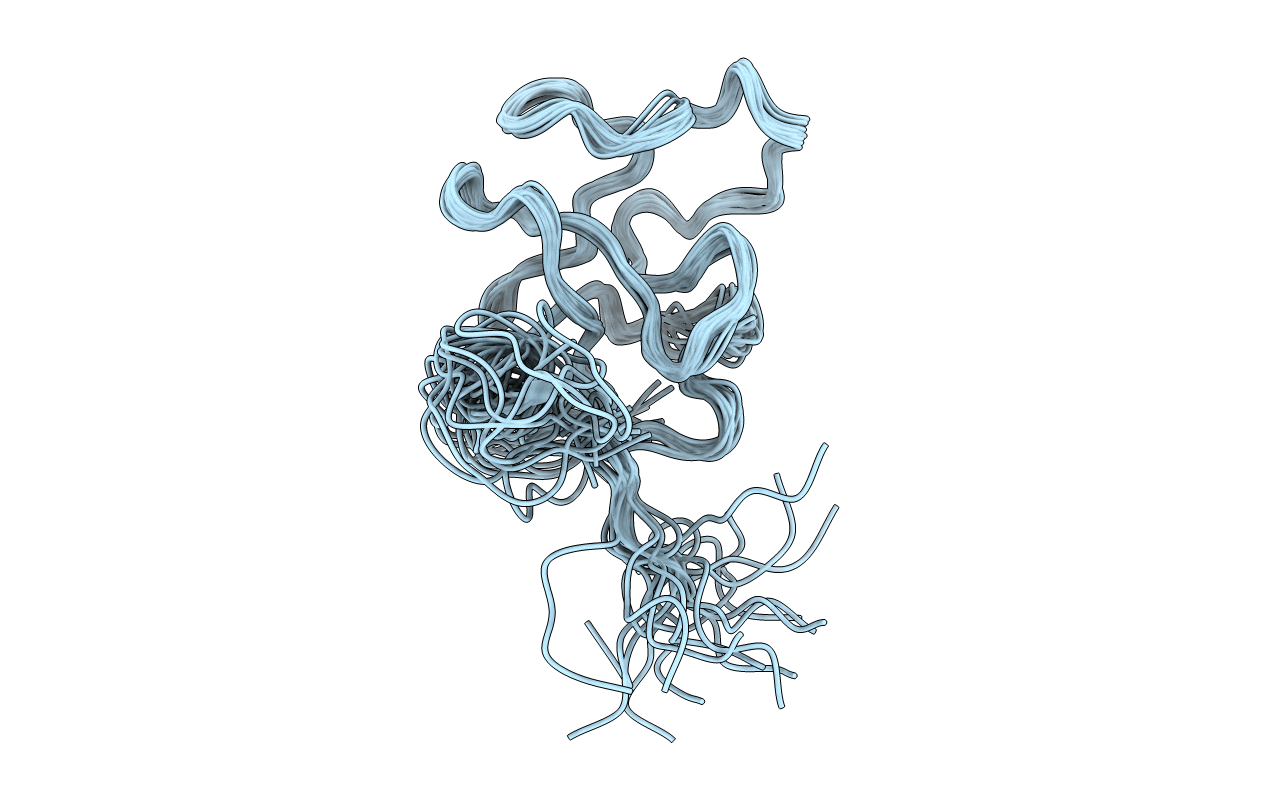
2FEB image
Deposition Date 2005-12-15
Release Date 2006-12-26
Last Version Date 2024-11-20
Entry Detail
PDB ID:
2FEB
Keywords:
Title:
NMR Solution Structure, Dynamics and Binding Properties of the Kringle IV Type 8 module of apolipoprotein(a)
Biological Source:
Source Organism:
Homo sapiens (Taxon ID: 9606)
Method Details:
Experimental Method:
Conformers Calculated:
20
Conformers Submitted:
20
Selection Criteria:
all calculated structures submitted,structures with acceptable covalent geometry,structures with favorable non-bond energy,structures with the least restraint violations,structures with the lowest energy

Macromolecular Entities
Structures with similar UniProt ID
Protein Blast
Polymer Type:polypeptide(L)
Molecule:Apolipoprotein(a)
Gene (Uniprot):LPA
Chain IDs:A
Chain Length:102
Number of Molecules:1
Biological Source:Homo sapiens
Ligand Molecules
Primary Citation
Nuclear magnetic resonance (NMR) solution structure, dynamics, and binding properties of the kringle IV type 8 module of apolipoprotein(a).
Biochemistry 46 1732 1742 (2007)
PMID: 17263558 DOI: 10.1021/bi061814g

Abstact

The plasma lipoprotein lipoprotein(a) [Lp(a)] comprises a low-density lipoprotein (LDL)-like particle covalently attached to the glycoprotein apolipoprotein(a) [apo(a)]. Apo(a) consists of multiple tandem repeating kringle modules, similar to plasminogen kringle IV (designated KIV1-KIV10), followed by modules homologous to the kringle V module and protease domain of plasminogen. The apo(a) KIV modules have been classified on the basis of their binding affinity for lysine and lysine analogues. The strong lysine-binding apo(a) KIV10 module mediates lysine-dependent interactions with fibrin and cell-surface receptors. Weak lysine-binding apo(a) KIV7 and KIV8 modules display a 2-3-fold difference in lysine affinity and play a direct role in the noncovalent step in Lp(a) assembly through binding to unique lysine-containing sequences in apolipoproteinB-100 (apoB-100). The present study describes the nuclear magnetic resonance solution structure of apo(a) KIV8 and its solution dynamics properties, the first for an apo(a) kringle module, and compares the effects of epsilon-aminocaproic acid (epsilon-ACA) binding on the backbone and side-chain conformation of KIV7 and KIV8 on a per residue basis. Apo(a) KIV8 adopts a well-ordered structure that shares the general tri-loop kringle topology with apo(a) KIV6, KIV7, and KIV10. Mapping of epsilon-ACA-induced chemical-shift changes on KIV7 and KIV8 indicate that the same residues are affected, despite a 2-3-fold difference in epsilon-ACA affinity. A unique loop conformation within KIV8, involving hydrophobic interactions with Tyr40, affects the positioning of Arg35 relative to the lysine-binding site (LBS). A difference in the orientation of the aromatic side chains comprising the hydrophobic center of the LBS in KIV8 decreases the size of the hydrophobic cleft compared to other apo(a) KIV modules. An exposed hydrophobic patch contiguous with the LBS in KIV8 and not conserved in other weak lysine-binding apo(a) kringle modules may modulate specificity for regions within apoB-100. An additional ligand recognition site comprises a structured arginine-glycine-aspartate motif at the N terminus of the KIV8 module, which may mediate Lp(a)/apo(a)-integrin interactions.

Legend

Protein

Chemical

Disease

Primary Citation of related structures
Feedback Form
Name
Email
Institute
Feedback