2F1N image
Deposition Date 2005-11-14
Release Date 2006-07-04
Last Version Date 2023-08-23
Entry Detail
PDB ID:
2F1N
Keywords:
Title:
Structure of CdtB, the biologically active subunit of Cytolethal Distending Toxin
Biological Source:
Source Organism:
Escherichia coli (Taxon ID: 562)
Host Organism:
Method Details:
Experimental Method:
Resolution:
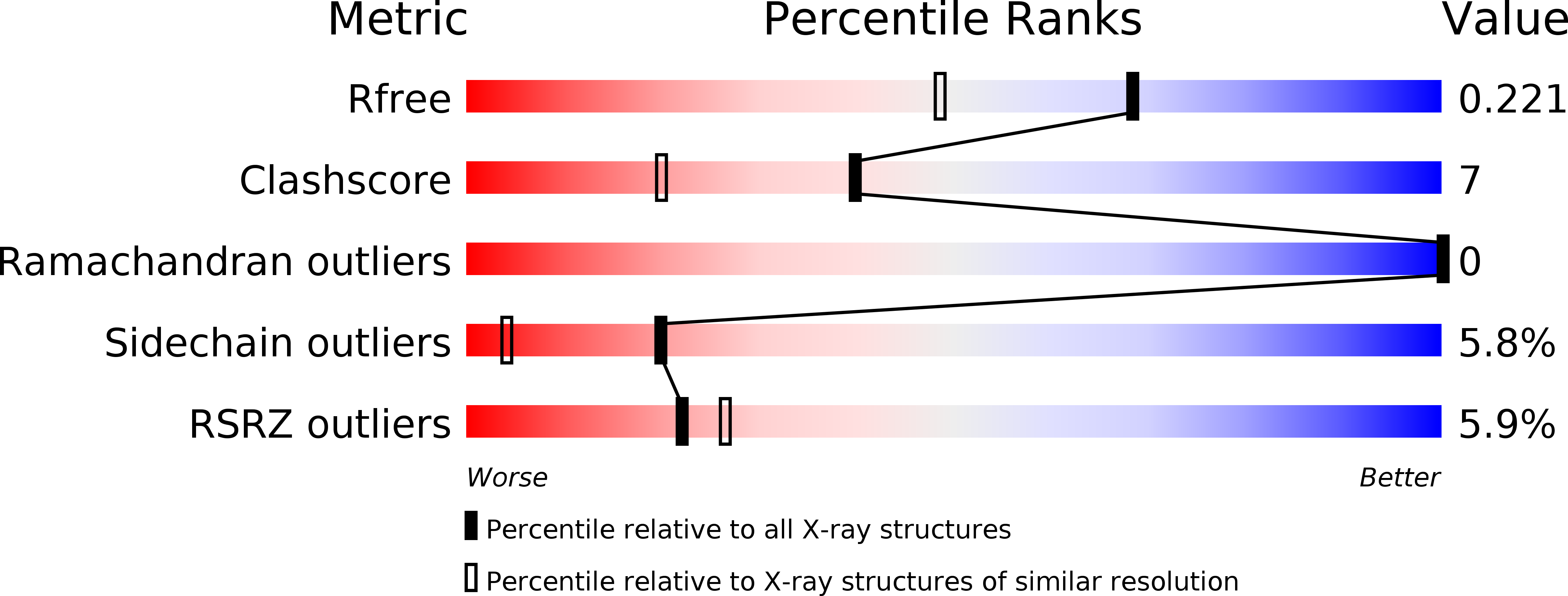
1.73 Å
R-Value Free:
0.22
R-Value Work:
0.19
R-Value Observed:
0.19
Space Group:
P 21 21 21
Macromolecular Entities
Structures with similar UniProt ID
Protein Blast
Polymer Type:polypeptide(L)
Molecule:Cytolethal distending toxin subunit B
Gene (Uniprot):cdtB
Chain IDs:A
Chain Length:262
Number of Molecules:1
Biological Source:Escherichia coli
Primary Citation
Differences in Crystal and Solution Structures of the Cytolethal Distending Toxin B Subunit: RELEVANCE TO NUCLEAR TRANSLOCATION AND FUNCTIONAL ACTIVATION.
J.Biol.Chem. 281 25365 25372 (2006)
PMID: 16809347 DOI: 10.1074/jbc.M603727200

Abstact

Cytolethal distending toxin (CDT) induces cell cycle arrest and apoptosis in eukaryotic cells, which are mediated by the DNA-damaging CdtB subunit. Here we report the first x-ray structure of an isolated CdtB subunit (Escherichia coli-II CdtB, EcCdtB). In conjunction with previous structural and biochemical observations, active site structural comparisons between free and holotoxin-assembled CdtBs suggested that CDT intoxication is contingent upon holotoxin disassembly. Solution NMR structural and 15N relaxation studies of free EcCdtB revealed disorder in the interface with the CdtA and CdtC subunits (residues Gly233-Asp242). Residues Leu186-Thr209 of EcCdtB, which encompasses tandem arginine residues essential for nuclear translocation and intoxication, were also disordered in solution. In stark contrast, nearly identical well defined alpha-helix and beta-strand secondary structures were observed in this region of the free and holotoxin CdtB crystallographic models, suggesting that distinct changes in structural ordering characterize subunit disassembly and nuclear localization factor binding functions.

Legend

Protein

Chemical

Disease

Primary Citation of related structures
Feedback Form
Name
Email
Institute
Feedback