2EKG image
Deposition Date 2007-03-23
Release Date 2008-04-01
Last Version Date 2023-10-25
Entry Detail
PDB ID:
2EKG
Keywords:
Title:
Structure of Thermus thermophilus Proline Dehydrogenase inactivated by N-propargylglycine
Biological Source:
Source Organism:
Host Organism:
Method Details:
Experimental Method:
Resolution:
1.90 Å
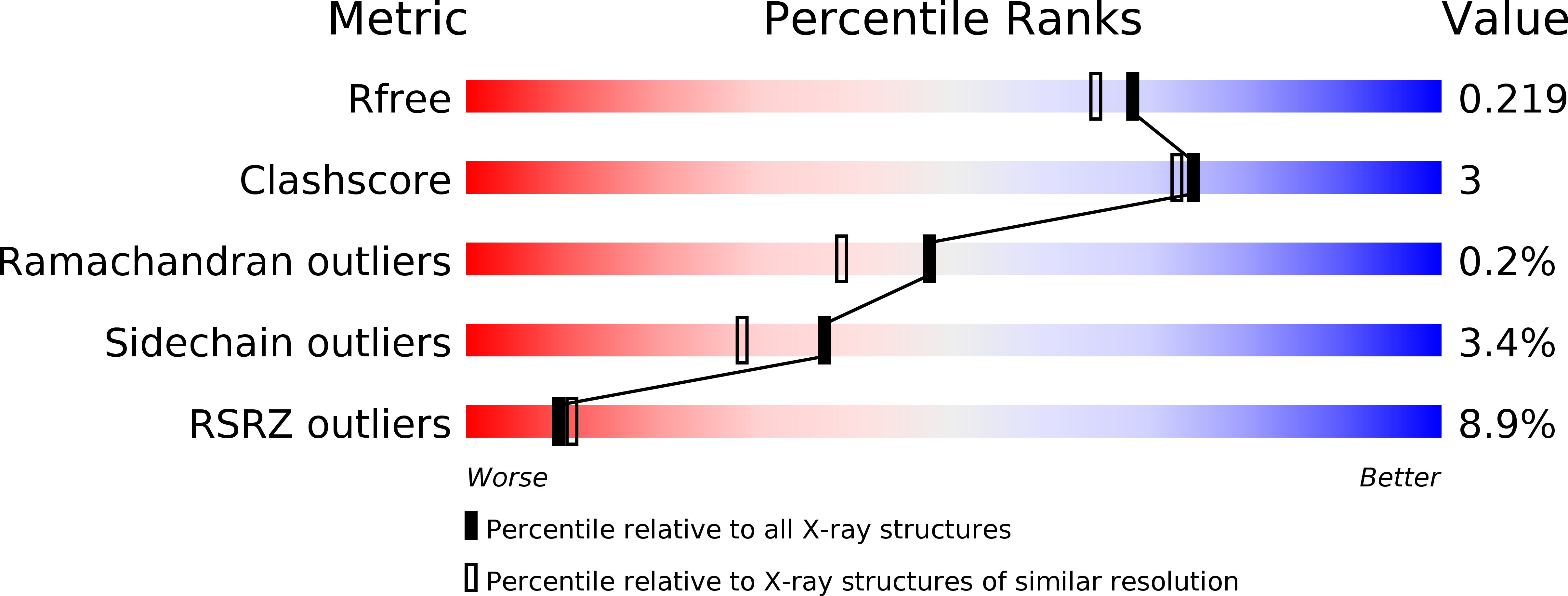
R-Value Free:
0.22
R-Value Work:
0.19
R-Value Observed:
0.19
Space Group:
P 21 21 21
Macromolecular Entities
Structures with similar UniProt ID
Protein Blast
Polymer Type:polypeptide(L)
Molecule:Proline dehydrogenase/delta-1-pyrroline-5-carboxylate dehydrogenase
Gene (Uniprot):TT_C1214
Chain IDs:A, B
Chain Length:327
Number of Molecules:2
Biological Source:Thermus thermophilus
Modified Residue
Compound ID Chain ID Parent Comp ID Details 2D Image
LYX A LYS N''-(2-COENZYME A)-PROPANOYL-LYSINE
Primary Citation
Structural basis for the inactivation of Thermus thermophilus proline dehydrogenase by N-propargylglycine
Biochemistry 47 5573 5580 (2008)
PMID: 18426222 DOI: 10.1021/bi800055w

Abstact

The flavoenzyme proline dehydrogenase catalyzes the first step of proline catabolism, the oxidation of proline to pyrroline-5-carboxylate. Here we report the first crystal structure of an irreversibly inactivated proline dehydrogenase. The 1.9 A resolution structure of Thermus thermophilus proline dehydrogenase inactivated by the mechanism-based inhibitor N-propargylglycine shows that N5 of the flavin cofactor is covalently connected to the -amino group of Lys99 via a three-carbon linkage, consistent with the mass spectral analysis of the inactivated enzyme. The isoalloxazine ring has a butterfly angle of 25 degrees , which suggests that the flavin cofactor is reduced. Two mechanisms can account for these observations. In both, N-propargylglycine is oxidized to N-propargyliminoglycine. In one mechanism, this alpha,beta-unsaturated iminium compound is attacked by the N5 atom of the now reduced flavin to produce a 1,4-addition product. Schiff base formation between Lys99 and the imine of the 1,4-addition product releases glycine and links the enzyme to the modified flavin. In the second mechanism, hydrolysis of N-propargyliminoglycine yields propynal and glycine. A 1,4-addition reaction with propynal coupled with Schiff base formation between Lys99 and the carbonyl group tethers the enzyme to the flavin via a three-carbon chain. The presumed nonenzymatic hydrolysis of N-propargyliminoglycine and the subsequent rebinding of propynal to the enzyme make the latter mechanism less likely.

Legend

Protein

Chemical

Disease

Primary Citation of related structures
Feedback Form
Name
Email
Institute
Feedback