2EFW image
Deposition Date 2007-02-26
Release Date 2008-02-26
Last Version Date 2023-10-25
Entry Detail
PDB ID:
2EFW
Keywords:
Title:
Crystal structure of the RTP:nRB complex from Bacillus subtilis
Biological Source:
Source Organism:
Host Organism:
Method Details:
Experimental Method:
Resolution:
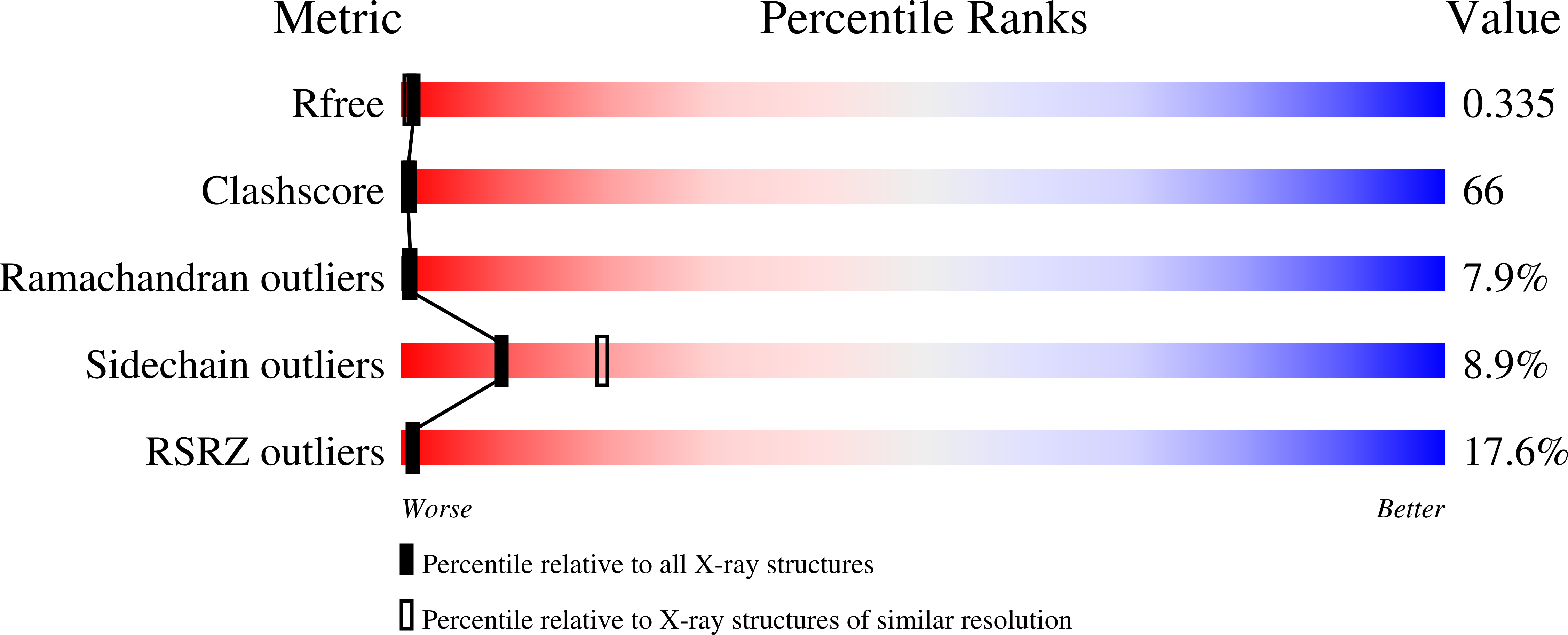
2.50 Å
R-Value Free:
0.33
R-Value Work:
0.29
R-Value Observed:
0.29
Space Group:
C 2 2 21
Macromolecular Entities
Structures with similar UniProt ID
Protein Blast
Polymer Type:polypeptide(L)
Molecule:Replication termination protein
Mutagens:C110S
Chain IDs:E (auth: A), F (auth: B), G (auth: F), H (auth: G)
Chain Length:122
Number of Molecules:4
Biological Source:Bacillus subtilis
Primary Citation
An asymmetric structure of the Bacillus subtilis replication terminator protein in complex with DNA
J.Mol.Biol. 370 481 491 (2007)
PMID: 17521668 DOI: 10.1016/j.jmb.2007.02.067

Abstact

In Bacillus subtilis, the termination of DNA replication via polar fork arrest is effected by a specific protein:DNA complex formed between the replication terminator protein (RTP) and DNA terminator sites. We report the crystal structure of a replication terminator protein homologue (RTP.C110S) of B. subtilis in complex with the high affinity component of one of its cognate DNA termination sites, known as the TerI B-site, refined at 2.5 A resolution. The 21 bp RTP:DNA complex displays marked structural asymmetry in both the homodimeric protein and the DNA. This is in contrast to the previously reported complex formed with a symmetrical TerI B-site homologue. The induced asymmetry is consistent with the complex's solution properties as determined using NMR spectroscopy. Concomitant with this asymmetry is variation in the protein:DNA binding pattern for each of the subunits of the RTP homodimer. It is proposed that the asymmetric "wing" positions, as well as other asymmetrical features of the RTP:DNA complex, are critical for the cooperative binding that underlies the mechanism of polar fork arrest at the complete terminator site.

Legend

Protein

Chemical

Disease

Primary Citation of related structures
Feedback Form
Name
Email
Institute
Feedback