2EC8 image
Deposition Date 2007-02-11
Release Date 2007-08-07
Last Version Date 2024-10-16
Entry Detail
PDB ID:
2EC8
Keywords:
Title:
Crystal structure of the exctracellular domain of the receptor tyrosine kinase, Kit
Biological Source:
Source Organism:
Homo sapiens (Taxon ID: 9606)
Host Organism:
Method Details:
Experimental Method:
Resolution:
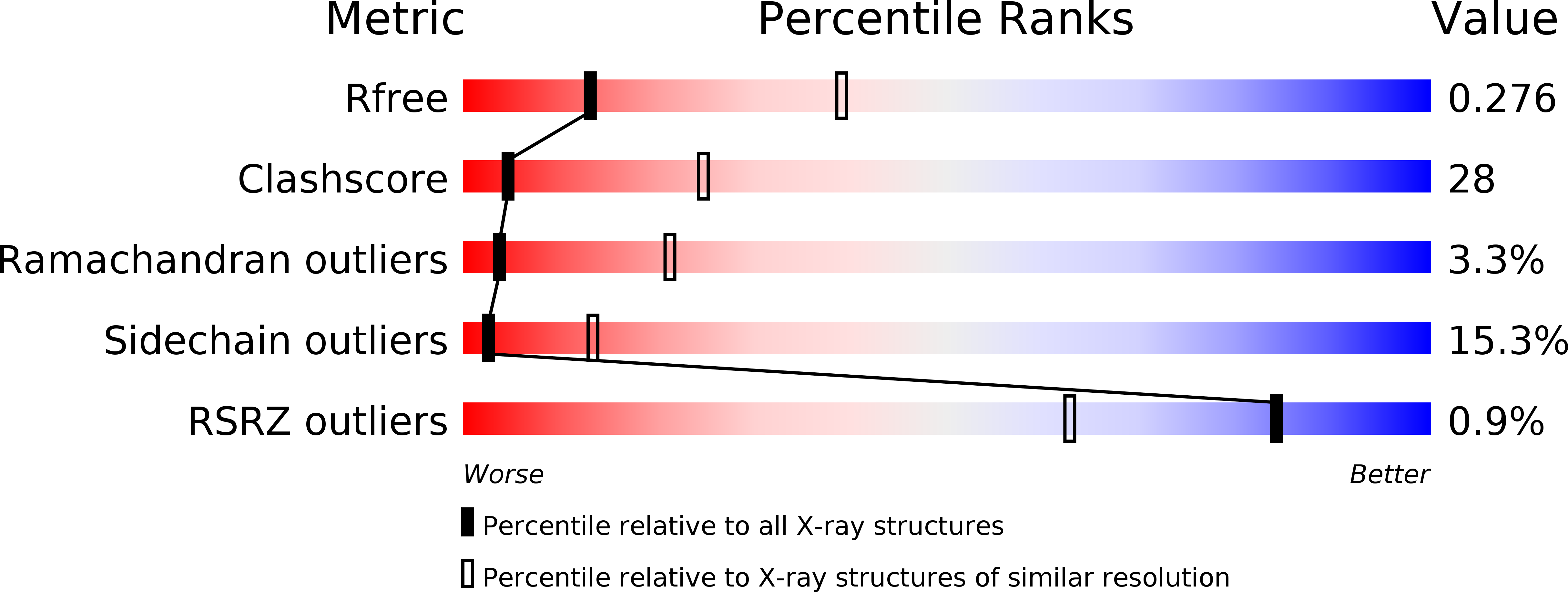
3.00 Å
R-Value Free:
0.29
R-Value Work:
0.25
R-Value Observed:
0.25
Space Group:
H 3
Macromolecular Entities
Structures with similar UniProt ID
Protein Blast
Polymer Type:polypeptide(L)
Molecule:Mast/stem cell growth factor receptor
Gene (Uniprot):KIT
Chain IDs:A
Chain Length:524
Number of Molecules:1
Biological Source:Homo sapiens
Modified Residue
Compound ID Chain ID Parent Comp ID Details 2D Image
ASN A ASN GLYCOSYLATION SITE
Ligand Molecules
Primary Citation
Structural Basis for Activation of the Receptor Tyrosine Kinase KIT by Stem Cell Factor
Cell(Cambridge,Mass.) 130 323 334 (2007)
PMID: 17662946 DOI: 10.1016/j.cell.2007.05.055

Abstact

Stem Cell Factor (SCF) initiates its multiple cellular responses by binding to the ectodomain of KIT, resulting in tyrosine kinase activation. We describe the crystal structure of the entire ectodomain of KIT before and after SCF stimulation. The structures show that KIT dimerization is driven by SCF binding whose sole role is to bring two KIT molecules together. Receptor dimerization is followed by conformational changes that enable lateral interactions between membrane proximal Ig-like domains D4 and D5 of two KIT molecules. Experiments with cultured cells show that KIT activation is compromised by point mutations in amino acids critical for D4-D4 interaction. Moreover, a variety of oncogenic mutations are mapped to the D5-D5 interface. Since key hallmarks of KIT structures, ligand-induced receptor dimerization, and the critical residues in the D4-D4 interface, are conserved in other receptors, the mechanism of KIT stimulation unveiled in this report may apply for other receptor activation.

Legend

Protein

Chemical

Disease

Primary Citation of related structures
Feedback Form
Name
Email
Institute
Feedback