2DS7 image
Deposition Date 2006-06-22
Release Date 2007-02-13
Last Version Date 2024-10-16
Entry Detail
PDB ID:
2DS7
Title:
Structure of the ZBD in the hexagonal crystal form
Biological Source:
Source Organism(s):
Escherichia coli (Taxon ID: 562)
Expression System(s):
Method Details:
Experimental Method:
Resolution:
2.50 Å
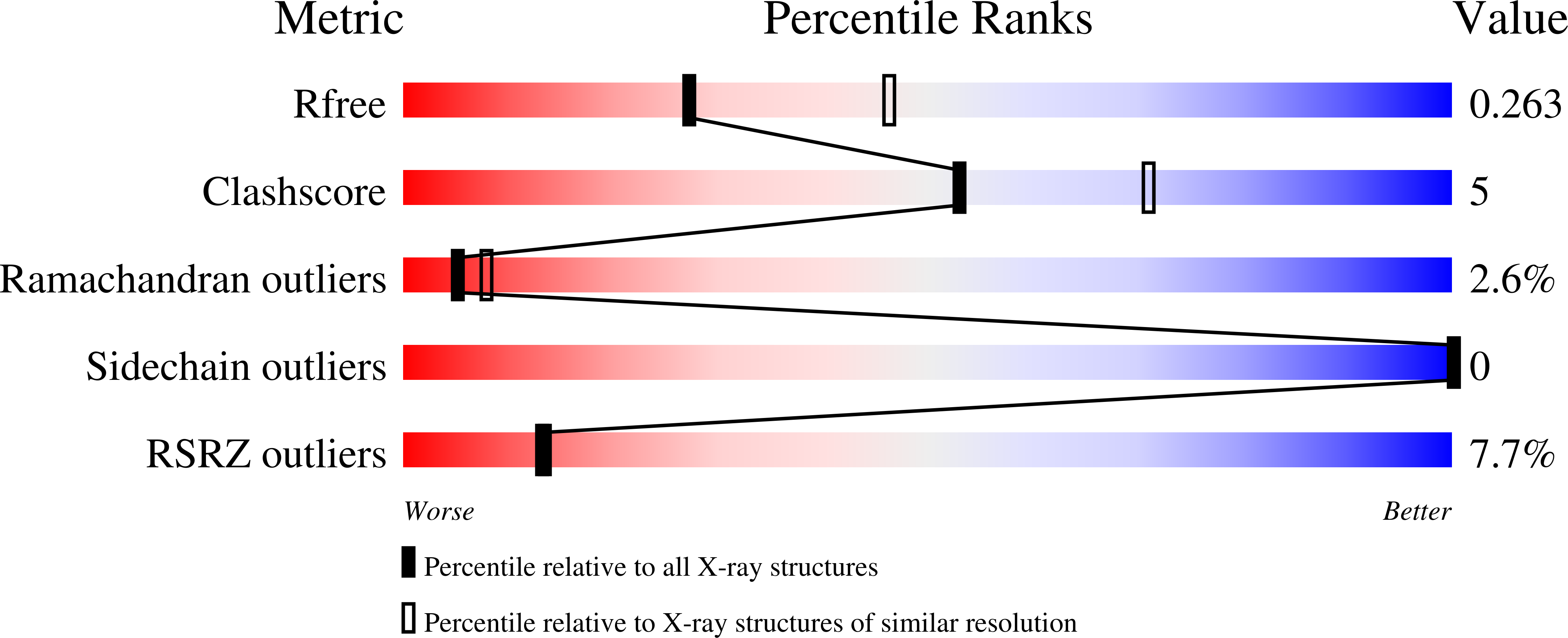
R-Value Free:
0.27
R-Value Work:
0.23
R-Value Observed:
0.23
Space Group:
P 64 2 2
Macromolecular Entities
Structures with similar UniProt ID
Protein Blast
Polymer Type:polypeptide(L)
Molecule:ATP-dependent Clp protease ATP-binding subunit clpX
Gene (Uniprot):clpX
Mutagens:C43M
Chain IDs:A
Chain Length:51
Number of Molecules:1
Biological Source:Escherichia coli
Modified Residue
Compound ID Chain ID Parent Comp ID Details 2D Image
MSE A MET SELENOMETHIONINE
Ligand Molecules
Primary Citation
Structural Basis of SspB-tail Recognition by the Zinc Binding Domain of ClpX.
J.Mol.Biol. 367 514 526 (2007)
PMID: 17258768 DOI: 10.1016/j.jmb.2007.01.003

Abstact

The degradation of ssrA(AANDENYALAA)-tagged proteins in the bacterial cytosol is carried out by the ClpXP protease and is markedly stimulated by the SspB adaptor protein. It has previously been reported that the amino-terminal zinc-binding domain of ClpX (ZBD) is involved in complex formation with the SspB-tail (XB: ClpX-binding motif). In an effort to better understand the recognition of SspB by ClpX and the mechanism of delivery of ssrA-tagged substrates to ClpXP, we have determined the structures of ZBD alone at 1.5, 2.0, and 2.5 A resolution in each different crystal form and also in complex with XB peptide at 1.6 A resolution. The XB peptide forms an antiparallel beta-sheet with two beta-strands of ZBD, and the structure shows a 1:1 stoichiometric complex between ZBD and XB, suggesting that there are two independent SspB-tail-binding sites in ZBD. The high-resolution ZBD:XB complex structure, in combination with biochemical analyses, can account for key determinants in the recognition of the SspB-tail by ClpX and sheds light on the mechanism of delivery of target proteins to the prokaryotic degradation machine.

Legend

Protein

Chemical

Disease

Primary Citation of related structures
Feedback Form
Name
Email
Institute
Feedback