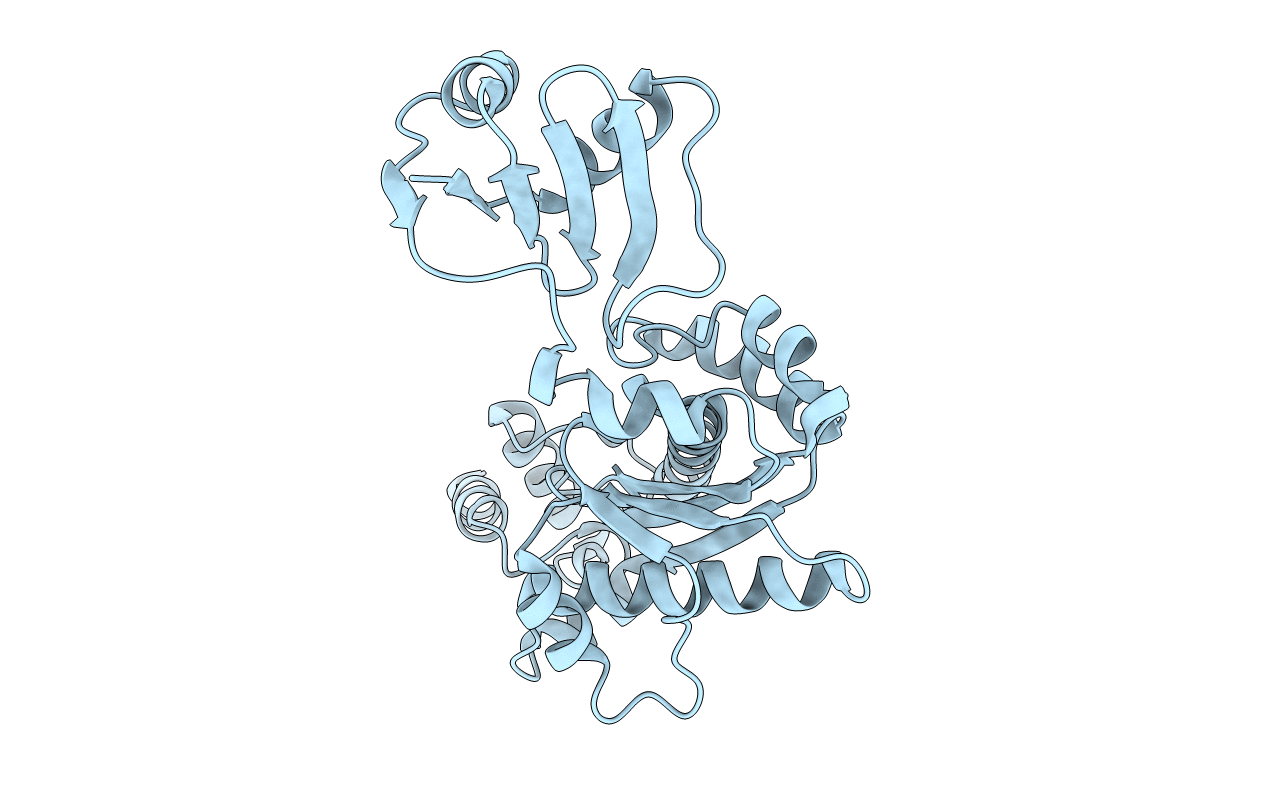
2D0A image
Deposition Date 2005-07-31
Release Date 2006-07-18
Last Version Date 2024-03-13
Entry Detail
PDB ID:
2D0A
Keywords:
Title:
Crystal structure of Bst-RNase HIII
Biological Source:
Source Organism(s):
Expression System(s):
Method Details:
Experimental Method:
Resolution:
2.30 Å
R-Value Free:
0.26
R-Value Work:
0.20
R-Value Observed:
0.20
Space Group:
P 21 21 2
Macromolecular Entities
Structures with similar UniProt ID
Protein Blast
Polymer Type:polypeptide(L)
Molecule:ribonuclease HIII
Gene (Uniprot):rnhC
Chain IDs:A
Chain Length:310
Number of Molecules:1
Biological Source:Geobacillus stearothermophilus
Primary Citation
Crystal structure and structure-based mutational analyses of RNase HIII from Bacillus stearothermophilus: a new type 2 RNase H with TBP-like substrate-binding domain at the N terminus
J.Mol.Biol. 356 165 178 (2006)
PMID: 16343535 DOI: 10.1016/j.jmb.2005.11.017

Abstact

Ribonuclease HIII (Bst-RNase HIII) from the moderate thermophile Bacillus stearothermophilus is a type 2 RNase H but shows poor amino acid sequence identity with another type 2 RNase H, RNase HII. It is composed of 310 amino acid residues and acts as a monomer. Bst-RNase HIII has a large N-terminal extension with unknown function and a unique active-site motif (DEDE), both of which are characteristics common to RNases HIII. To understand the role of these N-terminal extension and active-site residues, the crystal structure of Bst-RNase HIII was determined in both metal-free and metal-bound forms at 2.1-2.6 angstroms resolutions. According to these structures, Bst-RNase HIII consists of the N-terminal domain and C-terminal RNase H domain. The structures of the N and C-terminal domains were similar to those of TATA-box binding proteins and archaeal RNases HII, respectively. The steric configurations of the four conserved active-site residues were very similar to those of other type 1 and type 2 RNases H. Single Mn and Mg ions were coordinated with Asp97, Glu98, and Asp202, which correspond to Asp10, Glu48, and Asp70 of Escherichia coli RNase HI, respectively. The mutational studies indicated that the replacement of either one of these residues with Ala resulted in a great reduction of the enzymatic activity. Overproduction, purification, and characterization of the Bst-RNase HIII derivatives with N and/or C-terminal truncations indicated that the N-terminal domain and C-terminal helix are involved in substrate binding, but the former contributes to substrate binding more greatly than the latter.

Legend

Protein

Chemical

Disease

Primary Citation of related structures
Feedback Form
Name
Email
Institute
Feedback